
The Perpetual DEX Wars: Assessing Aster's Sustainability in a Fragmented Market
The perpetual decentralized exchange (perp DEX) market has entered a new phase of maturity, marked by intense competition and rapid innovation. As of Q4 2025, Hyperliquid maintains a commanding 63% of open interest (OI), a testament to its technological infrastructure and institutional credibility. However, the emergence of platforms like AsterASTER--, Lighter, and EdgeX has disrupted the status quo, forcing investors to reevaluate the sustainability of market leadership in this evolving sector. This analysis examines Aster's trajectory, its competitive advantages, and the structural challenges it faces in a market where volume metrics often mask deeper liquidity concerns.
Hyperliquid's Structural Dominance
Hyperliquid's dominance is underpinned by its proprietary Layer 1 blockchain, which employs HyperBFT consensus and sub-second order finality. This technological edge has allowed the platform to weather volatility, such as the October 2025 liquidation crisis, without significant performance degradation. Institutional adoption further cements its position: the regulated HYPE ETP listing on the Swiss Exchange has attracted institutional capital, while its ecosystem of yield and lending protocols enhances user retention. According to a report by OurCryptoTalk, Hyperliquid's OI share remains stable at 63%, even as rivals like Aster capture 19.3% of OI and 20–30% of trading volume.
Aster's Explosive Growth and Incentive-Driven Model
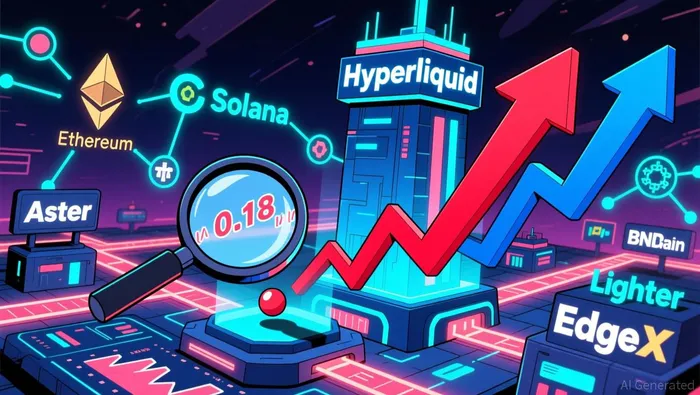
Aster's rise is a case study in aggressive growth hacking. Backed by Binance co-founder Changpeng Zhao (CZ) and a $10 million trading competition, the platform attracted 2 million users by Q3 2025. Its hybrid AMM-CEX model addresses DeFi liquidity challenges, while cross-chain capabilities on BNB Chain, EthereumETH--, and SolanaSOL-- broaden its appeal. However, Aster's metrics reveal a critical imbalance: its OI/Volume ratio of 0.18 suggests that much of its activity is driven by short-term incentives rather than durable liquidity. This dynamic raises questions about the platform's ability to retain capital in a market where traders often prioritize volume over long-term value.
Aster's credibility has also been tested. A temporary delisting by DefiLlama in late 2025-due to volume patterns mirroring Binance's 1:1 correlation-triggered a 56% drop in $ASTER's price. While the platform has since reintegrated, the incident underscores the risks of relying on incentive-driven growth in a sector where transparency is paramount.
The Broader Competitive Landscape
Aster's challenges are compounded by the emergence of niche competitors. Lighter, for instance, targets institutional and smart money flows with zero trading fees and low-latency execution, capturing 12.5% of OI. EdgeX, meanwhile, holds 6.1% of OI by leveraging its early-mover advantage and tailored risk management tools. These platforms highlight a maturing market where specialization and execution speed are becoming as critical as volume metrics.
Sustainability: The Long Game
For Aster to sustain its leadership, it must address two key issues: liquidity retention and institutional trust. While high leverage (up to 1001x) and hidden orders attract retail traders, these features alone cannot replace the capital retention strategies that Hyperliquid has mastered. The latter's integration of yield protocols and institutional-grade infrastructure provides a blueprint for long-term sustainability. Aster's recent focus on cross-chain capabilities and institutional-grade features is a step in the right direction, but its reliance on Binance-backed incentives remains a double-edged sword.
Conclusion
The perp DEX market in 2025 is a battleground of innovation and resilience. Hyperliquid's structural advantages position it as the long-term leader, but Aster's agility and aggressive growth strategies cannot be ignored. For investors, the key question is whether Aster can transition from a volume-driven model to one that prioritizes durable liquidity and institutional adoption. Until then, the market will remain a high-stakes arena where leadership is as much about execution as it is about ambition.






Comentarios
Aún no hay comentarios