
Perpetual DEX Aggregator Ranger and Its Token Sale: A Disruptive Force in DeFi Trading
The decentralized finance (DeFi) landscape is undergoing a seismic shift, driven by innovations in liquidity aggregation and cross-chain execution. At the forefront of this transformation is Ranger Finance, a Solana-based perpetual decentralized exchange (DEX) aggregator that aims to redefine trading efficiency in the DeFi ecosystem. With a token sale structured to raise $15.375 million and a strategic focus on aggregating fragmented liquidity, Ranger is positioning itself as a critical infrastructure player. For early investors, the platform's token economics, technological edge, and alignment with Solana's growth trajectory present a compelling case for disruption and returns.
Token Sale Structure: Balancing Incentives and Liquidity
Ranger's token sale, set to launch in November 2025, allocates 39.02% of its total supply to public investors, with a hard cap of $6 million for this segment. The ICO price of $0.6 per token implies a valuation of $6 billion at full allocation, a figure that aligns with the platform's ambition to capture a significant share of Solana's DeFi market. Notably, the token unlock schedule is designed to mitigate dumping risks: 39.02% of tokens will be released in five tranches, each tied to price milestones (2×, 4×, 8×, 16×, and 32× the ICO price) and confirmed via a 3-month trailing average price (TWAP) mechanism. This structure incentivizes long-term holding while ensuring liquidity providers and early adopters benefit from gradual value realization.
 A key differentiator is the points-based airdrop, which rewards active traders and community members with "Ranger Points" convertible to RNGR tokens at the token generation event (TGE). With 500,000 points distributed weekly, this campaign not only drives user engagement but also creates a deflationary effect by locking liquidity into the ecosystem. For investors, the airdrop represents a low-cost entry point, particularly for those who can accumulate points through trading or referrals before the May 2025 airdrop.
Technological Innovation: Solving Liquidity Fragmentation
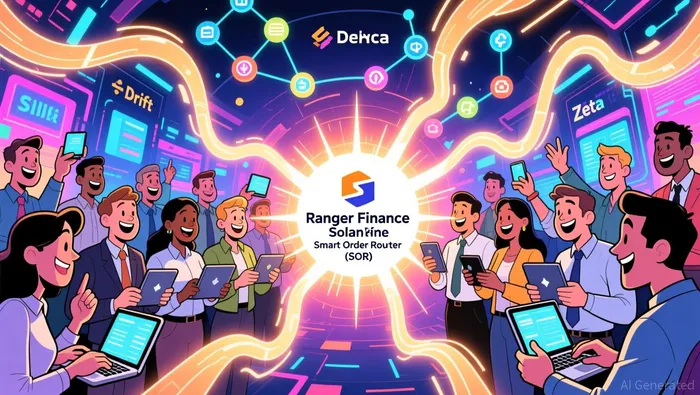
Ranger's core value proposition lies in its Smart Order Router (SOR), a proprietary algorithm that aggregates liquidity across Solana's decentralized exchanges (DEXs), including Drift, Zeta, and others. By dynamically routing trades to venues with the best price and depth, the SOR reduces slippage by up to 30% compared to standalone DEXs. This is critical in a market where liquidity fragmentation-across chains and protocols-has historically hindered execution efficiency.
The platform's real-time analytics tools further enhance its appeal. Traders gain access to metrics such as open interest, funding rates, and liquidation data across integrated DEXs, enabling data-driven decisions. For institutional players, this transparency and execution speed position Ranger as a viable alternative to centralized exchanges, particularly in the perpetual futures segment, which accounts for two-thirds of DeFi trading volume.
Strategic partnerships with Solana-based protocols like JupiterJUP-- and Flash have already driven a cumulative trading volume of $1 billion by Q3 2025. These integrations underscore Ranger's role as a neutral execution layer, bridging the gap between fragmented liquidity pools and user demand for seamless trading experiences.
Competitive Advantages: A Platform Built for Scale
Ranger's competitive edge stems from its multi-asset ecosystem and technical execution. By aggregating liquidity from DEXs, aggregators, and RFQ relays, the platform minimizes slippage and MEV leakage, a persistent issue in DeFi. Its UI/UX, tailored for both retail and institutional traders, further differentiates it from competitors.
Leveraging Solana's high-speed, low-cost infrastructure, Ranger ensures fast finality and scalability-critical for handling high-frequency trading. This aligns with Solana's vision of becoming the "Internet Capital Markets," where onchain activity rivals traditional financial systems. For investors, Ranger's first-mover advantage in the perpetuals aggregator space and its alignment with Solana's growth trajectory suggest strong long-term potential.
Investment Thesis: A High-Conviction Play
For early investors, Ranger's token sale offers a unique opportunity to participate in a platform poised to disrupt DeFi trading. The structured unlock schedule, points-based airdrop, and alignment with Solana's ecosystem growth create a compelling risk-reward profile. With a seed funding of $1.9 million at a $30 million valuation, the project has already demonstrated institutional credibility.
However, risks remain. The DeFi space is highly competitive, and execution on promised features-such as OTC trading and expanded analytics-will be critical. Additionally, regulatory scrutiny of token sales could impact liquidity. That said, Ranger's focus on utility-driven tokenomics and Solana's robust infrastructure mitigate many of these concerns.
Conclusion
Ranger Finance is more than a DEX aggregator; it is a foundational layer in Solana's evolving DeFi ecosystem. By addressing liquidity fragmentation and offering a seamless trading experience, the platform is well-positioned to capture a significant share of the Q3 2025 DEX volume of $326 billion. For investors, the token sale represents a high-conviction entry point into a project with the potential to deliver both disruptive impact and substantial returns.






Comentarios
Aún no hay comentarios