
Perpetua Resources' Stibnite Gold Project: A High-Stakes Gamble on U.S. Critical Minerals and Regulatory Approval
The Stibnite Gold Project, owned by Perpetua ResourcesPPTA--, has emerged as one of the most consequential mining ventures in the U.S. in decades. With total construction costs estimated at $2.2 billion, the project's financing structure—comprising a $445 million equity raise and pending debt facilities—is a critical test of Perpetua's ability to navigate complex regulatory and capital markets challenges. At its core, the project's success hinges on two interlinked questions: Can Perpetua secure the remaining pieces of its financing puzzle, and will regulatory approvals materialize as promised? The answers could redefine the company's valuation and its role in the U.S. critical minerals supply chain.
The Financing Jigsaw: Equity, Debt, and Risk Mitigation
Perpetua's $445 million equity financing, split between a $300 million bought deal at $13.20 per share and a $100 million private placement with Paulson & Co., forms the foundation of its capital stack. These transactions not only provide immediate liquidity but also signal institutional confidence: Paulson & Co.'s involvement as a strategic investor underscores the project's potential to deliver outsized returns. However, the equity portion alone covers only ~18% of the total $2.2 billion project cost, leaving Perpetua reliant on debt financing and creative financial instruments to bridge the gap.
The linchpin is the pending $2 billion EXIM Bank loan, which Perpetua submitted in May 2025. Securing this debt—backed by the U.S. government—is critical for two reasons. First, it would lock in long-term, low-cost capital, shielding the project from volatile debt markets. Second, EXIM's involvement could accelerate regulatory approvals, as the bank's participation often aligns with U.S. national security priorities. Antimony, a key byproduct of the Stibnite project, is a strategic material for defense applications, including munitions and electronics, making the project a geopolitical as well as an economic priority.
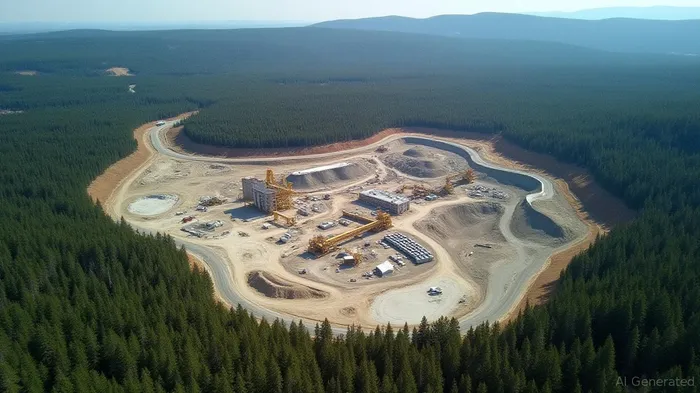
Reclamation Bonds and Regulatory Hurdles: The Final Milestones
Perpetua's ability to secure permits hinges on financial assurance for reclamation, a requirement that has tripped up past mining projects. The company's proposed $155 million reclamation bond guarantee and a potential $200–250 million funding package via a gold net smelter return (NSR) royalty or streaming agreement are central to this. The NSR (capped at 3.9%) strikes a balance between upfront capital and long-term cost control, but its final terms remain in negotiation—a delay here could jeopardize permit timelines.
Regulatory approvals are equally pivotal. Perpetua has stated it expects remaining state permits by summer 2025, with the U.S. Forest Service (USFS) notice to proceed contingent on financial assurances. Yet, as the company itself acknowledges, regulatory delays are a material risk. The Stibnite site's history of environmental damage—legacy pollution from prior operations—has fueled local opposition, and the USFS may demand stricter conditions. Investors must weigh the project's environmental remediation benefits—cleaning up 1,500 acres of contaminated land—against execution risks.
Strategic Value Drivers: Antimony and the U.S. Supply Chain
The Stibnite project's strategic mineral profile is its strongest tailwind. Antimony, a critical component of flame-retardant alloys and batteries, is largely sourced from China, which controls ~85% of global production. The U.S. has classified antimony as a critical mineral, and the Stibnite deposit—estimated to contain 13 million ounces of gold and 100,000 metric tons of antimony—positions Perpetua to reduce this strategic vulnerability. A would reveal whether the market is pricing in this geopolitical upside. To date, the stock has underperformed gold, suggesting skepticism about execution risks.
Risks and Investment Implications
The project's execution risks are layered. Funding dependency on the EXIM loan and NSR agreement creates counterparty risk: if either falters, Perpetua may face a funding gap. Permit delays, meanwhile, could push construction past late 2025, increasing costs. Environmental groups' lawsuits or regulatory demands for additional reclamation measures could also escalate expenses.
Yet, the rewards are massive. At full production, Stibnite could generate $1 billion in annual revenue and position Perpetua as a U.S. critical minerals leader. The project's remediation of historic pollution—a $500 million obligation already factored into costs—could also improve its social license, reducing opposition.
Final Analysis: A Call for Patience, but a Bullish Bet on U.S. Critical Minerals
Perpetua's Stibnite Gold Project is a high-risk, high-reward proposition. The financing structure is robust but not yet fully secured, and permits remain pending. Investors should monitor two key catalysts: EXIM's loan approval by Q3 2025 and final state permits by late summer. If both are achieved, the stock could surge on reduced execution risk. Conversely, delays could trigger a selloff.
For now, the risk-reward profile leans bullish, especially for investors focused on U.S. critical minerals independence. The project's antimony output alone justifies its strategic importance, while the gold component provides a liquidity backstop. However, this is not a “set it and forget it” investment. Perpetua's shares deserve a watchlist position until the EXIM and permit risks crystallize. Once they do, the path to $2.2 billion in construction—and the rewards—will become clearer.





Comentarios
Aún no hay comentarios