
Permianville Royalty Trust: Assessing Dividend Resilience in a Volatile Energy Market
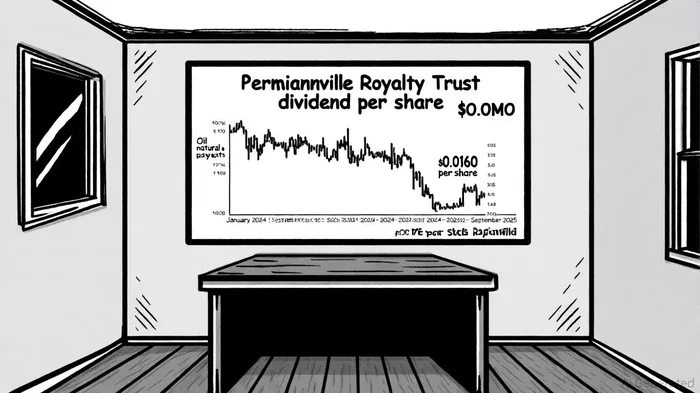
Permianville Royalty Trust (PVL) has long been a fixture in the energy sector's high-yield landscape, but its recent performance underscores the challenges of maintaining income stability amid market volatility. As of September 2025, PVLPVL-- declared a monthly dividend of $0.0160 per share, payable on September 15, 2025, to shareholders of record as of August 29, 2025[1]. This payout, while a modest increase from the $0.0085 per share distributed in April 2025[3], reflects a broader narrative of fluctuating returns for income-focused investors.
The Volatility Conundrum
The trust's dividend history reveals a stark contrast between its high-yield allure and operational headwinds. Over the past year, PVL's dividend growth rate has plummeted by -38.94%, driven by declining production volumes and commodity price swings[3]. For instance, the trust reduced its payout from $0.0105 per share in November 2024 to $0.0085 in March 2025[5], a move attributed to lower oil and natural gas cash receipts during that period[4]. Such volatility raises questions about the sustainability of its dividend policy, particularly as energy markets remain sensitive to geopolitical tensions and macroeconomic shifts.
However, PVL's recent $0.0160 per share distribution signals a potential stabilization. According to a report by Dividend Investor, the September 2025 payout was based on reported oil production for May 2025 and natural gas production for April 2025[1]. This suggests that the trust's management is recalibrating distributions to align with production cycles, albeit with a lag. The ex-dividend price of $1.98 on August 29, 2025[6], implies a dividend yield of approximately 8.08% (calculated as $0.0160 / $1.98 * 12), a figure that, while lower than the 17.06% cited in some sources[4], still positions PVL as a competitive option for high-yield seekers.
Income Stability in a Shifting Landscape
PVL's ability to maintain monthly dividends—despite a 12-month growth rate of -38.94%—highlights its unique structure as a royalty trust. Unlike traditional energy equities, PVL derives income from net profits interests in oil and gas properties, which are less tied to operational costs and more to production volumes[4]. This model offers a degree of insulation from market volatility, though it is not immune to broader trends. For example, the trust withheld $0.3 million in September 2025 to establish a cash reserve for future development expenses[4], a move that prioritizes long-term stability over short-term payouts.
Yet, the trust's reliance on a single geographic region—the Permian Basin—introduces concentration risk. While the Permian remains a resilient hub for U.S. oil production, any disruption in this area could ripple through PVL's cash flows. Data from StockInvest.us indicates that PVL's annual dividend of $0.192 per share (as of September 2025) is contingent on consistent production levels[2], a factor that remains uncertain in a market where oil prices have swung between $70 and $85 per barrel in 2025[7].
The Path Forward
For income investors, PVL's dividend resilience hinges on two critical factors: commodity price stability and operational efficiency. The trust's recent $0.0160 per share payout demonstrates a willingness to adjust distributions in response to production data, a strategy that could mitigate short-term volatility. However, the 38.94% decline in dividend growth over the past year[3] serves as a cautionary tale about the risks of over-reliance on high-yield energy trusts.
In conclusion, Permianville Royalty TrustPVL-- remains a compelling case study in the balance between yield and sustainability. While its recent dividend increase offers a glimmer of optimism, investors must weigh this against the broader uncertainties of the energy sector. For those prioritizing income stability, PVL's structure provides a unique edge—but not without its caveats.





Comentarios
Aún no hay comentarios