
The Perils of Hype-Driven Crypto Tokens: Lessons from the WLFI Collapse
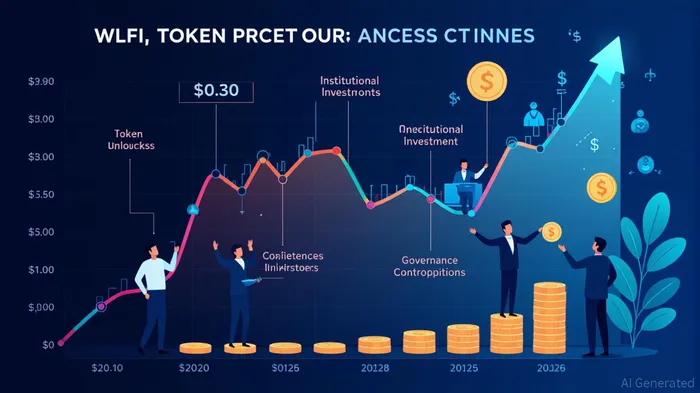
The collapse of the WLFI token, a crypto project tied to the TrumpTRUMP-- family and marketed as a DeFi platform, offers a cautionary tale for investors and institutions alike. Launched on September 1, 2025, with a $30 billion fully diluted valuation (FDV), WLFI’s meteoric rise and subsequent freefall expose critical flaws in institutional risk management and the volatile psychology of hype-driven markets. This analysis dissects the interplay of centralized governance, speculative token design, and behavioral biases that culminated in one of the most high-profile crypto failures of the year.
Institutional Risk Management: A Systemic Failure
WLFI’s governance model epitomized the dangers of centralized control in a space that prides itself on decentralization. The Trump family and affiliated entities held 60% of the token supply and 75% of token sale proceeds, effectively granting them unilateral authority over key decisions [1]. This concentration of power undermined the project’s legitimacy, as governance proposals were subject to arbitrary screening and rejection [5].
Institutional investors, including Point72 and DWF Labs, lent credibility to WLFI despite glaring red flags. For instance, the token’s circular transaction with Nasdaq-listed ALT5 Sigma—a deal where WLFI used its tokens to gain control of ALT5, which then repurchased WLFI tokens with investor funds—was a textbook example of artificial valuation inflation [1]. Yet, these institutions failed to implement robust risk frameworks to assess the project’s governance structure or liquidity risks. As Custodia Bank CEO Caitlin Long noted, legacy institutions lack updated risk tolerance models for crypto assets, relying instead on delayed settlement systems ill-suited for real-time markets [2].
The token’s speculative economics further exacerbated institutional blind spots. WLFI’s initial design reserved only 5% of its total supply for circulation, creating artificial scarcity while offering no utility beyond governance rights [1]. This structure incentivized leveraged futures trading, with $5.89 billion in open interest recorded before launch—much of it driven by long positions [6]. When the 20% presale unlock event triggered a liquidity flood, institutions were unprepared for the ensuing volatility, leading to cascading liquidations and a 16% price drop after the blacklisting of Justin Sun’s wallet [3].
Investor Psychology: The Hype Cycle and Its Consequences
WLFI’s collapse was not solely a product of poor governance but also a reflection of crypto’s psychological undercurrents. Political branding played a pivotal role in attracting speculative capital. A Chainplay survey revealed that 80% of crypto investors had purchased tokens linked to political figures, with 37% being first-time investors drawn by aggressive marketing [1]. The Trump family’s involvement transformed WLFI into a “narrative-driven” asset, where ideology and hype overshadowed fundamentals.
Behavioral biases amplified this dynamic. Fear of missing out (FOMO) drove early adopters to overlook red flags, such as the token’s lack of utility or the Trump family’s 70% supply control [5]. Overconfidence and anchoring biases further clouded judgment, as investors fixated on initial price highs ($0.30–$0.70) rather than adapting to new market realities [5]. Herd behavior was evident in the rush to buy WLFI during its launch, despite warnings about its centralized governance and speculative valuation.
The project’s stablecoin, USD1, also became a victim of psychological misalignment. While backed by U.S. Treasuries, its value was inextricably tied to WLFI’s governance decisions, creating a feedback loop where investor trust in the token directly impacted the stablecoin’s peg [4]. When WLFI’s price plummeted, USD1’s liquidity dried up, compounding losses for holders.
Lessons for the Future
The WLFI case underscores the need for institutional risk frameworks that prioritize transparency and decentralization. Legacy investors must adopt real-time settlement models and stress-test governance structures for centralization risks. For retail investors, the collapse serves as a stark reminder to scrutinize token utility, supply distribution, and regulatory alignment—particularly in politically branded projects.
Source:
[1] WLFI Eagle: An alchemical coronation feast that fuses... [https://www.panewslab.com/en/articles/1a9f4c89-0582-4494-8c51-cc35348ba9b7]
[2] Institutional investors from the traditional finance world lack... [https://www.facebook.com/manuel.guevarra.369210/posts/institutional-investors-from-the-traditional-finance-world-lack-the-updated-risk/754318780814666/]
[3] World Liberty Financial Blacklists Justin Sun's Wallet [https://coingape.com/world-liberty-financial-blacklists-justin-suns-wallet/]
[4] Deconstructing WLFI: A trinity of financial cornerstone... [https://www.panewslab.com/en/articles/1889974e-3c44-45e9-80c7-c92b22821704]
[5] Must-Read Before WLFI Launch: 20 Q&As Fully Explain the... [https://www.bitget.com/news/detail/12560604944118]
[6] Trump-backed World Liberty Financial's WLFI token... [https://www.fastbull.com/cn/news-detail/trumpbacked-world-liberty-financials-wlfi-token-launches-at-news_6100_0_2025_3_9928_3/6100_BTC-USDT]






Comentarios
Aún no hay comentarios