
The Peril of Leverage: How Short Position Overexposure Triggered Crypto's Worst Crashes
The October 2025 Crash: A Perfect Storm of Leverage and Manipulation
On October 10, 2025, the crypto market experienced its most devastating liquidation event in history, with $20 billion in positions wiped out within hours. BitcoinBTC-- plummeted $10,000 in minutes, and altcoins lost 50–75% of their value. At the heart of the collapse was a coordinated oracleADA-- manipulation attack targeting Binance's updated pricing mechanisms for assets like USDeUSDe--, wBETH, and BNSOL. These synthetic tokens depegged catastrophically on Binance while retaining stability elsewhere, triggering cascading liquidations across cross-collateralized accounts according to on-chain evidence.
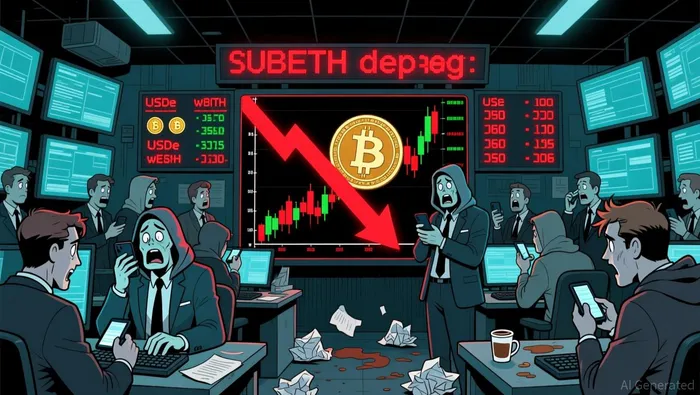 A single "whale" reportedly exploited the chaos, holding $1.1 billion in short positions that generated $80 million in 24 hours. This case underscores how sophisticated actors can weaponize leverage against market infrastructure. Meanwhile, retail traders-many of whom had been lured into over-leveraged long positions during the speculative "Pumptober" frenzy-faced total account wipeouts. According to financial reports, regulatory changes permitting 10x leverage on centralized exchanges had normalized risk-taking among inexperienced investors, leaving them vulnerable to sudden deleveraging.
Systemic Risks: Oracle Vulnerabilities and Cross-Collateralization
The October crash revealed critical flaws in crypto's reliance on oracles-third-party data feeds that anchor asset values to real-world prices. Attackers exploited Binance's oracle system to create artificial price dislocations, triggering automatic liquidations that exacerbated the downturn. As one analyst noted, "The attack wasn't just about market timing; it was about engineering a crisis through infrastructure weaknesses" according to technical analysis.
Cross-coin collateralization further amplified the damage. When a single position defaulted, it triggered liquidations across an investor's entire portfolio, regardless of the health of other assets. Exchanges like Hyperliquid activated auto-liquidation protocols to preserve solvency, while others, such as Lighter, avoided cascades by maintaining robust insurance reserves according to exchange reports. This divergence highlights the uneven risk management practices across platforms-a problem regulators have yet to address.
The February 2025 Bybit Hack: Leverage as a Vector for Exploitation
Just months earlier, the Bybit hack exposed another dimension of leverage risk. Attackers stole $1.4–1.5 billion in etherETH--, directly targeting leveraged positions held by institutional clients. The breach demonstrated how centralized custody models, when combined with high leverage, create attractive targets for cybercriminals. As a report by Economy Insights noted, "The hack wasn't just a technical failure-it was a business model failure, where excessive leverage created incentives for both traders and hackers to push risk limits."
Lessons for Investors: Beyond the Hype Cycle
The 2025 crises offer sobering lessons for crypto participants. First, leverage magnifies not just gains but also systemic fragility. On-chain data from the October crash showed sophisticated investors accumulating Bitcoin during the turmoil, betting on long-term value. Yet for retail traders, the human cost was severe, with life savings evaporating in minutes. Second, the attacks on oracle systems and exchange infrastructure reveal that crypto's "decentralized" promise often depends on centralized vulnerabilities.
Regulators and platform operators must prioritize reforms, including stricter limits on leverage, improved oracle security, and stress-testing for cascading liquidations. For individual investors, the takeaway is clear: short positions-especially when leveraged-require not just technical expertise but a deep understanding of the fragile ecosystems they inhabit.
Conclusion
The October 2025 crash and Bybit hack are not isolated incidents but symptoms of a market still grappling with its own complexity. As leverage remains a cornerstone of crypto trading, the industry must confront its risks with the same rigor applied to traditional finance. Until then, overexposure to short positions will continue to be a high-stakes gamble-one where the house, increasingly, seems to have an edge.






Comentarios
Aún no hay comentarios