
PEPE vs. Layer Brett: Assessing the Risks and Opportunities in Meme Coin Evolution
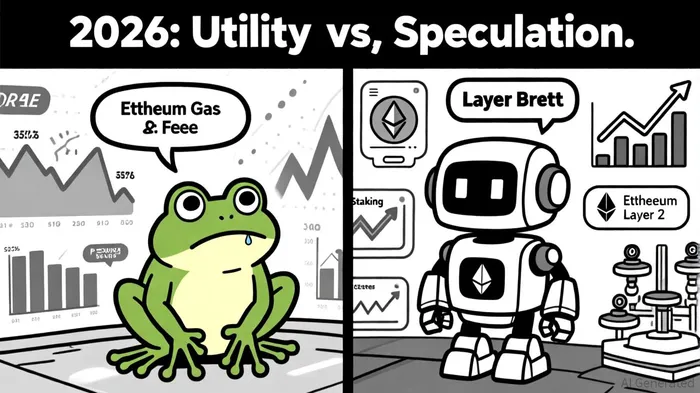
The memeMEME-- coin market has evolved from pure speculation to a battleground for utility-driven innovation. Two tokens—PEPE and LayerLAYER-- Brett (LBRETT)—represent divergent paths in this evolution. While PEPEPEPE--, the king of EthereumETH-- meme coins, clings to its cultural dominance, Layer Brett emerges as a technical disruptor with Ethereum Layer 2 infrastructure and gamified utility. This analysis evaluates their 2026 viability through market dynamics, token utility, and community trends, asking: Can PEPE retain its throne, or will Layer Brett dethrone it?
Market Dynamics: Stagnation vs. Scalability
PEPE's dominance is fraying. Despite a $5.15–$5.19 billion market cap in August 2025, its price ($0.00001228) has plummeted 99.18% from its 2023 peak [1]. High Ethereum Layer 1 gas fees ($15–$30 per transaction) and a lack of staking mechanisms have eroded its appeal [2]. Meanwhile, Layer Brett leverages Ethereum Layer 2 to process 10,000 transactions per second at $0.0001 fees, enabling micropayments and NFT integrations [3]. Analysts project LBRETT's presale—already raising $3.7 million—could fuel a 100x price surge by 2026, outpacing PEPE's speculative volatility [4].
The broader market favors scalability. As Ethereum's Layer 2 adoption grows, projects like LBRETT align with industry trends, while PEPE's reliance on Layer 1 infrastructure makes it increasingly obsolete [5].
Token Utility: Speculation vs. Staking
PEPE's utility remains limited to social media virality and speculative trading. Its no-staking model and infinite supply (420.69 trillion tokens) create structural weaknesses [6]. In contrast, Layer Brett introduces a deflationary model (burning 10% of transactions) and staking rewards up to 55,000% APY, incentivizing long-term holding [7]. These features position LBRETT as a hybrid of meme culture and DeFi, offering both financial incentives and real-world use cases like DAO governance and cross-chain bridges [8].
PEPE's ecosystem is not entirely stagnant. Projects like Pepe Dollar (PEPD) and Pepe Unchained (PEPU) aim to add utility through GameFi mechanics and Pay-Fi solutions [9]. However, these initiatives remain unproven, whereas Layer Brett's tokenomics are already delivering tangible rewards and community engagement.
Community Trends: Hype vs. Infrastructure
Community metrics reveal a shift in investor sentiment. PEPE's social media momentum has waned, with a 12.64% price decline over the past month [1]. Layer Brett, meanwhile, boasts a 30% presale allocation and a $1 million giveaway, driving rapid Telegram growth and developer adoption [10]. Analysts note that LBRETT's fixed supply (10 billion tokens) and Ethereum Layer 2 infrastructure make it a more sustainable investment than PEPE's speculative model [11].
Regulatory risks loom over both tokens, but Layer Brett's focus on utility may insulate it from the volatility affecting pure meme coins. As 2026 approaches, projects with real-world applications are likely to outperform those reliant on hype cycles [12].
Investment Thesis: The 2026 Outlook
By 2026, PEPE's survival hinges on broader market conditions and strategic partnerships (e.g., Bitnile accepting PEPE for payments). However, its lack of utility and structural weaknesses make it a high-risk bet [13]. Layer Brett, with its scalable infrastructure, staking incentives, and deflationary model, is better positioned to capitalize on Ethereum's Layer 2 growth and institutional adoption. Analysts project LBRETT could deliver 5,000% returns, eclipsing PEPE's potential [14].
Conclusion
The meme coin war of 2026 will be defined by the clash between legacy speculation (PEPE) and next-gen utility (Layer Brett). While PEPE's cultural cachet and large market cap offer short-term resilience, its technical limitations and lack of innovation make it a fading relic. Layer Brett, with its Ethereum Layer 2 scalability, gamified staking, and deflationary design, represents the future of meme coins—a space where virality meets infrastructure. For investors, the choice is clear: bet on a fading meme or a token built to outlast the hype.






Comentarios
Aún no hay comentarios