
PennantPark Floating Rate Capital: A Compelling Value Play Amid Earnings Volatility
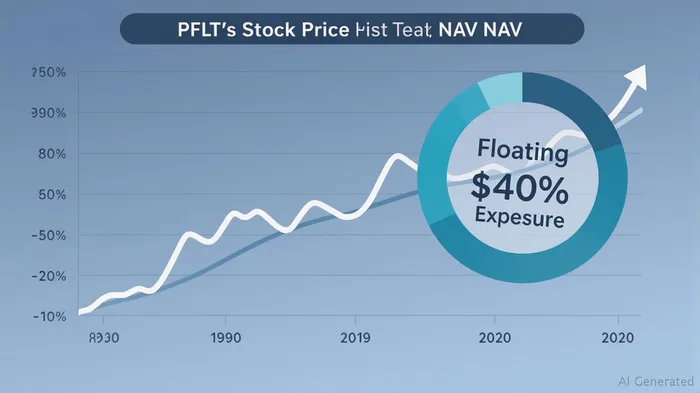
PennantPark Floating Rate Capital (PFLT) has faced near-term headwinds, with its Q2 2025 earnings missing consensus estimates. However, the company's ability to maintain its $0.31 quarterly dividend—equating to a 10.8% annualized yield—alongside its robust $2.34 billion portfolio and strategic floating-rate exposure, positions it as a compelling investment opportunity in an environment of rising rates and sector-wide valuation discounts. Let's dissect the case for PFLTPFLT-- as a value-driven play.
Earnings Resilience Amid Pressure
PFLT reported Q2 2025 diluted EPS of $0.28, falling short of the $0.33 consensus estimate. However, the core metric—net investment income (NII)—remained strong at $1.2 billion, up 20% from estimates but reflecting a sequential slowdown (down 20% from 2023–2024 growth). This deceleration was attributed to base effects and margin pressures from rising interest expenses. Crucially, PFLT maintained its $0.31 quarterly dividend, translating to a 10.8% yield at current prices, with an 81% payout ratio well within sustainable bounds.
While the dividend payout dipped slightly below NII per share ($0.28 vs. $0.31), PFLT's financial discipline—evident in its 1.40x leverage ratio (below the 2.0x regulatory cap) and falling cost of debt (7.0% in 2024)—supports the sustainability of distributions. The risk of a dividend cut remains low, especially given its 88% allocation to first-lien secured debt, a category with a historically low default rate and superior risk-adjusted returns.
Portfolio Strength in a Rising Rate Environment
PFLT's $2.34 billion portfolio boasts 100% floating-rate exposure, with a weighted average yield of 10.6% (as of Q4 2024). This structure is a key defensive feature in an era of persistent Fed rate hikes. Unlike fixed-rate peers, PFLT benefits from rising interest rates, as its loans reset quarterly to reflect higher benchmarks. The portfolio's first-lien focus (88% of assets) further mitigates risk, as these loans hold priority in the event of default.
The company's $1.5 billion joint venture with PennantPark Credit and cost-optimization efforts (reducing expenses to 35% of revenue) also bolster its margins. These initiatives, combined with a falling cost of debt, position PFLT to navigate macro challenges better than peers.
Valuation: A 12% Discount to NAV, vs. Peers' Higher Discounts
PFLT trades at a 12% discount to its net asset value (NAV) of $11.07 per share, with a P/NAV multiple of 7.5x—a near 52-week low. This discount is narrower than many REIT peers in sectors like hotels and industrial logisticsILPT--, which face steeper valuation drags. For example:
- Hotel REITs: RLJ Lodging TrustRLJ-- (-54.8% discount), Park HotelsPK-- & Resorts (-51.9%).
- Industrial REITs: Industrial Logistics Properties Trust (-58.5% discount).
- Healthcare REITs: Welltower Inc.WELL-- (+92.4% premium).
While healthcare REIT premiums reflect sector tailwinds, PFLT's discount is sector-relative undervaluation, given its BDC classification and superior floating-rate profile. The median US equity REIT discount is 19.1%, underscoring PFLT's relative attractiveness.
Why Invest Now?
Risk/Reward Trade-Off: PFLT's 10.8% yield acts as a safety net, while its floating-rate portfolio and low leverage reduce downside risk. The 12% NAV discount offers a margin of safety.
Catalysts:
1. Q3 2025 Earnings (August 11): A rebound in NII or improved expense management could narrow the discount. Historically, however, PFLT's stock has shown an average decline of 1.45% following earnings releases since 2022, with the largest drop reaching -0.23% on August 11, 2022. This volatility underscores the need for caution, but the company's financial discipline and dividend sustainability suggest potential upside.
2. Interest Rate Environment: Further Fed rate cuts (anticipated by late 2025) could lift floating-rate assets.
3. Sector Recovery: Deloitte's 2025 outlook highlights improving fundamentals in industrial and digital economy sectors, which align with PFLT's exposure.
Conclusion: A Buying Opportunity at Current Levels
PFLT's maintained dividend, portfolio resilience, and valuation discount relative to peers make it a compelling pick for income-focused investors. While near-term volatility remains a risk, the stock's 10.8% yield, floating-rate upside, and disciplined balance sheet argue for a “buy” rating. Investors should consider accumulating shares on dips below $10.00, with a target price of $12.00 (10% discount to NAV) and a stop-loss at $8.50.
In a market where peers trade at wider discounts or premiums based on sector-specific risks, PFLT offers a balanced blend of income, growth potential, and valuation support. The time to act is now—before the market catches up to its intrinsic value.







Comentarios
Aún no hay comentarios