
Penguin Solutions Inc's (PENG) Q4 2025 Earnings Performance and Future Growth Potential
Penguin Solutions Inc. (PENG) has emerged as a compelling case study in strategic reinvention, leveraging its deep expertise in high-performance computing (HPC) to pivot toward the burgeoning AI infrastructure market. The company's Q4 2025 earnings report and full-year results underscore its operational momentum, while its strategic initiatives position it to capitalize on long-term industry tailwinds. However, investors must weigh near-term challenges against the company's ambitious growth roadmap to assess its sustainability in a rapidly evolving landscape.
Q4 2025 Earnings: A Snapshot of Resilience
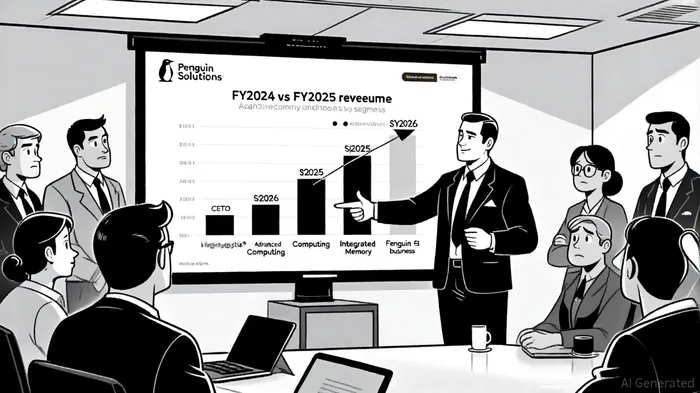
Penguin Solutions reported Q4 2025 net sales of $338 million, a 9% year-over-year increase, with full-year revenue reaching $1.37 billion-a 17% rise compared to fiscal 2024[1]. This growth was driven by robust performance in its Advanced Computing and Integrated Memory segments, which grew 17% and 30% YoY, respectively[1]. Non-GAAP earnings per share (EPS) surged 53% to $1.90 for the full year, reflecting improved margin discipline and cost management[1].
The company's GAAP results also showed marked improvement, with a transition from a $0.85 loss per share in fiscal 2024 to $0.28 in earnings for fiscal 2025[1]. This turnaround was fueled by strong demand for HPC and memory solutions, particularly in enterprise and government markets. Notably, the Advanced Computing segment's non-hyperscale HPC AI business grew 75% YoY in fiscal 2025, signaling a successful pivot toward higher-margin AI applications[2].
Strategic Positioning: AI Infrastructure as a Growth Engine
Penguin Solutions' strategic focus on AI infrastructure is central to its long-term vision. The company aims to capture $200 million in AI-related revenue by 2025-40% of its total revenue-by expanding cloud-native HPC solutions and strengthening partnerships with OEMs like NVIDIA, Intel, and AMD[3]. These collaborations are critical for developing turnkey AI systems tailored to enterprise needs, differentiating Penguin from hyperscalers like AWS and Microsoft, which dominate cloud-centric models[3].
The company's strategic plan also includes scaling manufacturing and supply chain capabilities to meet surging demand. A $75 million stock repurchase authorization in October 2025, bringing total authorizations to $225 million over four years, further signals management's confidence in capital allocation[1]. Additionally, joint ventures such as the partnership with SK hynix and SK Telecom to advance AI data center solutions highlight Penguin's commitment to R&D and innovation[4].
Market Dynamics: Navigating Headwinds and Opportunities
The AI and edge computing markets are undergoing seismic shifts. According to industry reports, edge computing adoption is accelerating, with over 40% of larger enterprises expected to implement edge solutions by 2025 due to latency and cost concerns[5]. Penguin SolutionsPENG-- is well-positioned to benefit from this trend, as its HPC expertise aligns with the demand for localized, high-speed data processing.
However, the company faces near-term challenges. The wind-down of its Penguin Edge business-a lower-margin segment-will create a 14 percentage point headwind to fiscal 2026 revenue growth[2]. Management acknowledges this drag but remains optimistic that expanding enterprise AI deployments and next-generation memory technologies (e.g., Compute ExpressLink and Optical Memory Appliance) will offset these challenges[2].
Sustainability of Growth: A Balancing Act
Penguin Solutions' ability to sustain its growth hinges on three factors:
1. Execution of AI Ambitions: Achieving $200 million in AI revenue requires scaling cloud-native platforms and securing enterprise customers. The company's Q3 2025 update noted progress, with plans to onboard 50+ enterprise clients by Q3 2025[1].
2. Margin Resilience: While non-GAAP gross margins remained stable at 30.9% in Q4 2025[1], exiting the Penguin Edge business may pressure margins in 2026. Management projects a slight decline to 29.5% but anticipates long-term stabilization as AI and memory segments mature[4].
3. Competitive Differentiation: Hyperscalers and emerging rivals pose a threat, but Penguin's focus on integration, technical expertise, and OEM partnerships provides a moat. Its recent $200 million investment from SK Telecom and strategic alliances with Dell Technologies further strengthen its position[3].
Investment Thesis: A High-Conviction Play on AI's Supercycle
Penguin Solutions' transformation into an enterprise AI infrastructure leader is gaining traction. With a 6% revenue growth projection for 2026 and a non-GAAP EPS target of $2.00[1], the company is balancing short-term pragmatism with long-term ambition. While risks such as supply chain constraints and hyperscale competition persist, its strategic agility and alignment with AI's explosive growth trajectory make it a high-conviction opportunity for investors seeking exposure to the next phase of the tech boom.





Comentarios
Aún no hay comentarios