
PENGU USDT Sell Signal and Its Implications for Stablecoin Investors
Market Sentiment: A Double-Edged Sword
Global market sentiment has been shaped by the growing anticipation of a U.S.-China trade deal, a development that has bolstered risk-on appetite and weakened the U.S. Dollar (DXY). According to a report by FXStreet, the GBP/USDT pair has rebounded to 1.3360, reflecting improved confidence in risk assets and a potential de-escalation of trade tensions. However, this optimism may not uniformly benefit algorithmic stablecoins like PENGU/USDT.
The U.S. Dollar's decline, driven by expectations of a Federal Reserve rate cut and a prolonged federal shutdown, has created a volatile environment for stablecoins reliant on algorithmic mechanisms. Unlike fiat-collateralized stablecoins, algorithmic models depend on market confidence and arbitrage incentives to maintain their peg. A weaker dollar could exacerbate redemption pressures if investors perceive reduced value in holding dollar-linked assets.
Technical Breakdown: Mixed Signals and Structural Risks
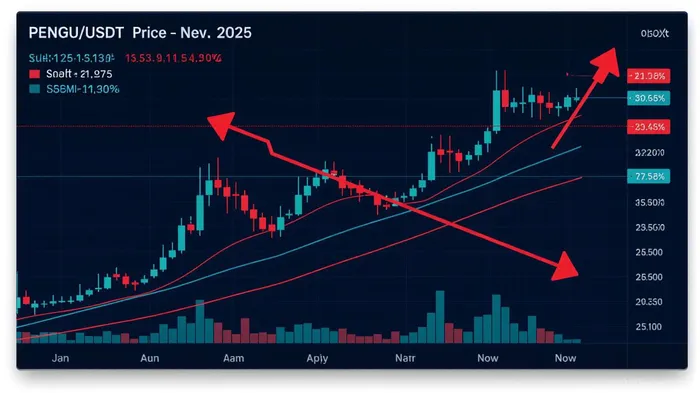
Technical analysis of PENGU/USDT reveals a conflicting outlook. While the 14-day RSI hovers near 40.00-a neutral zone, the moving averages suggest a "strong sell" signal. This divergence highlights the fragility of algorithmic stablecoins, which often rely on short-term liquidity to stabilize price action.
A critical concern lies in the token's price prediction for October 2025, which forecasts a value of $0.02982 with "neutral to mildly bearish" momentum. For a stablecoin, even minor deviations from $1 can trigger cascading depegging events, eroding user trust and liquidity. The absence of concrete data on PENGU/USDT's algorithmic mechanisms or technical failures in 2025 raises questions about transparency-a recurring vulnerability in the stablecoin sector.
Broader Implications for Algorithmic Stablecoins
The PENGU/USDT case underscores systemic risks in algorithmic stablecoins. Unlike traditional stablecoins backed by reserves, algorithmic models use supply adjustments and governance tokens to maintain value. However, these mechanisms are highly sensitive to liquidity shocks and market sentiment shifts. For instance, the Bank of England's potential easing of monetary policy-amid UK retailers cutting prices-could further destabilize algorithmic pegs by reducing demand for yield-generating stablecoin strategies.
Investors must also consider the lack of regulatory clarity. While Pudgy Penguins' collaboration with the Sam Altman-backed "proof of human" World project aims to enhance fairness in in-game economies, such innovations do not address the core risks of depegging or redemption runs. The absence of technical failures reported in 2025 may reflect either robust design or underreported vulnerabilities-a distinction critical for risk assessment.
Conclusion: Navigating Uncertainty
For stablecoin investors, the PENGU/USDT sell signal serves as a cautionary tale. Algorithmic stablecoins remain inherently exposed to macroeconomic volatility and liquidity constraints. While innovations like digital ID systems may improve user trust, they cannot replace the need for transparent, resilient peg-maintenance mechanisms. As the Fed's policy trajectory and U.S.-China trade dynamics evolve, investors should prioritize stablecoins with diversified collateral or hybrid models that blend algorithmic and fiat-backed approaches.
In the absence of concrete data on PENGU/USDT's technical resilience, the current sell signal warrants a reevaluation of risk exposure. The broader stablecoin market must address these challenges to avoid repeating the systemic failures of past years.






Comentarios
Aún no hay comentarios