
PENGU's Bullish Pennant Breakout: Short-Term Momentum and Pattern Reliability in Crypto Trading
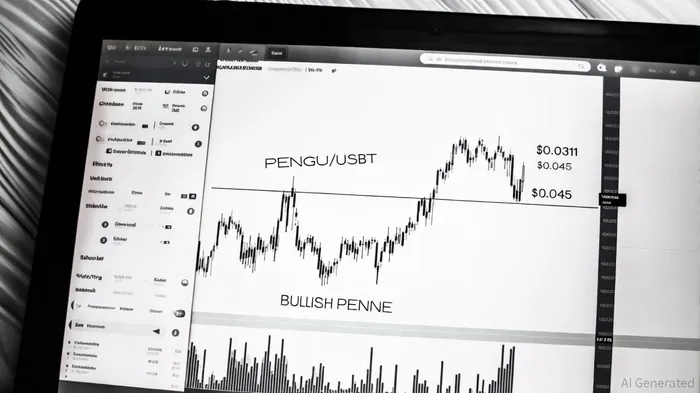
The Pudgy Penguins (PENGU) token has recently captured attention in the crypto market, with its price action forming a bullish pennant pattern—a classic technical analysis continuation formation. This pattern, characterized by converging trendlines during consolidation followed by a breakout, has historically signaled upward momentum in equities and cryptocurrencies. However, the reliability of such patterns in the volatile crypto market, particularly over short-term horizons (1–7 days), remains a contentious topic. This article dissects PENGU's breakout through the lens of classical technical analysis, on-chain metrics, and historical performance data to assess its short-term viability.
The Bullish Pennant: A Technical Primer
A bullish pennant is a continuation pattern that forms after a sharp price rise, followed by a narrowing consolidation phase. The pattern's validity hinges on a breakout above the upper trendline, with price targets often calculated by extending the prior upward move from the consolidation low. According to classical technical analysis, pennant patterns succeed approximately 56% of the time in equities and crypto, though this figure is debated in the crypto space due to market noise and liquidity constraints [2].
PENGU's chart currently mirrors this structure. After a rally from $0.03 to $0.045, the token has consolidated within a pennant formation, with sellers testing the $0.045 resistance level. A clean breakout above this level would project a target of $0.09, aligning with Fibonacci extension levels and prior psychological resistance [1]. However, the pattern's reliability in crypto is muddied by conflicting evidence. For instance, short-term breakouts (1–7 days) have historically yielded an average return of -2.8%, suggesting a bearish bias in the immediate aftermath of such moves [5]. This discrepancy underscores the need for caution.
On-Chain Metrics: Sellers Dominate, but Buyers Lurk
While the pattern's technical setup is compelling, on-chain data reveals a mixed picture. Over the past 90 days, Futures Taker CVD (Cumulative Volume Delta) indicates that sellers have dominated the market, with short-term traders aggressively unwinding long positions. Open Interest (OI) has also declined by over 7%, signaling a reduction in leveraged bets and a potential reset in market sentiment [1]. This drop in OI could precede a healthier rebound if buying resumes, as it flushes out weaker hands.
Liquidation data further complicates the narrative. Long positions have been hit harder than shorts, with $164,000 in long liquidations versus $42,000 in short liquidations. This suggests that aggressive buyers are being shaken out, creating a “buy the dip” scenario if the token stabilizes near key support levels like $0.0311 [1]. Analysts like Ali Martinez argue that this volatility could fuel a rebound toward $0.075, a 117% gain from current levels [4].
Historical Context and Pattern Reliability
The bullish pennant has appeared multiple times in PENGU's chart history, with mixed outcomes. For example, a similar pattern in early 2025 saw the token rally to $0.045 before retreating into consolidation. This history highlights the pattern's repetition but not guaranteed success, a common trait in crypto markets where sentiment and external catalysts (e.g., Binance's removal of the Seed Tag) often override technical signals [4].
Comparing PENGU to broader crypto trends, BitcoinBTC-- and EthereumETH-- have also shown pennant patterns recently, though with varying success rates. Bitcoin's bullish pennant suggests a potential move to $37,700, while Ethereum's bearish variant signals a long-term downtrend [3]. These examples reinforce the idea that pennant patterns require confirmation from volume, OI, and broader market conditions to be actionable.
Short-Term Momentum: A High-Risk, High-Reward Play
For traders eyeing PENGU's breakout, the key question is whether the pattern will hold in the short term. Historical data on crypto breakouts is inconclusive: while some traders emphasize the pattern's 56% success rate [2], others cite the -2.8% average return for 1–7 day breakouts as a warning [5]. This tension reflects the inherent volatility of crypto markets, where retail sentiment and macroeconomic factors can override technical setups.
A prudent approach would involve:
1. Waiting for confirmation: A close above $0.045 with increased volume would validate the pattern.
2. Risk management: Setting tight stop-loss orders below $0.0311 to mitigate downside.
3. Monitoring OI and liquidations: A rebound in OI and a shift in liquidation bias (e.g., more short liquidations) could signal a reversal.
Conclusion: A Cautionary Bull Case
PENGU's bullish pennant breakout presents an intriguing case study in crypto trading. While the pattern's historical success rate and on-chain catalysts (e.g., Binance's Seed Tag removal) offer a compelling narrative, the current dominance of sellers and declining OI suggest a choppy path ahead. Traders should treat this as a high-risk, high-reward opportunity, prioritizing confirmation signals and strict risk management.
As the market tests the $0.045 level, the coming days will be critical. If PENGU can hold above this threshold and attract renewed buying interest, the token could retest $0.075. However, a breakdown below $0.0311 would invalidate the pattern, reinforcing the need for patience and discipline in this volatile environment.






Comentarios
Aún no hay comentarios