
Pendle's Cross-Chain PT Expansion: A Catalyst for Liquidity Growth and Institutional Adoption in DeFi Fixed-Income Markets
In the rapidly evolving landscape of decentralized finance (DeFi), Pendle's cross-chain Principal Token (PT) expansion has emerged as a transformative force, redefining liquidity dynamics and institutional engagement in fixed-income markets. By leveraging multi-chain infrastructure and advanced financial primitives, Pendle has positioned itself as a bridge between on-chain yield innovation and traditional capital markets. This analysis explores how Pendle's strategic cross-chain adoption is catalyzing liquidity growth and attracting institutional interest, solidifying its role as a cornerstone of DeFi's fixed-income ecosystem.
Cross-Chain Expansion: Technical Innovation and Ecosystem Broadening
Pendle's 2025 cross-chain strategy, built on Ethereum's foundation, extends to Layer 2 solutions like Arbitrum and OptimismOP--, as well as emerging chains such as Base, Sonic, and Hyperliquid. This multi-chain approach reduces gas costs by up to 90% while enhancing user experience through faster transaction finality and interoperability[1]. The protocol's Pendle V4 upgrade introduces dynamic yield rebalancing and risk management algorithms, enabling automated adjustments to yield strategies based on real-time market conditions[5]. These innovations are critical for maintaining capital efficiency in a volatile environment, where liquidity providers demand both flexibility and security.
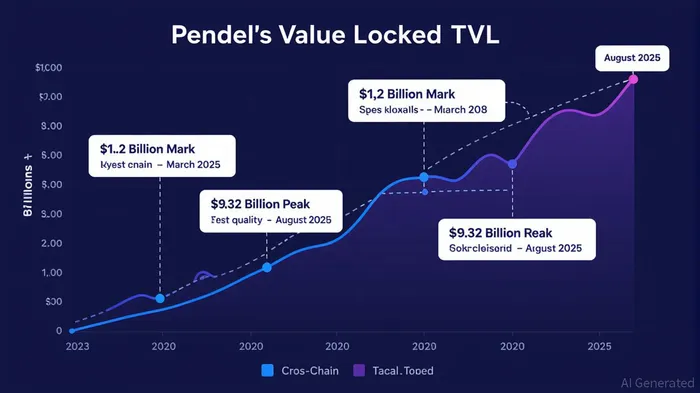
Partnerships with DeFi giants like AaveAAVE-- and Curve further amplify Pendle's reach, integrating tokenized yield for assets such as stETH, aTokens, and CRV gauge rewards[1]. By tokenizing future yield streams into PT and Yield Tokens (YT), Pendle allows users to trade or hold these assets independently, unlocking new arbitrage opportunities and deepening liquidity pools. For instance, Pendle's TVL surged to $6.72 billion in June 2024 and maintained a robust $4.88 billion TVL as of Q3 2025, with over 50% of the DeFi yield market captured[3]. This growth is not merely a function of Ethereum's dominance but a direct result of cross-chain liquidity aggregation, which reduces siloed TVL and enables seamless capital movement across ecosystems[1].
Liquidity Growth: Cross-Chain Synergies and Market Resilience
Cross-chain DeFi protocols like LayerZero and Stargate have unified liquidity across 25+ blockchains, addressing fragmentation that previously hindered DeFi's scalability[1]. Pendle's expansion into chains like SolanaSOL-- and TON—planned for Q3 2025—capitalizes on these synergies, tapping into rapidly growing ecosystems with low-cost, high-throughput networks[3]. For example, Pendle's TVL on HyperEVM reached $515 million within 2.5 weeks of deployment, demonstrating the protocol's ability to scale rapidly in new markets[2].
The economic model underpinning Pendle's success includes a 5% take rate on yield and trading fees, generating consistent monthly revenue exceeding $4 million since June 2024[1]. This revenue stream, combined with deflationary tokenomics and a decentralized autonomous organization (DAO) where 60% of token holders actively participate in governance, ensures long-term sustainability[5]. The introduction of Pendle Options and Perpetuals further diversifies revenue channels, offering sophisticated trading strategies that attract both retail and institutional participants[1].
Institutional Adoption: Compliance, Automation, and Capital Access
Pendle's 2025 roadmap prioritizes institutional-grade infrastructure, including a KYC-compliant Citadel to bridge on-chain yield with regulated markets[4]. Strategic partnerships with Ethena and Aave v3 have already enabled fixed-yield tokens like PT-USDe to be used as collateral, expanding Pendle's capital access and ecosystem participation[3]. The autonomous yield agent Pulse, launched in Q3 2025, automates portfolio rebalancing and expiry tracking, addressing key pain points for institutional users seeking 24/7 portfolio growth with minimal intervention[6].
Institutional interest is further fueled by Pendle's ability to tokenize traditional assets and integrate with legacy financial systems. For example, Pendle's whitelabeled vaults and API access allow institutional clients to execute algorithmic trading strategies and basis trades[1]. As global fixed-income markets surpass $100 trillion and tokenization trends accelerate, Pendle's infrastructure is uniquely positioned to capture a significant share of this market[2].
Market Performance and Future Outlook
Pendle's TVL reached $9.32 billion in August 2025, despite outflows from maturing assets, underscoring the resilience of its cross-chain model[2]. The PENDLE token, central to governance and staking, has seen strong performance driven by expanding utility in yield trading and risk management[5]. With plans to expand to TON and Hyperliquid, Pendle aims to reduce transaction costs further and attract users from non-EVM ecosystems[3].
Looking ahead, Pendle's autonomous yield agents and institutional-grade products like Citadel are expected to drive adoption in regulated markets, bridging the gapGAP-- between DeFi's innovation and traditional finance's compliance requirements[4]. As cross-chain DeFi continues to unify liquidity, Pendle's role as a fixed-income infrastructure layer will likely become even more critical, cementing its dominance in a space projected to grow exponentially.
Conclusion
Pendle's cross-chain PT expansion is more than a technical upgrade—it is a strategic redefinition of liquidity and capital access in DeFi fixed-income markets. By reducing friction across chains, automating yield strategies, and aligning with institutional compliance standards, Pendle has created a flywheel effect that drives both retail and institutional adoption. As the protocol continues to expand into Solana, TON, and beyond, its ability to unify liquidity and innovate in yield tokenization will likely solidify its position as the leading infrastructure layer for DeFi's next phase. For investors, Pendle's cross-chain vision represents not just a bet on DeFi's growth, but a stake in the future of global fixed-income markets.






Comentarios
Aún no hay comentarios