
Pendle's $6.4M PENDLE Transfer to Binance: Liquidity Dynamics and Institutional Signals in DeFi Yield Strategies
On-Chain Activity and Liquidity Dynamics
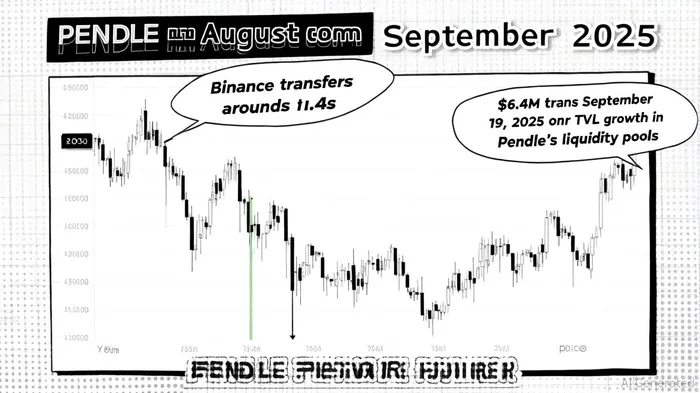
On September 19, 2025, the PendlePENDLE-- project's multisig wallet (0x811) transferred 1.2 million PENDLE tokens—valued at $6.44 million—to Binance, as reported by on-chain analytics firm Aftermath [1]. This move, executed via a multi-signature address, signals a coordinated effort rather than an individual decision, raising questions about its intent. Analysts like EmberCN have noted that such inflows into centralized exchanges often correlate with increased sell-side risk or liquidity provisioning [2]. The transaction coincided with other significant on-chain movements, including a 1 million PENDLE ($4.78M) transfer from an entity linked to @Trend_Research_ and a 1.4 million PENDLE ($7.7M) outflow from a presumed dormant investor's wallet [3]. These events collectively suggest a period of active liquidity management, though the net effect on PENDLE's price remains ambiguous.
Pendle's Total Value Locked (TVL) has surged to $10.948 billion, driven by Ethereum's $9.189 billion contribution and cross-chain expansions to HyperEVM and BeraChainBERA-- [4]. However, TVL growth has not translated into stable price performance. As of September 2025, PENDLE trades at $4.51, down 13.35% weekly, with technical indicators like RSI (40.65) and MACD (-0.158) confirming bearish momentum [5]. The recent $6.44 million inflow to Binance may exacerbate short-term volatility, as large token transfers to exchanges are often interpreted as pre-sale signals.
Institutional Signals and Market Psychology
Institutional activity has further complicated the narrative. Over the preceding six days, entities like DWF Labs and HashKey withdrew over 2.18 million PENDLE tokens ($8.3M) from Binance, signaling confidence in the token's long-term prospects amid improving regulatory clarity [6]. DWF Labs alone moved 117,563 PENDLE ($424K), a move analysts attribute to strategic accumulation for private custody [7]. These withdrawals contrast with the multisig's Binance deposit, creating a tug-of-war between liquidity provisioning and sell-side pressures.
Market psychology reflects this duality. The Fear & Greed Index for PENDLE stood at 44 in early September 2025, indicating fear, while technical sentiment was bearish at 62% [8]. However, long-term optimism persists, with price targets reaching $160 based on Fibonacci extensions and wave theory [9]. Institutional demand is further bolstered by Pendle's Boros platform, which tokenizes perpetual futures funding rates and targets the $150B+ derivatives market [10]. Innovations like Sharia-compliant yield products and cross-chain deployments on HyperEVM and BeraChain are attracting non-U.S. investors, insulating the project from some regulatory risks [11].
Implications for DeFi Yield Strategies
Pendle's liquidity dynamics highlight its role as a critical infrastructure protocol in DeFi yield trading. The project's dual-token system (Principal Tokens and Yield Tokens) enables sophisticated yield management, while Boros' introduction of Yield Units (YU) isolates funding fee volatility from asset prices [12]. These tools allow institutions to engage in delta-neutral strategies, minimizing price risk and enhancing capital efficiency.
However, challenges remain. Pendle's $4.2 billion in Aave-collateralized Principal Tokens (PTs) exposes it to systemic risks if stablecoin yields fall below borrowing costs, triggering forced liquidations [13]. Additionally, the Network Value to Transactions (NVT) ratio spiked to 865 in late August 2025, suggesting temporary overvaluation relative to network activity [14]. Liquidity providers must also navigate impermanent loss risks, though Pendle's liquidity mining strategies mitigate this by offering high swap fees and protocol rewards [15].
Price Momentum and Strategic Outlook
Short-term price action for PENDLE is fragile. The token is trading below its 30-day SMA ($5.14) and faces resistance at $5.50 [16]. A breakout above this level could reignite bullish momentum, while a breakdown below $4.40 may accelerate declines. Institutional inflows and cross-chain TVL growth provide a floor, but macroeconomic headwinds—including potential U.S. rate cuts and geopolitical tensions—remain [17].
Long-term fundamentals are stronger. Pendle's TVL-to-market cap ratio of 0.07 suggests undervaluation relative to locked capital [18]. The project's roadmap for 2025 includes scaling institutional adoption to trillions via TradFi integrations and expanding Boros' derivatives offerings [19]. These developments, coupled with its 50%+ share of the yield trading market, position Pendle to capitalize on DeFi's maturation.






Comentarios
Aún no hay comentarios