
PayPal USD's Expansion to TRON via LayerZero: Cross-Chain Interoperability as a Catalyst for Stablecoin-Driven DeFi Growth
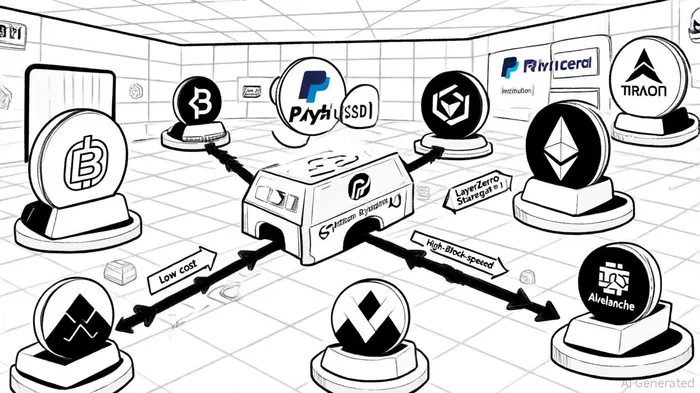
The Cross-Chain Revolution: How PayPalPYPL-- USD's TRONTRX-- Integration is Reshaping DeFi
The expansion of PayPal USD (PYUSD) to the TRON network via LayerZero's Stargate Hydra bridge marks a pivotal moment in the evolution of stablecoin-driven decentralized finance (DeFi). By introducing PYUSD0—a permissionless, fungible version of its stablecoin—PayPal is notNOT-- only broadening its digital payment infrastructure but also accelerating the adoption of cross-chain interoperability as a foundational pillar for global financial systems. This move, underpinned by LayerZero's Omnichain Fungible Token (OFT) standard, ensures that PYUSD and PYUSD0 remain fully interchangeable across blockchains, eliminating the need for manual token wrapping or centralized intermediaries [1].
Strategic Synergy: TRON's Ecosystem as a Launchpad for Global Reach
TRON's integration with PYUSD is a masterstroke of strategic alignment. With over 332 million user accounts and $28 billion in total value locked (TVL), TRON offers a high-throughput, low-cost infrastructure that complements PayPal's vision of accessible, institutional-grade digital assets [2]. According to a report by Chainwire, this partnership positions TRON as a critical settlement layer for stablecoin transactions, leveraging its existing dominance in cross-border remittances and decentralized applications (dApps) [3]. LayerZeroZRO-- CEO Bryan Pellegrino emphasized that the integration “represents a critical step in building a global financial market that operates across networks without borders or time constraints” [4].
Technical Innovation: OFT Standard and Seamless User Experience
The technical architecture behind PYUSD0 is equally compelling. By adopting LayerZero's OFT standard, PayPal ensures that PYUSD0 retains the same economic identity as PYUSD across chains, enabling users to transfer value between TRON, EthereumETH--, AvalancheAVAX--, and other networks without friction [5]. This eliminates the slippage and complexity often associated with cross-chain transactions, a barrier that has historically hindered DeFi adoption. As stated by CoinCentral, the integration “supports practical use cases such as remittances, B2C payments, and treasury management” [6], all of which are critical for scaling decentralized finance.
Market Implications: A $270 Billion Stablecoin Sector Ripe for Disruption
The stablecoin market, now exceeding $270 billion in circulation, is a battleground for innovation. PayPal's PYUSD, with a current market cap of $1.34 billion [7], is directly challenging industry giants like TetherUSDT-- (USDT) and Circle's USDCUSDC--. By expanding to nine new blockchains—including Avalanche, SeiSEI--, and Aptos—PayPal is positioning PYUSD as a universal reserve asset for DeFi protocols, institutional treasuries, and retail users [8]. This expansion is not just about volume; it's about composability. As CoinDesk noted, the integration “reinforces PYUSD's role as a key player in the growing stablecoin market” [9], particularly in ecosystems where speed and scalability are non-negotiable.
Investment Outlook: Cross-Chain Interoperability as the New Infrastructure Layer
For investors, the implications are clear. Cross-chain interoperability is no longer a niche concept—it's the bedrock of the next phase of DeFi growth. LayerZero's role in enabling this transition is particularly noteworthy. By acting as a “hub” for PYUSD0, LayerZero's Stargate Hydra model allows assets to flow freely between “spoke” blockchains, creating a network effect that benefits both users and developers [10]. This infrastructure-driven approach mirrors the early days of the internet, where open protocols democratized access and innovation.
However, risks remain. Regulatory scrutiny of stablecoins, particularly in the U.S., could introduce volatility. Additionally, competition from centralized stablecoins and emerging protocols like Diem (now Novi) may test PayPal's market share. Yet, the technical and strategic advantages of PYUSD's cross-chain deployment—coupled with TRON's user base and LayerZero's infrastructure—position this initiative as a long-term winner in the DeFi space.
Conclusion: A New Era of Financial Inclusion
PayPal's expansion to TRON via LayerZero is more than a technical upgrade—it's a declaration of intent. By prioritizing interoperability, scalability, and user experience, PayPal is laying the groundwork for a future where stablecoins are the lifeblood of global finance. For investors, this represents a unique opportunity to bet on the infrastructure layer that will power the next wave of DeFi innovation. As the lines between traditional finance and decentralized systems blurBLUR--, cross-chain solutions like PYUSD0 will be the catalysts that drive mass adoption.





Comentarios
Aún no hay comentarios