
PayPal's Strategic Expansion in Global Digital Payments: UPI Integration as a Gateway to Emerging Markets
In the rapidly evolving landscape of digital payments, PayPal's 2025 strategic pivot toward integrating India's Unified Payments Interface (UPI) marks a pivotal moment in its quest to dominate emerging markets. By embedding UPI into its global platform, PayPal World, the company is not only addressing the unique needs of India's 700 million digital consumers but also creating a scalable blueprint for expansion into other high-growth regions. This move underscores a broader vision: to transform local payment systems into global commerce enablers, leveraging interoperability to bridge the gap between regional ecosystems and international markets.
UPI Integration: A Strategic Catalyst
India's UPI has emerged as a cornerstone of digital finance, processing over 14.96 billion transactions in August 2024 alone, valued at ₹20.60 lakh crores, according to NPCI statistics. PayPal's collaboration with NPCI International Payments Limited, as reported in an Econotimes article, allows Indian users to transact globally using UPI, while enabling international merchants to tap into India's vast consumer base. This bidirectional flow of value is a masterstroke, as it reduces friction in cross-border commerce and positions UPI as a universal key to unlock emerging market potential.
The integration is part of PayPalPYPL-- World, a platform designed to connect the world's largest payment systems, starting with interoperability between PayPal and Venmo. By the end of 2025, this platform will streamline cross-border transactions, reducing costs for businesses and enhancing user experience for consumers, as explained by Outlook Business. For instance, an Indian startup selling handicrafts can now accept UPI payments from local buyers and seamlessly convert them into global transactions for overseas customers, all within a single interface.
UPI's Scalability and PayPal's Ecosystem Synergy
The success of UPI-now used by 675 Indian banks-demonstrates the power of a unified, low-cost digital infrastructure. PayPal's adoption of UPI's model in its global strategy aligns with its goal to connect nearly two billion users across digital wallets and payment systems. This synergy is critical in markets where local payment methods dominate, such as Southeast Asia's e-wallets or Africa's mobile money platforms. By replicating the UPI integration playbook, PayPal can rapidly onboard users without overhauling existing financial infrastructure, according to DemandSage data.
Data from NPCI further reinforces this strategy: UPI transactions are projected to hit 20 billion monthly within 18–24 months, according to AsiaTechDaily. For PayPal, this represents a compounding opportunity. As UPI's user base grows, so does the volume of cross-border transactions, creating a flywheel effect that drives both transaction fees and merchant adoption.
Beyond India: PayPal's Emerging Markets Playbook
While UPI integration is a flagship initiative, PayPal's 2025 roadmap includes aggressive expansion into Southeast Asia and Africa. A $100 million investment in the Middle East and Africa, for example, targets entrepreneurs and fintech startups like Tabby and Paymob, accelerating digital commerce adoption in regions where cash still dominates, as outlined in a NextSprints guide. This strategy mirrors its UPI approach: partner with local leaders, integrate regional payment systems, and scale via technology.
In Southeast Asia, PayPal's focus on AI-driven fraud detection and BNPL (buy-now-pay-later) services aligns with consumer preferences for flexible credit options. Meanwhile, in Africa, its emphasis on mobile money interoperability addresses the continent's fragmented financial landscape. These moves are not isolated but part of a cohesive strategy to create a "global financial interface" that integrates payments, lending, and investments, as analyzed by Yahoo Finance.
Risks and Opportunities
Despite its momentum, PayPal faces challenges. Regulatory hurdles in emerging markets, such as India's strict data localization laws, could delay cross-border integrations. Additionally, competition from local players like PhonePe and Google Pay in India, or M-Pesa in Africa, remains fierce. However, PayPal's strength lies in its global infrastructure and ability to scale partnerships quickly. For instance, its fiscal 2025 outlook projects 4%-5% growth in Total Market Determination (TMD), driven by emerging market strategies.
Conclusion: A Gateway to the Future of Global Commerce
PayPal's UPI integration is more than a technical upgrade-it's a strategic lever to unlock emerging markets. By transforming UPI into a global payment conduit, PayPal is redefining cross-border commerce, reducing barriers for small businesses, and capturing a share of the $10 trillion digital payments market in Asia alone. For investors, this represents a high-conviction opportunity: a fintech giant leveraging local innovation to build a global empire. As PayPal World rolls out, the company's ability to replicate its UPI success in other regions will determine its long-term dominance in the digital payments space.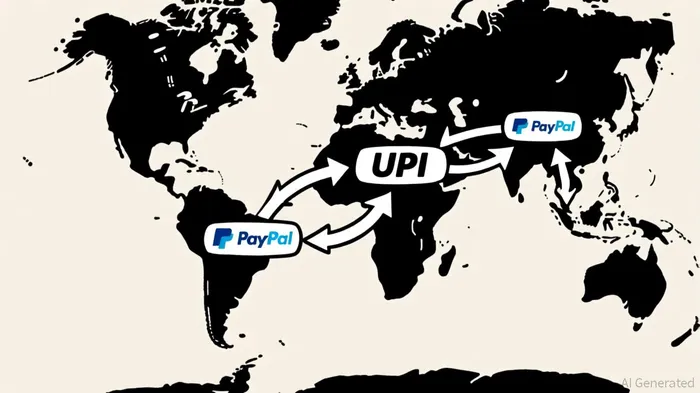





Comentarios
Aún no hay comentarios