
PayPal's $1B Injection into PYUSD and the Future of Institutional Adoption of DeFi
In 2025, PayPal's $1 billion investment into its stablecoinNOT--, PYUSD, marks a pivotal moment in the evolution of institutional finance and decentralized finance (DeFi). By partnering with SparkSPK--, a DeFi lending platform, PayPalPYPL-- is notNOT-- only deepening PYUSD's liquidity but also redefining how traditional financial institutions interact with blockchain ecosystems. This move signals a broader shift: stablecoins are no longer just tools for remittances or speculative trading—they're becoming foundational infrastructure for a hybrid financial system.
The Rise of PYUSD: A Regulated, Multi-Chain Stablecoin
PYUSD, launched in August 2023, is a U.S. dollar-pegged stablecoin issued by Paxos Trust Company. Unlike many stablecoins that rely on opaque reserve structures, PYUSD is fully backed by U.S. dollar deposits, short-term Treasuries, and cash equivalents, with monthly transparency reports and KPMG attestations[1]. This regulatory rigor has made it a trusted asset for institutions, with 90% of its supply held by institutional investors and whales[2].
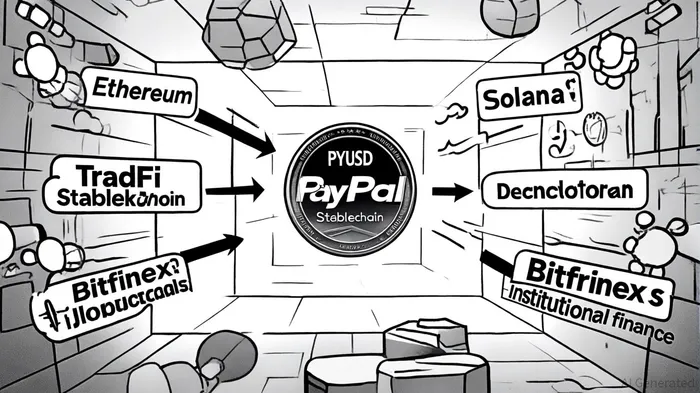
The stablecoin's multi-chain strategy—operating on EthereumETH--, SolanaSOL--, ArbitrumARB--, and now Bitfinex's Stablechain—has been critical to its growth. By leveraging low-fee, high-speed blockchains like Solana, PYUSD captured 65% of its circulating supply on that network, attracting both retail and institutional users[3]. As of September 2025, PYUSD's market capitalization has surged to $1.18 billion, up from $783 million in early 2025[4].
The $1B Spark: Liquidity, DeFi, and Institutional Adoption
PayPal's $1 billion injection into PYUSD via Spark is a strategic play to bridge the gap between TradFi and DeFi. Spark, a decentralized lending platform, is deploying over $8 billion in reserves to create liquidity pools for PYUSD, reducing costs by 7-8% compared to traditional market makers[5]. This partnership enables users to supply and borrow PYUSD on SparkLend, a protocol that accepts blue-chip collateral like BitcoinBTC-- and Ethereum[6].
The implications are profound. For institutions, PYUSD offers a regulated, liquid asset that can be seamlessly integrated into DeFi protocols. For DeFi, it introduces a stablecoin with the backing of a global fintech giant, reducing volatility risks and attracting capital from traditional investors. According to a report by CoinDesk, PYUSD deposits on Spark have already grown from $100 million to tens of millions of USDCUSDC-- being swapped daily[7].
Reshaping Stablecoin Dynamics
PYUSD's rise challenges the dominance of TetherUSDT-- (USDT) and USD Coin (USDC), which control 62.5% and 24.21% of the stablecoin market, respectively[8]. While PYUSD holds just 0.38% of the market, its institutional adoption and regulatory compliance position it as a niche leader. PayPal's ecosystem—20+ million merchants, 400 million users, and zero-fee transfers with Mastercard and Coinbase—creates a flywheel effect, driving utility and adoption[9].
The $1B investment also accelerates PYUSD's integration into DeFi's $150 billion total value locked (TVL) ecosystem[10]. By offering high annualized yields on protocols like SparkLend, PYUSD taps into DeFi's innovation while mitigating its risks through regulatory safeguards. This hybrid model could become a blueprint for future TradFi-DeFi collaborations.
Regulatory Compliance as a Competitive Edge
In an era of tightening regulations, PYUSD's transparency is a key differentiator. The MiCA (Markets in Crypto-Assets) framework in the EU and the U.S. SEC's scrutiny of stablecoins have created a “compliance premium” for assets like PYUSD[11]. By maintaining full reserve backing and publishing audited reports, PayPal avoids the reputational risks that plagued earlier stablecoins like TerraUSD (UST).
This compliance advantage is not lost on institutional investors. A 2025 report by Stablecoin Insider notes that 78% of institutional PYUSD holders cite regulatory certainty as their primary motivation[12]. As DeFi matures, this alignment between compliance and innovation will likely become a standard for institutional adoption.
The Road Ahead: Challenges and Opportunities
While PYUSD's trajectory is promising, challenges remain. The stablecoin must navigate evolving regulations, maintain its peg during market stress, and compete with newer stablecoins targeting niche markets. However, its multi-chain strategy, institutional partnerships, and DeFi integration provide a robust foundation.
Looking ahead, PYUSD's expansion to Bitfinex's Stablechain and potential integrations with LayerZero's cross-chain infrastructure could further enhance its utility[13]. If PayPal continues to prioritize DeFi liquidity and regulatory alignment, PYUSD could triple in adoption by 2026, as predicted by fintech analysts[14].
Conclusion
PayPal's $1 billion bet on PYUSD is more than a liquidity play—it's a statement of intent. By merging the strengths of TradFi (regulation, scale) with DeFi (innovation, composability), PayPal is redefining stablecoin dynamics. For investors, this hybrid model offers a glimpse into the future: a financial system where institutional-grade assets and decentralized protocols coexist, creating new avenues for growth, efficiency, and inclusion.





Comentarios
Aún no hay comentarios