
Is Paying Off a High-Interest Personal Loan Early a Strategic Financial Move? A Cost-Benefit Analysis for 2025
In 2025, the financial landscape remains a tightrope between debt management and investment opportunities. With high-interest personal loans averaging 21.65% to 35.99% for borrowers with poor or fair credit, and stock market returns projected to stagnate or underperform historical averages, the decision to prioritize debt repayment over investing demands rigorous scrutiny. This analysis evaluates the cost-benefit framework of paying off high-interest personal loans early, using 2025 data to assess its alignment with long-term financial health.
The Cost of High-Interest Debt: A Guaranteed Expense
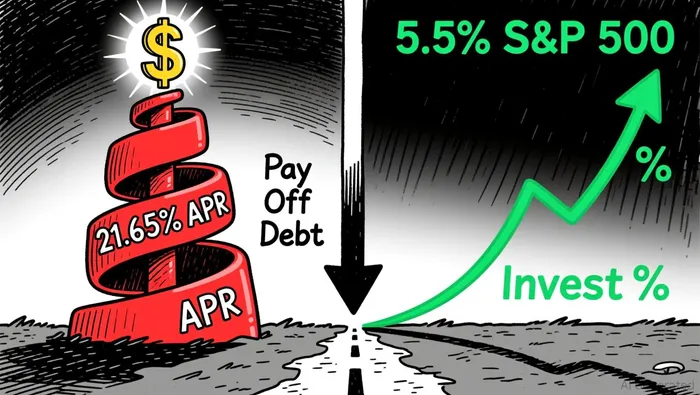
High-interest personal loans, defined as those exceeding 14% to 18% APR, represent a predictable and compounding financial burden. For borrowers with fair to poor credit (630–629 scores), average rates hover near 21.65%, meaning every dollar not paid toward principal accrues interest at a rate that dwarfs most investment returns. For example, a $10,000 loan at 21.65% APR would incur over $2,165 in interest annually-equivalent to a guaranteed negative return.
This cost is further amplified by the psychological toll of debt. High-interest obligations create liquidity constraints and reduce financial flexibility, which can hinder emergency savings or force riskier investment choices. As noted by NerdWallet, borrowers with good credit (690–719) face average rates of 14.48%, still significantly higher than the projected 2025 returns for most investment vehicles.
Investment Returns in 2025: A Risky Proposition
The S&P 500, a benchmark for broad-market returns, has historically averaged 10% annually but is expected to trade sideways in 2025, with some analysts projecting returns as low as 5.5%. Even optimistic scenarios, such as Fidelity's ZERO Large Cap Index Fund's 5-year annualized return of 14.8%, fail to match the interest rates of high-risk personal loans. Inflation, which erodes real returns by 2–3% annually, further diminishes the appeal of stock market exposure for debtors facing double-digit borrowing costs.
Schwab's 2025 capital market expectations highlight a narrowing gap between equities and risk-free assets, suggesting that even long-term investors may struggle to outperform low-risk alternatives. For context, a high-interest loan at 21.65% APR would require an investment return of 21.65% to break even-a threshold far exceeding the S&P 500's 10% historical average.
Cost-Benefit Framework: Debt vs. Investment
The decision to pay off high-interest debt early hinges on a simple principle: If the cost of debt exceeds the expected return on investments, debt repayment is the superior strategy. For borrowers with rates above 14%, the math is clear. A $10,000 loan at 21.65% APR would cost $2,165 in interest annually-equivalent to a 21.65% guaranteed loss. By contrast, even the most aggressive equity investments in 2025 offer returns that fall short of this benchmark.
However, borrowers with excellent credit (720+ scores) face a different calculus. With access to rates as low as 6.49%, these individuals could theoretically allocate funds to investments that outperform their borrowing costs. For instance, a 6.49% loan could be offset by a diversified portfolio targeting 8–10% returns. Yet this strategy assumes market consistency and risk tolerance-factors that often falter during downturns.
Long-Term Financial Health: The Hidden Benefits of Debt Elimination
Beyond immediate cost savings, paying off high-interest debt accelerates long-term financial stability. Debt-free individuals enjoy higher credit scores, reduced stress, and greater capacity to invest in low-risk vehicles like index funds or real estate. According to Bankrate, borrowers who prioritize debt repayment often achieve compound savings that outweigh the forgone returns of missed investments.
Moreover, eliminating high-interest debt creates a psychological buffer against market volatility. In 2025, with inflation and geopolitical risks persisting, the certainty of avoiding compounding interest becomes a critical advantage.
Conclusion: A Strategic Imperative for Most Borrowers
For the majority of Americans-particularly those with fair or poor credit-paying off high-interest personal loans early is a strategically sound decision. The 2025 data underscores that the cost of debt averages 21.65% to 35.99% APR far exceeds the returns of even the most optimistic investment scenarios projected at 5.5% to 14.8%. While high-net-worth individuals with access to low-interest loans may justify investing, the broader population would benefit from prioritizing debt elimination.
In an era of economic uncertainty, the surest path to long-term financial health lies in minimizing guaranteed losses before pursuing speculative gains.





Comentarios
Aún no hay comentarios