
PayFi's 2025 Showdown: XRP vs. Remittix in the $26.9M Presale Era
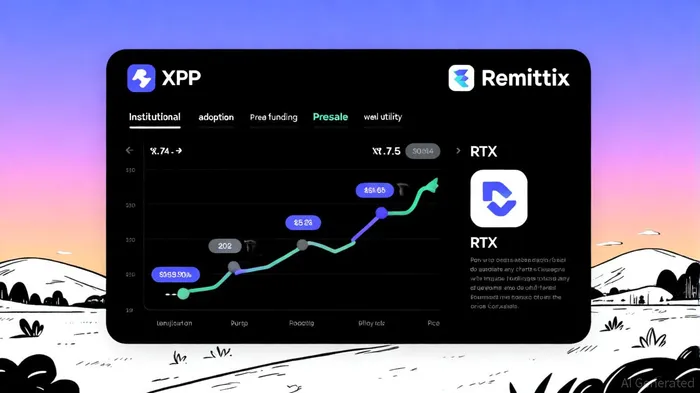
The PayFi (Payment Finance) sector is undergoing a seismic shift in 2025, driven by institutional adoption, regulatory clarity, and the rise of utility-driven projects. Two names dominate the conversation: XRP, Ripple's battle-tested token, and Remittix (RTX), a viral PayFi challenger with a $26.9M presale. This analysis dissects their trajectories, risks, and potential to reshape global payments.
XRP: Institutional Backing Meets Regulatory Uncertainty
XRP's resurgence in 2025 is fueled by the U.S. SEC's updated rules for spot crypto ETFs, which accelerated approval timelines for assets like XRPXRP--, according to Invezz. Major firms like VanEck and Bitwise have filed ETF applications, creating a tailwind for institutional adoption. Analysts at Invezz note that XRP's price could break out to $3.60 if it holds above $2.75, supported by on-chain accumulation from large wallet holders.
However, XRP's path is not without hurdles. Regulatory uncertainties-despite recent progress-remain a wildcard, and its development pace lags behind newer projects, according to The Currency Analytics. While Ripple's partnerships with banks and payment processors provide credibility, the token's success hinges on sustained ETF momentum and favorable rulings in ongoing legal battles.
Historical data from 2022 to 2025 reveals that XRP has shown a tendency to rebound after breaching its daily Support 1 level. In 12 such events (all clustered in mid-2025), the token generated an average cumulative excess return of ~9.5 percentage points over a benchmark buy-and-hold strategy around day 17 post-event, before fading. While the sample size is small and results are not statistically significant, this pattern suggests a potential short-term rebound window for traders monitoring support levels.
Remittix (RTX): The Viral PayFi Challenger
Remittix has emerged as a disruptive force, leveraging a $26.8M presale and 40,000+ holders to build a utility-driven ecosystem. Its core offering-crypto-to-bank transfers in 30+ countries and real-time FX conversions-addresses pain points in cross-border payments far more effectively than XRP's enterprise-focused model, according to Coindoo.
Key advantages include:
- Deflationary tokenomics and a CertiK audit, boosting investor confidence.
- Exchange listings on BitMart and LBank, with a 15% USDT referral program accelerating community growth (noted in Invezz).
- A price trajectory from $0.10 to $7 projected by analysts, driven by real-world adoption (reported by The Currency Analytics).
According to The Currency Analytics, Remittix's grassroots approach and focus on retail users position it to outpace XRP in 2025, particularly in markets where traditional banking infrastructure is weak.
The PayFi Narrative: XRP 1.0 vs. RTX 2.0
The broader PayFi narrative is about solving inefficiencies in global finance. XRP represents institutional-grade infrastructure, while Remittix embodies decentralized, user-first innovation.
- XRP's strength lies in its established network and institutional partnerships, but its reliance on regulatory outcomes makes it a higher-risk bet.
- RTX's edge is its viral presale, tangible utility, and community-driven growth. Its $26.9M funding round-largely driven by retail investors-signals a shift in power from Wall Street to Main Street (covered by Coindoo).
A critical question remains: Can XRP's institutional traction offset RTX's grassroots momentum? The answer may hinge on whether ETF approvals catalyze mass adoption or if RTX's hypergrowth outpaces Ripple's playbook.
Investment Implications: Diversify or Double Down?
For investors, the PayFi showdown presents a strategic fork in the road:
1. XRP offers exposure to institutional crypto adoption but carries regulatory risk.
2. RTX provides high-growth potential with a utility-first model, though its scalability remains unproven.
Given the $26.9M presale and RTX's aggressive roadmap, it's prudent to allocate a portion of PayFi exposure to both tokens. However, RTX's deflationary mechanics and real-world use cases make it a compelling speculative play, particularly for risk-tolerant investors.






Comentarios
Aún no hay comentarios