
Paychex's Strategic Earnings Outperformance and Revenue Guidance Amid Macroeconomic Uncertainty
The HR services sector has long been a barometer for economic resilience, and Paychex's Q3 2025 performance underscores its strategic positioning in a volatile macroeconomic climate. Despite broader economic uncertainties, including inflationary pressures and geopolitical tensions, PaychexPAYX-- reported revenue growth of 5% year-on-year, reaching $1.5 billion-a-figure in line with Wall Street estimates but outperforming expectations in non-GAAP EPS. This performance, coupled with forward-looking guidance, highlights the company's ability to navigate challenges while capitalizing on industry-wide tailwinds.
Earnings Outperformance and Operational Challenges
Paychex's Q3 results revealed a nuanced picture. While non-GAAP EPS of $1.22 exceeded analyst forecasts by 1.4%, the company fell short of adjusted EBITDA estimates, reporting $680 million against a projected $709.5 million according to financial data. The decline in operating margins-from 41.5% in Q3 2024 to 35.2% in Q3 2025-signals rising cost pressures, a common challenge in a sector reliant on technology and labor-intensive services. However, the 4.76% surge in Paychex's stock price following the earnings report, closing near its 52-week high of $158.37, reflects investor confidence in its long-term strategy.
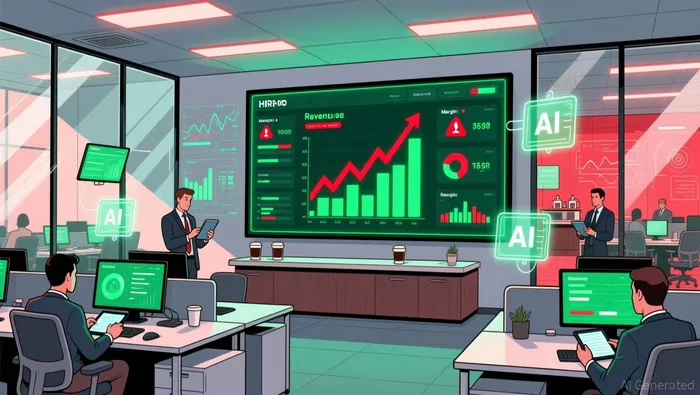 This confidence is further bolstered by Paychex's fiscal 2025 guidance, which anticipates total revenue growth of 4% to 5.5%. Notably, the company projects a 10-12% revenue increase in Q4 2025, driven by the anticipated acquisition of Paycor, a strategic move expected to close in April 2025. This acquisition aligns with broader industry trends toward consolidation and digital transformation, as companies seek to scale capabilities in payroll, benefits, and compliance solutions.
Industry Resilience Amid Macroeconomic Headwinds
The HR services sector's resilience in 2025 is underpinned by its role in addressing labor shortages and adapting to evolving workforce demands. According to the World Employment Confederation, the sector remains a critical bridge for economic growth, even as global agency work activity declined in 2023 due to skills mismatches and geopolitical tensions. This adaptability is further evidenced by the shift toward remote work and skills-based compensation, which has increased demand for HR services that support decentralized teams and upskilling initiatives.
However, the sector is not immune to macroeconomic pressures. SHRM's Q2 2025 CHRO Economic Outlook reveals that HR executives are adopting a cautious stance, with many anticipating poor economic conditions in the next six months. Cost control and workforce flexibility have become priorities, as companies brace for reduced capital expenditures and revenue volatility. Paychex's focus on scalable, technology-driven solutions positions it to meet these demands, particularly as businesses seek to optimize operational efficiency amid tightening budgets.
Sustainability and the Future of HR Services
While Paychex has not yet disclosed specific ESG initiatives, the broader HR services sector is increasingly aligning with sustainability goals. A report by Benomik highlights 10 key trends for sustainable HR practices in 2025, including digital recruitment strategies and AI-driven processes that reduce environmental impact while enhancing retention. Additionally, LinkedIn's 2025 Green Skills Report notes a 46.6% higher hiring rate for workers with green skills compared to the global average, reflecting a growing emphasis on sustainability across industries.
For Paychex, the integration of AI and data analytics into its service offerings not only addresses immediate client needs but also aligns with the sector's shift toward skills-based hiring. As companies prioritize sustainability, HR services providers that can facilitate green skill development and reduce operational carbon footprints will likely see sustained demand.
Conclusion
Paychex's Q3 2025 performance and forward-looking guidance demonstrate its ability to outperform in a challenging economic environment. While operational margins face pressure, the company's strategic focus on innovation, consolidation, and digital transformation positions it to capitalize on industry tailwinds. The HR services sector's resilience-driven by labor market dynamics, remote work normalization, and sustainability trends-further reinforces Paychex's growth potential. As macroeconomic uncertainties persist, investors should view Paychex's strategic agility and alignment with long-term industry shifts as key drivers of sustainable value creation.







Comentarios
Aún no hay comentarios