
Paxos's SEC Clearing Agency Bid and the Future of Tokenized Assets
The financial infrastructure landscape is undergoing a seismic shift as blockchain technology converges with traditional markets. At the forefront of this transformation is Paxos, whose bold application to the U.S. Securities and Exchange Commission (SEC) to become a registered clearing agency could redefine how securities are issued, traded, and settled. If approved, this move would not only legitimize Paxos as a bridge between crypto and conventional finance but also accelerate the tokenization of real-world assets (RWAs), unlocking trills in liquidity and innovation. For investors, this represents a pivotal opportunity to position capital at the intersection of regulatory progress and technological disruption.
The Strategic Significance of Paxos's SEC Application
Paxos's bid to become a clearing agency under Section 17A of the Securities Exchange Act of 1934 marks a watershed moment. By seeking this status, the firm aims to directly hold and issue traditional securities-such as stocks and bonds-on a blockchain, enabling real-time, on-chain settlement. This would eliminate intermediaries like custodians and brokers, reducing counterparty risk and operational costs while enhancing transparency. The SEC's evaluation process, which includes assessing Paxos's organizational capacity and fee structures, underscores the regulator's cautious yet open-minded approach to blockchain innovation.
The implications are profound. If approved, Paxos would become the first crypto entity to operate within the SEC's traditional financial framework, setting a precedent for others to follow. This aligns with broader industry trends toward regulatory compliance, as seen in the growing adoption of tokenized securities that remain subject to federal securities laws. For investors, this signals a maturing market where blockchain infrastructure is no longer a speculative experiment but a viable, institutional-grade solution.
Tokenized Assets: A $3 Trillion Opportunity by 2030
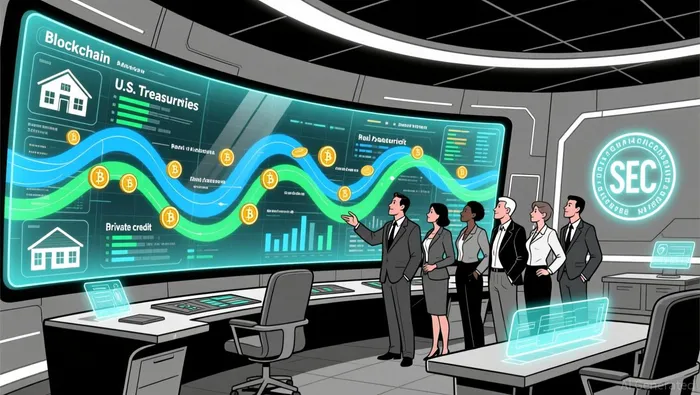
The tokenization of RWAs is already gaining momentum, with the market reaching $33 billion in October 2025. U.S. Treasuries dominate this space, driven by their stability and the efficiency gains of blockchain-based settlement. Real estate and private credit are also emerging as key sectors, with tokenization enabling fractional ownership and democratizing access to high-value assets. For example, BlackRock's tokenized U.S. Treasury fund (BUIDL) attracted $500 million in early months, while Siemens' €300 million tokenized bond offering highlights corporate adoption.
Projections suggest the public tokenized RWA market could grow to $500 billion–$3 trillion by 2030, with private credit alone surpassing $200 billion. This growth is fueled by regulatory clarity, such as the U.S. GENIUS Act of 2025, which established a framework for stablecoins and boosted institutional confidence. Stablecoin supply has surged to $280 billion in 2025, with projections of $1.9 trillion by 2030, further solidifying blockchain's role in global finance.
Strategic Investment in Blockchain Infrastructure
Investors seeking exposure to this transformation should focus on blockchain-based financial infrastructure. The Global X Blockchain ETF (BKCH) offers equity access to companies driving innovation in tokenization, stablecoins, and decentralized finance. Additionally, firms like CircleCRCL-- Internet Group, which issues USD Coin (USDC), have seen 66% year-over-year revenue growth, reflecting the demand for stable, regulated digital assets.
Beyond equities, opportunities exist in blockchain application layers that facilitate real-world payments and liquidity. The integration of AI with blockchain is also reshaping compute models, turning crypto mining data centers into diversified infrastructure providers. Globally, countries like the UAE, Singapore, and the EU are fostering supportive ecosystems, while China and Japan are advancing blockchain in trade and public services.
Navigating Risks and Regulatory Nuance
While the potential is vast, investors must remain mindful of regulatory risks. As SEC Commissioner Hester Peirce emphasized, tokenized securities are still securities, requiring adherence to disclosure and compliance standards. This means tokenization projects must navigate existing legal frameworks, balancing innovation with investor protection. However, Paxos's application and the GENIUS Act demonstrate that regulatory alignment is achievable, paving the way for scalable adoption.
Conclusion: Positioning for the Next-Generation Financial System
Paxos's SEC clearing agency bid is more than a regulatory milestone-it is a harbinger of a new financial paradigm. By enabling on-chain settlement of traditional assets, the firm is accelerating the tokenization of trillions in value, supported by a growing ecosystem of institutional adoption, regulatory clarity, and technological innovation. For strategic investors, the key lies in capitalizing on early-stage infrastructure opportunities, from stablecoins to RWA platforms, while staying attuned to evolving regulatory dynamics. The future of finance is being rewritten in code-and those who invest wisely today will reap the rewards of tomorrow.





Comentarios
Aún no hay comentarios