
Third-Party Risks in Crypto Custody: The Ledger Breach and Its Implications for Secure Asset Storage
The 2026 Ledger breach, linked to its third-party payment processor Global-e Online Ltd.GLBE--, has reignited critical debates about the vulnerabilities inherent in centralized and semi-centralized crypto custody models. While Ledger emphasized that no private keys or recovery phrases were compromised, the exposure of customer names, contact information, and order details underscored a systemic risk: third-party dependencies in the crypto ecosystem. This incident, coupled with prior breaches in 2020 and 2023, highlights a growing industry trend of attackers exploiting supply chains to access user data. For investors, the breach serves as a stark reminder that even reputable custodians are not immune to cascading risks from external partners.
The Anatomy of Third-Party Risks
Ledger's 2026 breach followed a familiar pattern: a third-party vendor's security lapse indirectly compromised user trust. According to a report by BleepingComputer, the breach originated from Global-e's systems, which processed customer payments for Ledger's e-commerce operations. While Ledger's hardware wallets and core infrastructure remained secure, the incident exposed a critical weakness-reliance on third-party services for non-core functions. This aligns with broader industry trends, where 78% of G20 nations now enforce strict security standards for crypto service providers, yet breaches persist due to fragmented supply chains.
The 2025 Trust Wallet hack further illustrates this risk. Attackers injected malicious JavaScript into Trust Wallet's Chrome extension, siphoning $7 million in crypto assets. These events demonstrate that third-party risks extend beyond data leaks to direct asset theft, particularly when custodians integrate external tools into their user interfaces. For investors, the lesson is clear: third-party custody introduces layers of complexity that can amplify exposure to phishing, social engineering, and supply-chain attacks.
Long-Term Risks and Investor Implications
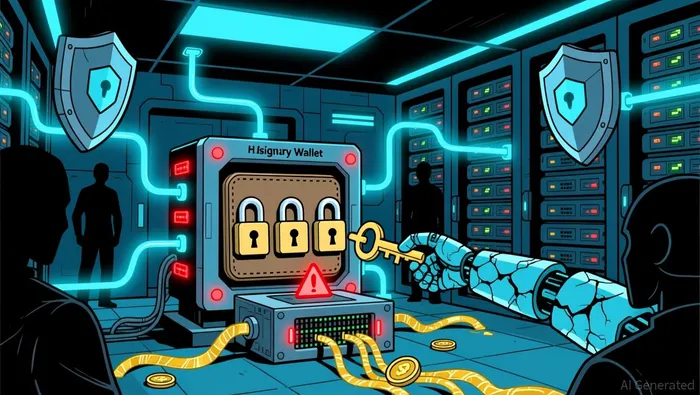 The Ledger and Trust Wallet breaches highlight three long-term risks for the crypto custody sector:1. Phishing and Social Engineering: Exposed user data from breaches becomes fuel for targeted scams. Ledger explicitly warned users to avoid sharing recovery phrases or validating unsolicited transactions according to security advisories. However, repeated breaches erode user vigilance, making phishing a persistent threat.2. Regulatory Scrutiny: As 2026 regulatory frameworks like the EU's Markets in Crypto-Assets (MiCA) and U.S. SEC custody rules tighten, custodians face pressure to audit third-party vendors rigorously. Non-compliance could lead to penalties or loss of institutional business.3. Erosion of Trust: Repeated breaches, even if they don't directly compromise assets, damage brand credibility. A 2025 survey by Fireblocks found that 62% of institutional investors now prioritize custodians with zero third-party dependencies.
Decentralized Self-Custody: A New Paradigm
In response to these risks, the market is pivoting toward decentralized, self-custody solutions. Multi-Party Computation (MPC) and multi-signature wallets are gaining traction as they eliminate single points of failure. For example, MPC wallets split private keys into distributed fragments, ensuring no single entity controls the full key. This technology is projected to grow at a 8.1% CAGR from 2025 to 2031, reaching $120 million in market value.
Investors should also consider platforms like Fireblocks and BitGo, which offer institutional-grade custody with features such as threshold signature schemes and quantum-resistant cryptography according to State Street's analysis. These solutions align with the post-breach demand for transparency and compliance, particularly as Bitcoin and Ethereum ETFs attract $50 billion in institutional assets.
Regulatory Tailwinds and Market Growth
The 2025 passage of the U.S. GENIUS Act and the EU's MiCA regulation has created a fertile environment for decentralized custody. According to State Street's 2025 Digital Digest, banks and custodians are now launching tokenized deposit platforms, signaling a shift toward blockchain-based infrastructure. Meanwhile, the global cryptocurrency custody software market is forecasted to grow from $4.6 billion in 2025 to $18 billion by 2035, driven by demand for cold storage and multi-currency support.
Investment Opportunities
For investors seeking exposure to secure custody solutions, the following opportunities stand out:- MPC Wallet Development: Startups like Intel's MPC-focused firms are capitalizing on institutional demand for quantum-resistant protocols according to market research.- Decentralized Exchange (DEX) Integration: Platforms enabling non-custodial trading, such as UniswapUNI-- and SushiSwapSUSHI--, are gaining traction as users seek to avoid centralized exchange risks as reported by industry analysis.- Insurance Protocols: Projects like Nexus Mutual and Cover Protocol are addressing the residual risks of self-custody by offering decentralized insurance against smart contract failures according to research findings.
Conclusion
The Ledger breach of 2026 is a watershed moment for the crypto custody sector. While third-party risks remain a persistent challenge, the industry's shift toward decentralized, self-custody solutions offers a path forward. For investors, the key lies in prioritizing platforms that combine cryptographic innovation with regulatory compliance. As the market evolves, those who recognize the urgency of secure asset storage will be best positioned to capitalize on the next wave of institutional adoption.







Comentarios
Aún no hay comentarios