
Partisan Policies and Inflation: How Political Strategies Shape Retail and Agricultural Markets
Republican Tariffs: A Double-Edged Sword
The Trump administration's expansive tariff regime, reintroduced and expanded in 2025, has had measurable inflationary effects. By August 2025, the Consumer Price Index (CPI) for all food had risen 3.2% year-over-year, with tariff-sensitive goods like coffee, beef, and household furniture seeing sharp price hikes . The St. Louis Fed estimates that tariffs accounted for 10.9% of headline PCE annual inflation as of August 2025, a figure that underscores their role in driving up costs for durable goods and agricultural products .
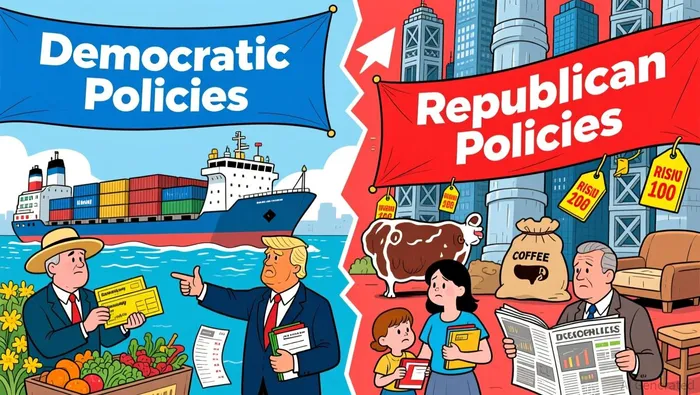 These policies, while intended to bolster domestic manufacturing, have also disrupted supply chains. For example, beef and veal prices surged 13.9% compared to August 2024, driven by both tariffs on imports and a shrinking U.S. cattle herd . The Federal Reserve's decision to signal one fewer interest rate cut in 2026 reflects the central bank's concern over persistent inflation linked to these policies .
Republicans defend these measures as necessary to protect American industries, but critics argue they disproportionately burden consumers. Senate Minority Leader Mitch McConnell and others have highlighted rising costs for everyday items like tomatoes and coffee, even as the Trump administration rolled back some tariffs on agricultural goods .
Democratic Subsidies and Trade Promotion: Mitigating Volatility
In contrast, the Biden administration's approach has focused on stabilizing agricultural markets through subsidies and export promotion. The 2024 American Relief Act allocated $21 billion in disaster aid to farmers, including $10 billion for economic losses from low crop prices . These payments, projected to reach $42.4 billion in 2025, have cushioned farmers against market volatility caused by retaliatory tariffs from China and Canada .
The administration's export programs, such as the Market Access Program, have also expanded U.S. agricultural exports, generating over $850 million in support for global market access in 2024 alone . While these efforts have bolstered farm income-forecasted to rise in 2025 after declines in 2023 and 2024-they have not fully offset inflationary pressures. For instance, fertilizer and equipment costs for farmers spiked due to tariffs on Chinese imports, pushing up production expenses and, ultimately, consumer prices .
Democratic policies have also faced criticism for their indirect inflationary effects. The Inflation Reduction Act and increased government spending have been linked to broader economic inflation, though the administration argues these measures are necessary to address climate change and strengthen food supply chains .
Partisan Divergence and Market Implications
The contrast between these approaches is stark. Republican policies, centered on tariffs and tax cuts, have directly inflated prices for imported goods and agricultural products, while Democratic strategies emphasize subsidies and trade expansion to stabilize markets. However, both approaches carry risks: Trump's tariffs have made U.S. goods less competitive in global markets, while Biden's subsidies risk crowding out private investment and exacerbating fiscal pressures.
For investors, the key takeaway lies in sector-specific exposure. Retailers selling tariff-sensitive goods (e.g., electronics, furniture) face margin compression, while agricultural firms may benefit from higher commodity prices and government support. Conversely, consumers-particularly lower-income households-bear the brunt of rising food and goods costs, with 13.5% of U.S. households experiencing food insecurity in 2023 .
Conclusion: Navigating a Politicized Economy
As the 2026 election approaches, partisan economic policies will remain a dominant force shaping inflation and market performance. Investors must weigh the short-term inflationary impacts of tariffs against the long-term risks of protectionism, while also monitoring how subsidies and trade agreements influence agricultural and retail sectors. Diversification and hedging against inflationary shocks-through assets like Treasury Inflation-Protected Securities or inflation-linked commodities-will be essential in this polarized economic landscape.
[2] How Tariffs Are Affecting Prices in 2025 | St. Louis Fed [https://www.stlouisfed.org/on-the-economy/2025/oct/how-tariffs-are-affecting-prices-2025]
[3] Short-Run Effects of 2025 Tariffs So Far [https://budgetlab.yale.edu/research/short-run-effects-2025-tariffs-so-far]
[5] 5 facts about food costs in America [https://www.pewresearch.org/short-reads/2025/05/15/5-facts-about-food-costs-in-america/]
[7] Examining Support for US Farmers: The 2025 Ad Hoc Economic Assistance Programs [https://www.aei.org/research-products/report/examining-support-for-us-farmers-the-2025-ad-hoc-economic-assistance-programs/]
[9] Farm Sector Income Forecast - ERS.USDA.gov [http://www.ers.usda.gov/topics/farm-economy/farm-sector-income-finances/farm-sector-income-forecast]
[12] Biden-Harris Administration Advances Agricultural Exports [https://www.usda.gov/about-usda/news/press-releases/2025/01/08/fact-sheet-biden-harris-administration-advances-agricultural-exports-support-us-economy]
[14] Economic policy of the Biden administration [https://en.wikipedia.org/wiki/Economic_policy_of_the_Biden_administration]
[16] The Impact of Tariffs on the U.S. Agriculture Industry [https://www.edengreen.com/blog-collection/tariff-impact-agriculture-industry]







Comentarios
Aún no hay comentarios