
Paramount's Streaming Bet: Can $1.5 Billion in 2026 Spend Offset Layoffs and $500M Restructuring Hit?
The immediate catalyst is a clean break from the past. On May 22, CBS News Radio-a service with origins tracing back nearly a century-will cease operations. This closure is not a minor adjustment but a total shutdown, eliminating all roles within that unit. The move is part of a broader, sweeping overhaul of the news division, with roughly 6% of its workforce being cut. That translates to about 60 employees departing, a second round of layoffs since new owner David Ellison took control last summer.
Executives Bari Weiss and Tom Cibrowski framed the decision as a necessary reallocation of resources driven by "challenging economic realities" and a fundamental shift in how radio stations program content. They acknowledged the emotional weight, noting the unit's legacy from Edward R. Murrow's wartime reporting to its long-running "World News Roundup." Yet they also signaled a decisive pivot, stating the news business is changing radically and that some parts must shrink to make room for new investments. This is the clearest signal yet that the new leadership is willing to sacrifice a historic asset to reshape the newsroom for a new era.
The Strategic Pivot: Streaming Focus vs. Financial Reality
The stated strategy is clear: Editor-in-Chief Bari Weiss is reshaping CBS News to focus on streaming video and presenting more points of view. This is a direct pivot from traditional broadcast, aimed at building a differentiated, non-commodity news product for audiences skeptical of institutions. The recent layoffs, including the shutdown of CBS News Radio, are framed as necessary to "make room for the things we must build to remain competitive."
Yet this ambitious pivot clashes sharply with Paramount's financial reality. The company just posted its first quarterly loss under new ownership, citing a restructuring charge of approximately $500 million for the fourth quarter. This loss underscores the immediate cost of the transformation. At the same time, the new leadership is calling for massive future spending, with incremental programming investments in 2026 in excess of $1.5 billion.
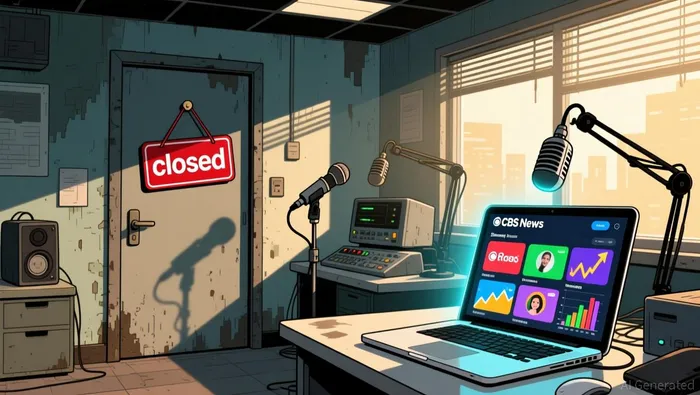
The bottom line is a stark tension between stated ambition and current financial strain. The company is simultaneously slashing costs through layoffs and restructuring while committing to spend billions more on programming. This creates a high-risk, high-cost bet on the streaming pivot. The $1.5 billion in planned spending must now cover not just new content but also the integration and potential underperformance of a restructured news division. For investors, the key question is whether these future investments will generate the revenue needed to offset today's losses and the hefty restructuring charge, or if the financial pressure will only intensify.
Valuation and Forward Catalysts: What to Watch
The market's verdict is clear and harsh. Paramount's stock trades at $18.50, but the median analyst price target sits at just $11.00. That implies a potential 40.5% downside from current levels. This skepticism is reflected in the stock's recent performance, which has been under pressure. It is down 11.3% year-to-date and trades below its 52-week high of $20.86. The analyst consensus is neutral, with more Sell and Hold ratings than Buy, framing the situation as one of high risk and uncertain payoff.
The immediate forward catalyst is a simple math problem. The company is committing to incremental programming investments in 2026 in excess of $1.5 billion. This spending spree is meant to fuel growth toward a $30 billion revenue target for 2026. Yet, this aggressive investment plan is paired with significant cost-cutting, including the recent restructuring charge of approximately $500 million and massive layoffs. The critical question for the stock is whether the savings from these cuts can offset the massive planned spending and help achieve that lofty revenue goal. If the cost savings are insufficient, the financial pressure will only intensify, making the current valuation stretch even further.
For investors, the setup is a classic event-driven tension. The shutdown of CBS News Radio and the broader layoffs are tangible, near-term cost reductions. But they are being deployed against a backdrop of even larger, forward-looking expenses. The stock's deep discount to analyst targets suggests the market is betting that the spending will not pay off quickly enough. The next few quarters will test this thesis, as the company must demonstrate that its streaming pivot and new programming investments can generate the revenue needed to justify the current price. Until then, the valuation remains a function of faith in a strategy that is both expensive and unproven.







Comentarios
Aún no hay comentarios