
Paramount's Legal Push: Can a Lawsuit Break the Netflix Deal?
The hostile takeover battle just got a new weapon. On Monday, January 12, Paramount SkydancePSKY-- filed a lawsuit in Delaware Chancery Court to force Warner Bros.WBD-- Discovery to reveal the financial details of its $83 billion deal with Netflix. This is a direct tactical move, aimed at pressuring WBDWBD-- shareholders by casting doubt on the NetflixNFLX-- transaction's fairness.
Paramount's core demand is specific and pointed. It wants WBD to disclose how it valued the Global Networks stub equity and the basis for its 'risk adjustment' to Paramount's own $30-per-share cash offer. The lawsuit argues that WBD's board has failed to provide any disclosure on these critical valuation points, leaving shareholders in the dark about the Netflix deal's true worth. The goal is clear: to give WBD shareholders the information they need to decide whether to tender into Paramount's bid instead.
This legal push follows a decisive rejection. Just last week, WBD's board turned down Paramount's amended offer, which included a $40 billion in equity personally guaranteed by Oracle's co-founder Larry Ellison. The lawsuit is a response to that rejection, attempting to shift the battlefield from boardroom negotiations to a courtroom where disclosure rules apply. For now, it's a high-stakes gambit to create uncertainty around the Netflix deal and bolster Paramount's own $30 offer.
The Stakes: Valuation and Shareholder Math
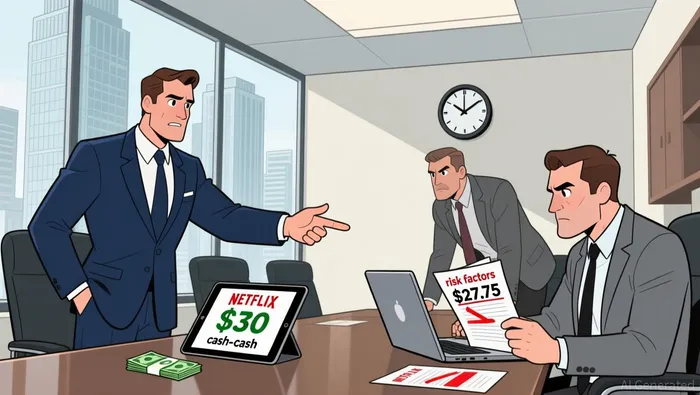
The financial math for WBD shareholders is now a direct comparison between two starkly different offers. Paramount's bid is a clean $30-per-share cash offer. Netflix's deal, by contrast, is a $27.75-per-share cash-and-stock transaction. On paper, Paramount's offer is $2.25 per share higher. But the Netflix package includes a significant additional component: $4.501 in Netflix stock per WBD share. This injects future value and regulatory complexity into the equation, making the total package's worth dependent on Netflix's stock performance and the uncertain timeline for closing.
The core of Paramount's lawsuit is an attempt to discredit this future value. It has argued that the value of the cable spinoff central to the Netflix deal was effectively worthless. If successful, this would directly undermine the stock portion of the Netflix offer, potentially making Paramount's cash bid look even more attractive. The lawsuit's demand for disclosure on the "risk adjustment" to Paramount's own offer is a direct challenge to the valuation assumptions underpinning the Netflix deal.
Market sentiment, however, is skeptical of Paramount's ability to deliver. The stock of Paramount (PSKY) has fallen ~14% over the past 20 days. That sharp decline reflects investor doubt about the viability of the hostile bid, despite the legal pressure. The stock's recent weakness suggests the market is pricing in a high probability of failure, viewing the lawsuit as a tactical maneuver rather than a fundamental shift in the deal's economics. For shareholders, the immediate question is whether the legal uncertainty created by the lawsuit will be enough to tip the scales, or if the market's skepticism about Paramount's execution is the more accurate read.
The Structural Edge: Speed vs. Complexity
The fundamental difference between the two offers now comes down to execution. Paramount's $108.4 billion bid is a straightforward, all-cash deal for the entire company. It bypasses the need for a complex spinoff and regulatory approval of a standalone entity. This simplicity creates a clear structural advantage: a more certain and quicker path to completion.
By contrast, the Netflix deal is a multi-year project. Both companies expect it to close in 12-18 months, a timeline that hinges entirely on a protracted and uncertain multi-jurisdictional regulatory clearance process. This regulatory hurdle is a major vulnerability. The Netflix transaction requires approval from competition authorities in multiple countries, a process that can be unpredictable and easily delayed. The complexity is further compounded by the deal's structure, which includes a mix of cash and stock and the future value of the spun-off Global Networks business.
Paramount's offer, in theory, avoids this entire regulatory maze. It doesn't require the separation of Global Networks, sidestepping the need for antitrust clearance of that standalone, overleveraged entity. This is a key part of Paramount's argument: it provides shareholders with a transaction that is not only superior in value but also less exposed to the delays and potential rejection that can derail a complex merger. The lawsuit's push for disclosure on the "risk adjustment" to Paramount's offer is, in part, a way to highlight the uncertainty inherent in the Netflix timeline.
The bottom line is a trade-off between immediate certainty and future potential. Paramount's cash offer is a known quantity with a faster, simpler path. Netflix's deal promises a larger total package but delivers it through a longer, riskier regulatory gauntlet. For shareholders, the lawsuit may be trying to force a choice, but the structural edge in execution clearly favors the simpler, all-cash bid.
Catalysts and Risks: What to Watch
The immediate test for Paramount's legal pressure is a Delaware Chancery Court ruling. The lawsuit demands that WBD disclose the financial basis for its valuation of the Netflix deal and its "risk adjustment" to Paramount's offer. A court order forcing this disclosure would be a significant win for Paramount, potentially creating a new wave of shareholder questioning. It would force WBD to justify its board's decision to reject a higher cash bid, directly challenging the narrative that the Netflix deal is superior.
Simultaneously, watch for the formal proposal of Paramount's competing slate of directors at WBD's next annual meeting. This move, announced alongside the lawsuit, is designed to test the board's unity and force a direct vote on leadership. If Paramount's slate gains traction, it could pressure the current board to reconsider its stance. The board's response will be a key indicator of whether the legal and proxy campaign is creating real internal friction or is being dismissed as a distraction.
The primary risk for Paramount is that the lawsuit fails to change the board's calculus. WBD has already stated its board "unanimously concluded" the Netflix deal is superior. If the court rules against disclosure or if the board maintains its position, the legal pressure may prove ineffective. This would allow the Netflix transaction to proceed on its 12-18 month timeline, with its regulatory hurdles intact. The market's recent skepticism, reflected in Paramount's stock decline, suggests many investors see this as the most likely outcome.
The setup now hinges on two near-term events: a court decision on disclosure and the formal director vote. If either creates significant uncertainty, it could force a re-evaluation. But if the board stands firm, the path to closing the Netflix deal remains on schedule, and Paramount's legal gambit may be seen as a costly distraction.





Comentarios
Aún no hay comentarios