
Paramount's $30 Bid: The Tactical Setup for a Hostile Takeover
The tactical setup has just sharpened. Paramount's aggressive move from a tender offer to a full-blown proxy fight and lawsuit is the specific catalyst that creates a potential mispricing if WBD's board caves. This isn't just noise; it's a calculated escalation designed to force a negotiation.
Paramount filed suit in Delaware Chancery Court and announced it will nominate directors for election at the WBDWBD-- 2026 Annual Meeting. This dual-pronged attack aims to control the shareholder vote on the NetflixNFLX-- deal. The lawsuit's core demand is straightforward: disclosure on how WBD valued the Netflix transaction and its own 'stub' equity (Global Networks). Paramount also notified WBD shareholders it intends to launch a proxy fight. The trigger for this escalation was WBD's board rejection of Paramount's amended offer, which included a $40 billion in equity personally guaranteed by Oracle's co-founder Larry Ellison.
This creates a clear, time-bound pressure point. The "advance notice" window for WBD's 2026 annual meeting opens in three weeks, and Paramount has committed to nominating a slate of directors who would, in accordance with their fiduciary duties, exercise WBD's right under the Netflix Agreement to engage on Paramount's offer. Paramount will nominate a slate of directors who, in accordance with their fiduciary duties, will exercise WBD's right under the Netflix Agreement to engage on Paramount's offer. The board's rejection of the Ellison-backed bid, calling it "inadequate" and citing debt risk, only fuels Paramount's narrative that the board is obstructing shareholder choice. Warner Bros.WBD-- Discovery's board had on Wednesday rejected Paramount's amended offer.
The bottom line for investors is a forced confrontation. Paramount's lawsuit seeks to compel disclosure, while its proxy fight aims to replace directors who may be more receptive to a deal. If WBD's board continues to reject Paramount's superior offer, the shareholder vote becomes the battleground. The tactical opportunity lies in whether the board, facing this direct challenge and potential loss of control, will ultimately cave to the pressure and engage.
The Valuation Battlefield: $30 vs. the Stub
The core of this takeover fight is a stark clash over valuation. Paramount's $108.4 billion bid hinges on a simple, aggressive claim: the value of Warner Bros. Discovery's cable networks-its "stub" equity-is effectively zero. Paramount reiterated that its $108.4 billion bid was superior to rival Netflix on Thursday, adding that the value of the cable spinoff central to the Netflix offer is effectively worthless. By dismissing this asset, Paramount justifies its $30 per share price for the entire company, arguing it captures the value of the studios and streaming assets alone.
WBD's board pushes back on that math, calling Paramount's offer "inadequate" and pointing to a major structural flaw. The board said Paramount's offer hinges on "an extraordinary amount of debt financing" that heightens the risk of closing. The board's counter-argument is that Paramount's plan, which includes a $40 billion in equity personally guaranteed by Oracle's co-founder Larry Ellison, is too risky for WBD shareholders. This debt-heavy structure creates a clear downside if the deal fails, exposing shareholders to significant costs and uncertainty.
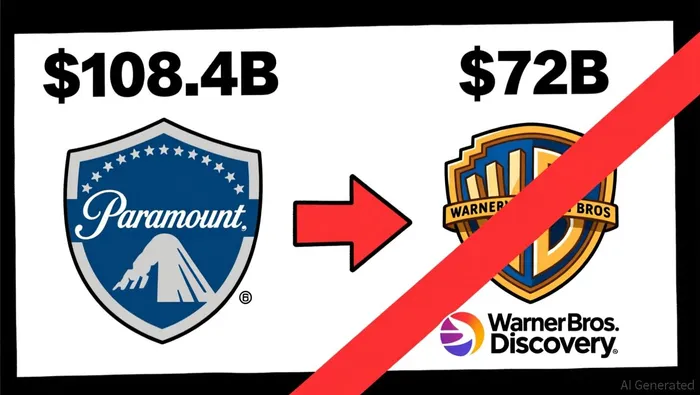
The competing Netflix deal provides the benchmark for comparison. It values the entire company at $72 billion, a lower total but a different asset mix. Netflix's deal requires no equity financing and is backed by $59 billion in debt from banks. This clean, bank-backed structure avoids the perceived risk of Paramount's leveraged model. Yet, Netflix is paying for the studios and streaming assets, not the cable networks, which Paramount deems worthless.
The tactical setup here is clear. Paramount is betting that the market will agree with its valuation of the stub as a liability, not an asset. WBD's board is betting that the financing risk and deal uncertainty Paramount's plan introduces outweigh the higher per-share price. The immediate risk/reward for a WBD shareholder is a choice between a higher price with higher execution risk (Paramount) or a lower price with a cleaner, bank-backed path (Netflix). The proxy fight and lawsuit are the tools to force that choice.
Catalysts and Execution Risks
The immediate path to a Paramount deal runs through a shareholder vote. The proxy fight's success is now the central test. Paramount has committed to nominating a slate of directors for the 2026 Annual Meeting, with the "advance notice" window opening in three weeks. Their plan is for these new directors to exercise WBD's right under the Netflix Agreement to engage on Paramount's offer. This is a high-stakes gamble. The board has not engaged with Paramount and is sticking with the Netflix deal, calling the $30 bid "inadequate." The tactical setup hinges on Paramount winning enough shareholder support to replace enough directors to force a negotiation.
Regulatory scrutiny adds a major wildcard. President Trump has signaled potential involvement, posting an article last month titled "Stop the Netflix Cultural Takeover." While this is a political statement, not a binding action, it introduces a layer of uncertainty that could delay or complicate the Netflix deal. This creates a tactical opening for Paramount, as any regulatory headwind against Netflix could make its own $30 per share offer look more attractive by comparison. However, it also means the timeline for a resolution is less predictable.
The primary risk to the entire setup is a failed deal. If Paramount loses the proxy fight or fails to secure shareholder approval for a new transaction, it walks away from a $108.4 billion bid that required significant resources to prepare and launch. The board has already stated that Paramount's offer "remains inadequate" and cited the exposure of WBD shareholders to "significant risks and costs in the event of deal failure." That risk is now squarely on Paramount's shoulders. The company would be left with no control over WBD's future and the substantial costs of its aggressive campaign, while WBD's board retains the Netflix deal on its terms. For now, the board's refusal to negotiate means the risk of failure is the default outcome unless the shareholder vote shifts.





Comentarios
Aún no hay comentarios