
Paraguay's Monetary Policy Stability and Investment Potential
Inflation Control: A Pillar of Stability
Paraguay's annual inflation rate has shown a steady decline, dropping to 4.1% in October 2025 from 4.3% in September, signaling easing inflationary pressures. While sectors like transport have experienced deflation (-4.9% year-on-year), others such as food and non-alcoholic beverages continue to see robust price growth 10.3%. This divergence underscores the BCP's challenge in maintaining equilibrium. To address this, the Central Monetary Council (CMC) has held the reference rate at 6.0% since 2023, a level designed to anchor inflation expectations around the 3.5% target. This consistency has been critical in preventing a resurgence of hyperinflationary risks that once plagued the region.
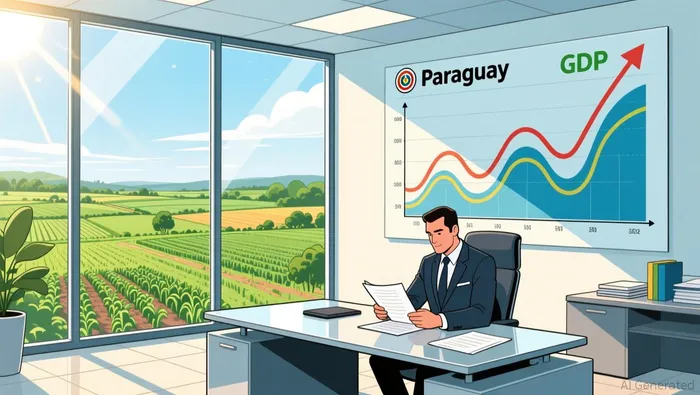
Economic Expansion: A Gradual but Steady Climb
Paraguay's GDP growth has followed a similarly measured trajectory. After a remarkable rebound of 4.71% in 2023-a stark contrast to the 0.18% contraction in 2022-the economy grew by 4.25% in 2024 (https://www.macrotrends.net/global-metrics/countries/pry/paraguay/gdp-growth-rate). Projections suggest a slight moderation to 3.30% in 2025, reflecting both domestic and global headwinds. However, these figures mask a broader narrative of structural resilience. The BCP's March 2025 monetary policy report notes improved global economic growth expectations, which have bolstered confidence in Paraguay's export-oriented sectors, particularly agriculture and manufacturing.
Monetary Policy Effectiveness: Beyond Interest Rates
While the reference rate remains a cornerstone of Paraguay's monetary strategy, the BCP has also prioritized exchange rate management and capital market development. From 2023 to 2025, the bank overhauled regulations governing public debt securities, expanded foreign exchange access for investors, and modernized infrastructure such as the Caja de Valores de Paraguay (CAVAPY) and the Asunción Stock Exchange. These reforms have not only attracted foreign investment-foreign holdings in local currency government bonds surged from 1.7% in 2023 to 5.0% in 2024-but also aligned Paraguay with international custody standards, enhancing transparency and liquidity.
Investment Potential: A Calculated Case for Optimism
For investors, Paraguay's approach to monetary policy offers a dual advantage. First, the BCP's inflation-targeting framework provides a buffer against currency depreciation and capital flight, which are perennial risks in emerging markets. Second, the country's capital market reforms have created a more hospitable environment for foreign participation, particularly in government bonds. These instruments now offer competitive yields relative to regional peers, supported by the BCP's commitment to maintaining fiscal discipline.
However, challenges remain. The projected slowdown in GDP growth to 3.30% by 2025, while still outpacing many Latin American economies, highlights the need for continued diversification of the economy. Additionally, while the BCP's reforms have improved market efficiency, the lack of detailed data on tools like reserve requirements or open market operations suggests a reliance on indirect measures, which may limit flexibility in a crisis.
Conclusion
Paraguay's monetary policy stability, characterized by a consistent reference rate, proactive exchange rate management, and capital market modernization, positions the country as a relative safe haven in a volatile region. For long-term investors, the combination of controlled inflation, steady GDP growth, and structural reforms offers a compelling case for inclusion in emerging market portfolios. Yet, as with any investment, vigilance is required. The BCP's ability to adapt its toolkit-particularly in addressing gaps in traditional monetary instruments-will be critical in sustaining this trajectory.







Comentarios
Aún no hay comentarios