
The Paradox of Potential: Political Instability and Investment Risks in East Africa's Emerging Markets
Political instability and human rights crises in East Africa have long cast a shadow over the region's economic potential. By 2025, the cumulative effects of conflict, authoritarian repression, and institutional failure have created a paradox: while East Africa's demographic dividend and natural resources remain tantalizing to investors, the risks of capital flight and market volatility are increasingly acute. This article examines how repression and instability in countries like Sudan, the Democratic Republic of Congo (DRC), and Ethiopia are reshaping investor behavior and the long-term viability of emerging markets in the region.
The Cost of Conflict and Repression
In Sudan, the protracted war between the Sudanese Armed Forces (SAF) and the Rapid Support Forces (RSF) has displaced 12 million people and triggered famine in five regions. Human Rights Watch has documented war crimes, including sexual violence and obstruction of humanitarian aid. Despite AU-mandated roadmaps for civilian protection, the lack of enforcement has left investors in a precarious position. Agriculture, a cornerstone of Sudan's economy, now faces collapse due to land degradation and displacement of labor. Meanwhile, Ethiopia's Tigray conflict, though paused under a 2022 AU-mediated agreement, has not led to accountability for atrocities, and Eritrean forces continue to destabilize Western Tigray. The Ethiopian government's suppression of dissent, including the premature termination of the AU's Tigray Commission of Inquiry, has further eroded trust.
Kenya, often seen as a regional economic beacon, is not immune. The 2024 Finance Bill protests, which paralyzed business activity and led to business closures, underscored how political tensions can disrupt markets. Similarly, Tanzania's looming October 2025 elections and currency depreciation have created uncertainty for investors in its mining and agriculture sectors.
Sectoral Resilience and FDI Flows
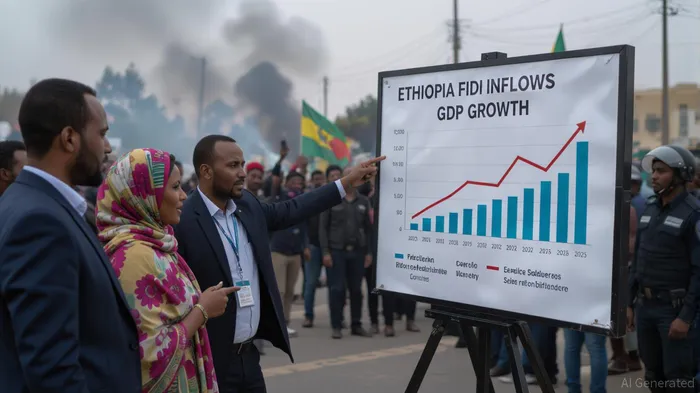
Despite these challenges, some countries have demonstrated surprising resilience. Ethiopia, for instance, recorded a 28.1% year-on-year increase in FDI inflows to $4.1 billion in 2024, driven by reforms in banking and raw coffee exports. However, this growth is fragile: the country's public debt-to-GDP ratio now exceeds 60%, and the upcoming election could trigger currency instability. Kenya's GDP growth is projected at 5.3% in 2025, supported by agricultural output and infrastructure projects, but its reliance on dollar-denominated debt makes it vulnerable to shilling depreciation.
In the DRC, the M23 conflict has devastated infrastructure and disrupted mining operations, a sector critical to the country's economy. Yet, with 24% of the population under 14, the DRC's demographic potential remains a lure for long-term investors, albeit one contingent on regional peace efforts.
The Role of Currency Depreciation and Inflation
Currency repression has had mixed effects. In Ethiopia, the birr's 2024 depreciation (from 57.7 to 128.1 per dollar) initially stabilized foreign exchange reserves but spiked inflation to 20.8%. While temporary subsidies on essentials have eased pressure, the risk of second-round inflation persists. Kenya's shilling, which appreciated in 2024 due to Eurobond issuance, is now projected to depreciate again in 2025, compounding debt servicing costs. Tanzania's shilling, meanwhile, saw its steepest decline since 2016, pushing inflation to 3.3% in March 2025.
Investment Advice: Navigating the Paradox
For investors, the key lies in balancing risk and reward. Here are three strategic considerations:
- Sectoral Diversification: Prioritize sectors with structural resilience, such as agriculture (Kenya, Ethiopia) and renewable energy (Tanzania). Ethiopia's liberalization of raw coffee exports and Kenya's digital agriculture platforms offer long-term upside.
- Political Hedging: Avoid overexposure to single countries. For example, while Ethiopia's FDI reforms are promising, pairing investments with regional players like Kenya or Rwanda (which has maintained relative stability) can mitigate risk.
- Currency Management: Hedge against currency depreciation by investing in dollar-denominated assets or instruments like inflation-linked bonds. In Ethiopia, the Ethiopian Securities Exchange's nascent growth could provide a platform for local capital raising, though liquidity remains a concern.
Conclusion
East Africa's emerging markets remain a study in contrasts. Political instability and repression have undoubtedly curtailed growth, yet pockets of resilience—driven by demographic trends, resource wealth, and policy reforms—persist. For investors, the path forward requires not only a nuanced understanding of geopolitical risks but also a willingness to engage with long-term structural opportunities. As the AU's inability to enforce civilian protection underscores, the region's future hinges on both local governance and international diplomacy. For now, patience and diversification will be the investor's best allies.







Comentarios
Aún no hay comentarios