
The Paradox of Dogecoin's Futures Surge Amid Range-Bound Price Action
The cryptocurrency market has long been a theater of contradictions, but DogecoinDOGE-- (DOGE) in late 2025 exemplifies a particularly striking paradox: a dramatic surge in futures market activity coexisting with a price action that remains stubbornly range-bound. This phenomenon, driven by a collision of retail fervor, institutional calculus, and end-of-year risk management strategies, reveals the intricate interplay of market psychology and speculative behavior in crypto trading.
Market Psychology: Retail Hype vs. Institutional Prudence
Dogecoin's futures market has seen extraordinary volatility in late 2025. According to CoinGlass data, futures volume spiked by 5,590.40% in a single 24-hour period, while open interest (OI) fluctuated between $1.5 billion and $1.67 billion, reflecting both bullish optimism and bearish deleveraging. This surge, however, has not translated into sustained price gains. Instead, DOGE's price has oscillated within a narrow range, testing key support levels like $0.145 amid mixed technical indicators such as a bearish RSI and MACD.
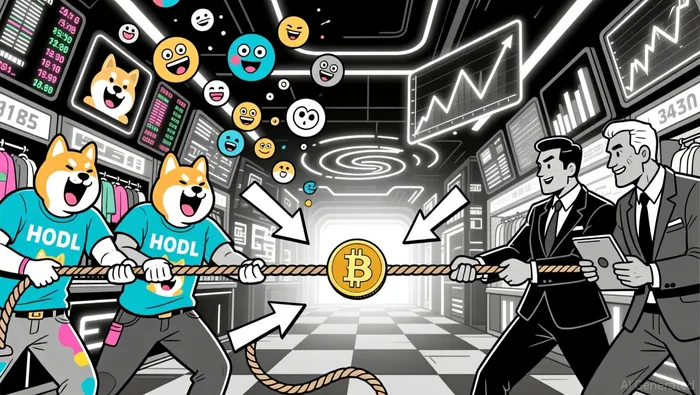
The disconnect between futures activity and spot price can be attributed to divergent market psychology. Retail traders, often swayed by social media sentiment and meme-driven narratives, have flocked to long positions, pushing funding rates into positive territory (e.g., 0.0076% on November 19). Conversely, institutional actors have adopted a more measured approach. CleanCore Solutions, for instance, has accumulated over 710 million DOGE tokens, valued at $180+ million, signaling long-term confidence despite short-term volatility. This duality-retail speculation versus institutional accumulation-creates a tug-of-war that keeps the price range-bound while inflating derivatives activity.
Risk Management: Tax-Loss Harvesting and Hedging Strategies
End-of-year 2025 has also amplified strategic trading behaviors. With DOGE down 57.13% year-to-date, many investors are leveraging tax-loss harvesting to offset gains in other assets. The IRS's lack of a wash-sale rule for crypto allows traders to sell DOGEDOGE-- at a loss and repurchase it immediately, a tactic particularly appealing in a bearish environment. Meanwhile, hedging via futures contracts has become a priority for institutional players. The OI-weighted funding rate's shift from -0.0083% to +0.0076% in a single day underscores the derivatives market's role in balancing risk, as traders adjust positions ahead of year-end liquidity crunches.
For long-term holders, tax efficiency is critical. Selling DOGE after holding for over a year qualifies for long-term capital gains treatment (0-20%), compared to short-term rates of 10-37%. This has incentivized strategic rebalancing, with investors liquidating underperforming positions to reallocate capital to stronger assets. Such behavior further contributes to the paradox: while spot prices stagnate, futures markets and tax-driven trading amplify activity.
The Paradox in Context: A Market in Transition
The broader crypto ecosystem adds nuance to this paradox. Dogecoin's price remains tightly correlated with BitcoinBTC--, often amplifying its movements by 2-3x. As Bitcoin faces macroeconomic headwinds-including Federal Reserve policy uncertainty-DOGE's derivatives market has become a barometer of speculative sentiment. Institutional adoption, however, introduces a stabilizing force. CleanCore's accumulation and similar efforts suggest that while retail traders may drive short-term volatility, institutional confidence could anchor DOGE's long-term value.
Yet risks persist. A breakdown below $0.145 could trigger extended bearish momentum, while a failure to break above $0.150 may prolong range-bound conditions. For traders, this environment demands a dual focus: exploiting short-term derivatives opportunities while hedging against macroeconomic shocks.
Conclusion: Navigating the Paradox
Dogecoin's late-2025 paradox-surging futures activity amid stagnant spot prices-highlights the crypto market's unique dynamics. Retail psychology, institutional strategy, and end-of-year tax planning converge to create a landscape where volume and sentiment often outpace price action. For investors, understanding this interplay is key to navigating the volatility. As 2025 draws to a close, the question remains: will institutional confidence and macroeconomic clarity resolve the paradox, or will the tug-of-war between speculation and stability persist into 2026?






Comentarios
Aún no hay comentarios