
The Paradox of Censorship-Resistant Finance: How Decentralization Enables and Protects Criminal Activity
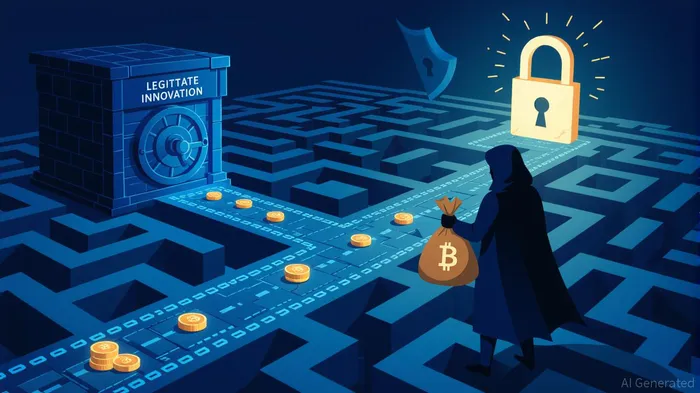
The rise of censorship-resistant financial systems—decentralized finance (DeFi), privacy coins, and Ethereum-based protocols—has created a paradox: the same technologies designed to empower individuals and resist authoritarian control are increasingly weaponized for illicit activity. This duality has forced regulators, investors, and developers into a high-stakes balancing act, where innovation clashes with enforcement, and financial freedom collides with systemic risk.
The Dual-Use Dilemma
Censorship-resistant systems thrive on decentralization, anonymity, and open access. These traits, while foundational to financial sovereignty, also create fertile ground for criminal exploitation. For instance, privacy coins like Monero (XMR) and Zcash have seen a 17% annual increase in global transactions, with 11.4% of all crypto activity now involving such assets [1]. Monero alone dominates 58% of the privacy coin market, valued at $4.3 billion, as its untraceable transactions become a preferred tool for money laundering and ransomware operations [1].
Meanwhile, DeFi protocols, despite their noncustodial nature, remain vulnerable to exploitation. The Bybit exploit in February 2025, which resulted in $1.5 billion in losses, exemplifies how smart contract vulnerabilities can be weaponized by malicious actors [3]. EthereumETH--, the backbone of DeFi, has been targeted in 98 incidents since 2011, totaling $2 billion in losses, underscoring its critical role in both innovation and risk [3].
Regulatory Responses: Precision Over Overreach
The U.S. Department of Justice (DOJ) has recalibrated its approach to address these challenges without stifling innovation. A 2025 memo from Deputy Attorney General Todd Blanche emphasized a narrow focus on "direct individual harm," such as crypto fraud and smart contract exploits, rather than prosecuting developers for writing code without malicious intent [1]. This marks a departure from earlier broad interpretations of unlicensed money transmission laws, which risked criminalizing legitimate DeFi projects.
However, the DOJ's hands-off stance on code is tempered by strict enforcement of willful violations. For example, Section 1960(b)(1)(C) charges—requiring proof of knowingly transmitting criminal funds—remain a priority, particularly for privacy coins. Matthew R. Galeotti, acting assistant attorney general, clarified that developers of truly decentralized protocols are not automatically liable, but they must proactively address illicit finance risks where control exists [1].
Globally, regulatory pressure has intensified. By early 2025, 97 countries had implemented stricter compliance frameworks for privacy coins, a 34% increase from 2024 [1]. Exchanges like Binance have delisted XMR, ZEC, and DASH in key markets, while the Financial Action Task Force (FATF) expanded its Travel Rule to include privacy coins, impacting 57% of global transactions [1]. These measures reflect a growing consensus that anonymity must be balanced with accountability.
Investment Risks: Navigating a Shifting Landscape
For investors, the paradox of censorship-resistant finance introduces three critical risks:
Regulatory Uncertainty: The U.S. regulatory landscape is in flux. President Trump's appointments, including pro-crypto figures like Jonathan Gould (Comptroller of the Currency) and Brian Quintenz (CFTC Chair), signal a potential easing of federal oversight. However, the shutdown of the Financial Conduct Protection Bureau (CFPB) has created a vacuum in consumer protection enforcement, shifting responsibility to state regulators and private compliance teams [1]. This fragmented approach increases operational risk for projects operating across jurisdictions.
Technological Vulnerabilities: The Crystal Intelligence 2025 report highlights a troubling trend: fewer but more sophisticated cyberattacks, with losses averaging $1.5 billion per incident [3]. Ethereum's dominance in DeFi means that exploits targeting its infrastructure could have cascading effects on the broader ecosystem. Investors must weigh the technical robustness of protocols against their exposure to zero-day vulnerabilities.
Market Volatility: Privacy coins have outperformed other crypto sectors in 2025, driven by macroeconomic factors like capital controls and geopolitical instability [2]. However, their association with illicit activity makes them a regulatory target. For example, South Korea's new privacy regulations, which allow limited private transactions for retail payments, have spurred a 41% increase in Monero-based transactions—both legitimate and criminal [1]. This duality creates a volatile market where demand is driven by both innovation and illicit use.
The Future of Censorship-Resistant Finance
The paradox of censorship-resistant finance is unlikely to resolve itself. Instead, it will evolve as regulators and developers adapt to new threats. Projects like Ethereum's FOCIL (EIP-7805), which aims to prevent transaction censorship, highlight the technical and philosophical commitment to decentralization [3]. Yet, these advancements also raise questions about how to reconcile open access with anti-money laundering (AML) requirements.
For investors, the key lies in hedging against regulatory and technological risks while capitalizing on the long-term potential of decentralized systems. This includes:
- Prioritizing projects with robust governance and proactive AML measures (e.g., Zcash's optional transparency features).
- Diversifying exposure to avoid overreliance on privacy coins or high-risk DeFi protocols.
- Monitoring geopolitical shifts, such as the impact of Trump-era deregulation on cross-border compliance.
Conclusion
The paradox of censorship-resistant finance is a double-edged sword: it empowers individuals to bypass oppressive systems while enabling criminal actors to exploit the same tools. As the DOJ and global regulators refine their approaches, the focus will remain on intent, harm, and proportionality. For investors, the challenge is to navigate this complex landscape by balancing innovation with caution—a task that demands both technical expertise and a nuanced understanding of regulatory dynamics.







Comentarios
Aún no hay comentarios