
The Paradox of AVAX and ZXP: Why Top Losers Turn Into Top Gainers
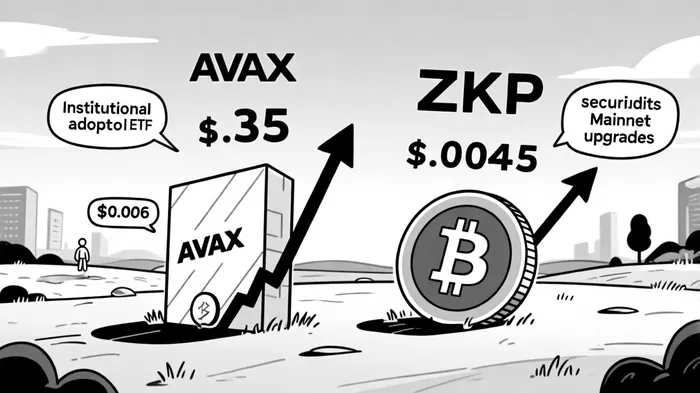
The crypto market is a theater of paradoxes. Tokens that once seemed doomed can stage roaring comebacks, while darlings of the hype cycle crumble under their own weight. Two recent case studies—Avalanche (AVAX) and Panther Protocol (ZKP)—exemplify this phenomenon. Both faced correction-driven declines in early 2025, yet their paths to recovery diverged sharply. AVAXAVAX-- turned its bearish phase into a bullish breakout, while ZKP remains in a protracted slump. The key to understanding these divergences lies in dissecting market sentiment, structural catalysts, and the psychology of rebounds.
AVAX: From Consolidation to Breakout
Avalanche's journey in 2025 reads like a textbook example of a correction-driven rebound. By April, AVAX had been consolidating around $20, a psychological level that traders and analysts fixated on[1]. The token's volatility—swinging between $19.25 and $20.51—reflected uncertainty about its long-term value proposition[1]. However, this period of indecision set the stage for a breakout.
The catalyst? A perfect storm of institutional adoption and macroeconomic tailwinds. By September, Avalanche's Total Value Locked (TVL) had doubled to $2.1 billion, driven by integrations with EthenaENA-- Labs and PendlePENDLE-- Finance[2]. SkyBridge Capital's $300 million migration to AvalancheAVAX-- and VanEck's PurposeBuilt fund further signaled institutional confidence[2]. Technically, AVAX broke above key resistance levels, trading at $34 by September 19, 2025[2]. Analysts now project a rally to $42.91, assuming bullish momentum continues[2].
Market sentiment played a critical role. While 85% of CoinMarketCap users remained bullish on AVAX in April[1], the broader market's fear of a macroeconomic downturn initially capped its upside. But as Grayscale's conversion of its Avalanche Trust into a spot ETF gained traction, optimismOP-- surged[2]. The paradox here is clear: AVAX's correction in early 2025 wasn't a failure but a necessary phase to clear out speculative noise and attract capital with a longer-term vision.
ZKP: A Bearish Dilemma
Panther Protocol (ZKP) tells a different story. As of September 2025, ZKP had plummeted 19.85% over 30 days, trading at $0.006116[3]. The Fear & Greed Index for ZKP stood at 44 (Fear), and technical indicators like the 14-day RSI (29.67) reinforced a bearish outlook[3]. Short-term forecasts predict a drop to $0.004573 by October 25, a 25.08% decline[3].
Yet ZKP isn't without catalysts. The protocol launched its Limited Mainnet Beta on Polygon in March 2025, enabling privacy-preserving DeFi swaps and partnerships with Eurobit and PureFi[4]. A 171-day security audit by Veridise and open-sourcing of its codebase under LGPL3.0/MIT licenses further bolstered credibility[4]. Despite these developments, ZKP's price remains anchored by short-term pessimism.
The disconnect between fundamentals and price highlights a common pitfall in crypto: the lag between innovation and market recognition. ZKP's ecosystem growth—38,133 Twitter followers and 8,425 Discord members—suggests a vibrant community[5]. However, the broader market's bearish sentiment, exacerbated by declining trading volumes and macroeconomic headwinds, has overshadowed these positives[3]. For ZKP to stage a rebound, it must first navigate this short-term bearish phase and prove its utility in a crowded privacy-preserving DeFi space.
Historically, when ZKP's RSI-14 drops below 30, the market has shown a tendency to mean-revert. A backtest from 2022 to 2025 reveals that while the first week often sees a -3% drawdown, the subsequent four weeks typically recover with an average return of +14.9% by day 30, with a 75.8% win rate[6]. This suggests that while the short-term outlook is bearish, there may be opportunities for recovery if the RSI reaches oversold levels again.
The Psychology of Rebounds
The AVAX and ZKP cases underscore a universal truth: corrections are inevitable, but rebounds depend on aligning structural catalysts with market sentiment. AVAX's success stemmed from its ability to leverage institutional adoption and macroeconomic optimism during a period of consolidation. ZKP, meanwhile, faces the challenge of converting technical progress into price action amid a bearish climate.
A would visually reinforce this dynamic.
Conclusion: The Paradox in Action
The paradox of AVAX and ZKP lies in their contrasting paths to recovery. AVAX turned a correction into a catalyst for growth, while ZKP remains trapped in a bearish narrative. For investors, the lesson is clear: corrections are not verdicts but opportunities to reassess value. The key is to distinguish between temporary setbacks and structural weaknesses. In a market as volatile as crypto, the top losers of today may well be the top gainers of tomorrow—provided they have the fundamentals to justify it.






Comentarios
Aún no hay comentarios