
Papa John's Strategic Resilience and Value Creation: Operational Strength and Brand Differentiation in a Post-M&A Landscape
Strategic Resilience Through Operational Overhaul and Franchisee Partnerships
Papa John's has navigated a complex post-M&A landscape by leveraging strategic refranchising, supply chain optimizations, and targeted development incentives to bolster operational resilience. The 2021 refranchising of 90 units in Texas to Sun Holdings-a deal valued at $106 million in fiscal 2021 revenue-marked a pivotal shift toward empowering high-capacity franchisees to drive growth, according to Papa John's press release. By 2025, the company had secured a commitment from Sun Holdings to open 100 new stores by 2029, underscoring confidence in the brand's scalability, per the Sun Holdings agreement.
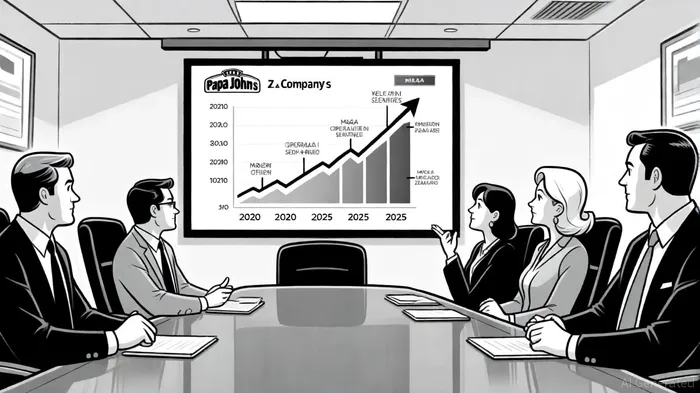
Operational improvements post-2021 further solidified Papa John's resilience. The company reduced franchisees' required marketing spend from 8% to 6%, retaining 200 basis points of margin at the restaurant level, as reported by Restaurant Dive. Additionally, a revised U.S. commissary model increased fixed operating margins from 4% to 8% by 2027, supported by volume-based rebates to offset costs. These adjustments, coupled with logistics and inventory optimizations, have enhanced profitability despite macroeconomic headwinds. For instance, Q2 2025 results showed 1% North America comparable sales growth and 4% international gains, though net income dipped to $10 million due to elevated administrative expenses.
Brand Differentiation: Rebuilding Consumer Trust and Digital Engagement
Papa John's has prioritized brand differentiation through culturally resonant campaigns and digital innovation. The 2024 launch of the "Better Get You Some" platform, developed in collaboration with The Martin Agency, repositioned the brand around sensory-driven storytelling and localized engagement, according to QSR Magazine. This initiative, featuring high-profile partnerships (e.g., NCAA March Madness) and community-focused programs like "A Better Way to BOGO," has driven a 1% increase in North America comparable sales in 2023.
Digital transformation has also been central to value creation. The company enhanced its app experience with first-party data-driven promotions and loyalty program upgrades, while waiving national marketing fund contributions for new franchisees over five years. These efforts align with a $20 million increase in marketing spend and a 20% hike in national marketing fund contributions, aimed at improving return on ad spend.
The 2025 Takeover Bid: A Catalyst for Long-Term Value?
The $2 billion bid by Apollo Global Management and Irth Capital Management-valuing Papa John's at $60.75 per share-has introduced a new dimension to its strategic trajectory, as reported by RetailWire. This all-cash offer, if finalized, could enable operational overhauls such as menu simplification, supply chain scale, and loyalty program enhancements, which are often more agile in private ownership. Apollo's experience with brands like Qdoba and Chuck E. Cheese, combined with Irth's track record in turnarounds (e.g., Bojangles), positions the duo to address long-standing challenges like labor costs and franchisee profitability.
However, success hinges on franchisee buy-in and financing structure. Franchisees control store-level operations, and any changes to royalty arrangements or development incentives could impact adoption rates. The bid also faces regulatory scrutiny, though the franchise-based model minimizes antitrust risks.
Conclusion: A Balancing Act of Growth and Efficiency
Papa John's strategic resilience lies in its ability to balance operational efficiency with brand innovation. While the 2025 takeover speculation introduces uncertainty, the company's foundational improvements-ranging from supply chain optimizations to localized marketing-position it to capitalize on long-term growth opportunities. For investors, the key will be monitoring how these initiatives evolve post-deal, particularly in aligning franchisee interests with shareholder value.







Comentarios
Aún no hay comentarios