
Catch pre-market movers with AI signals.
PANW vs. FTNT: Which Cybersecurity Stock Should You Buy Right Now?
Palo Alto Networks PANW and Fortinet FTNT are well-known players in the cybersecurity domain. While PANWPANW-- focuses broadly on next-generation firewalls, cloud security and AI-driven threat detection, FortinetFTNT-- combines a variety of hardware and cloud-based security solutions.
Both PANW and FTNTFTNT-- are riding the key industry trends, driven by the mounting incidents of credential theft, remote desktop protocol breaches and social engineering-based strikes by malicious actors. However, from an investment point of view, one stock offers a more favorable outlook than the other right now. Let’s break down their fundamentals, growth prospects, market challenges and valuation to determine which stock offers a more compelling investment case.
The Case for PANW Stock
Palo Alto Networks remains a cybersecurity leader, offering solutions for network security, cloud security and endpoint solutions for customers who need full enterprise security support. Its next-generation firewalls and advanced threat detection technologies are widely recognized and adopted globally.
Palo Alto Networks’ wide range of innovative products, strong customer base and growing opportunities in areas like Zero Trust, Secure Access Service Edge (SASE) and private 5G security continue to support its long-term growth potential. For instance, the company’s SASE bookings grew 40% in fiscal 2026, supported by growth across Access, SD-WAN and secure browser. PANW displaced legacy vendors in nearly 100 customer accounts, representing more than $400 million in total contract value. The displacement volume was nearly double that of the prior year.
PANW's SASE business is benefiting from strong customer demand for cloud-delivered networking and security solutions as enterprises continue to support hybrid work environments and secure access to cloud applications. The company integrates SASE with its firewall, SD-WAN and other security products, allowing existing customers to add SASE without bringing in another vendor. Management said this makes platform standardization a simpler choice for customers. In the fourth quarter of fiscal 2026, a global telecom leader signed a $126 million agreement to expand its next-generation firewall footprint while replacing legacy proxy providers with Prisma Access for SASE.
However, PANW’s non-GAAP gross margin fell 100 basis points year over year to 74.8% in the fourth quarter of fiscal 2026, while non-GAAP gross margin for fiscal 2026 declined 60 basis points to 75.8%. The decline was mainly due to the growing mix of SaaS offerings, which are still scaling toward mature margin levels. Management expects cloud hosting costs to grow faster than revenues in fiscal 2027, which could weigh on gross-margin expansion.
Further, Palo Alto NetworksPANW-- expects higher commodity costs, particularly for memory and storage, to persist in its hardware business. While strong demand for its Gen 5 firewall appliances remains positive, higher component costs could weigh on hardware profitability.
The Case for FTNT Stock
Fortinet is seeing strong demand for its SASE Firewall as enterprises upgrade network security to support AI workloads, cloud environments and distributed workforces. In the second quarter of 2026, Fortinet’s SASE Firewall business grew 34% to more than $2 billion. Unified SASE billings increased 35%, while FortiSASE billings grew more than 100% year over year. FortiSASE adoption also reached 90% of Fortinet’s large-enterprise installed base.
Fortinet believes its SASE Firewall can address a larger market than cloud-only SASE solutions. The company combines firewall, SASE and hybrid mesh capabilities on its FortiOS platform and supports both cloud and on-premises deployments. Management believes this opportunity could be two to three times larger than the cloud-only SASE market. Demand for sovereign SASE is also increasing as enterprises and service providers look for better data privacy, local processing and performance.
AI is adding another growth driver. As AI applications increase machine-to-machine and data-center traffic, customers need better visibility and control over network traffic. Fortinet said AI is accelerating the convergence of networking and security. The company is also seeing AI data center wins, including an eight-figure deal with a cloud provider offering generative AI infrastructure.
The growth in SASE could also support Fortinet’s financial performance. Product revenues increased 52% year over year in the second quarter of 2026, while service revenues grew 14% year over year. Service billings increased 26% year over year, and management expects service revenue growth to improve in the second half of 2026. New SASE and SD-WAN services can add to Fortinet’s recurring service revenues as customers expand their deployments. With strong SASE demand, AI-driven security needs and growing adoption of sovereign SASE, the SASE Firewall could become an important driver of Fortinet’s product and service revenue growth.
PANW vs. FTNT: Earnings Estimate Trend
The earnings estimate revision trend for the two companies reflects that analysts are turning more bullish toward FTNT.
PANW Earnings Estimate Revision Trend
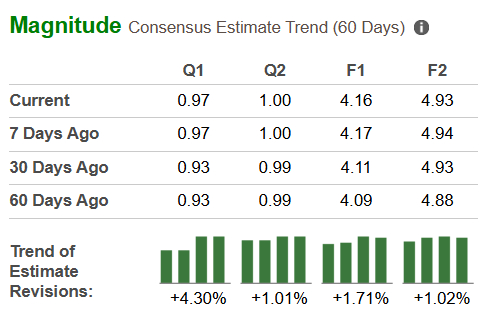
Image Source: Zacks Investment Research
FTNT Earnings Estimate Revision Trend
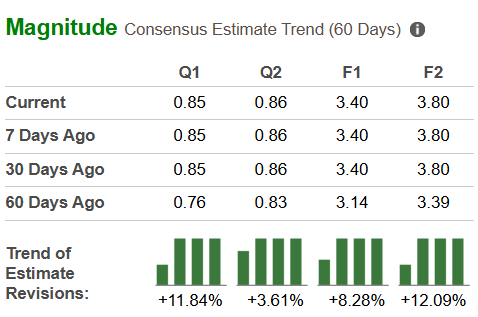
Image Source: Zacks Investment Research
PANW vs. FTNT: Price Performance and Valuation
Year to date, shares of PANW and FTNT have surged 79.5% and 96.5%, respectively.
PANW Vs. FTNT: YTD Price Return Performance
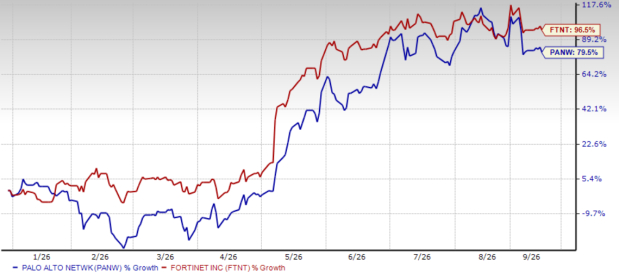
Image Source: Zacks Investment Research
Currently, FTNT is trading at a forward sales multiple of 13.01X, significantly lower than PANW’s forward sales multiple of 18.80X. FTNT’s reasonable valuation makes it more attractive for investors looking for value and stability.
PANW vs. FTNT: Forward 12-Month P/S Ratio
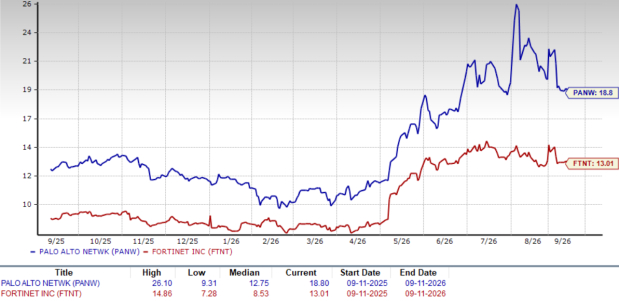
Image Source: Zacks Investment Research
Conclusion: Buy FTNT, Hold PANW Right Now
Both Palo Alto Networks and Fortinet are key players in the cybersecurity space, but their near-term outlooks are quite different. However, PANW continues to face pressure from lower gross margins, while higher cloud hosting and hardware costs could limit margin improvement.
In contrast, Fortinet shows steadier execution, where the company is witnessing strong adoption of FortiSASE, Unified SASE and sovereign SASE. Further, FTNT’s reasonable valuation offers some downside protection as well, making the stock an attractive buy, particularly for investors seeking exposure to cybersecurity growth at a fair price.
Currently, FTNT sports a Zacks Rank #1 (Strong Buy), making the stock a stronger pick over PANW, which has a Zacks Rank #3 (Hold). You can see the complete list of today’s Zacks #1 Rank stocks here.
Zacks' Research Chief Names "Stock Most Likely to Double"
Our team of experts has just released the 5 stocks with the greatest probability of gaining +100% or more in the coming months. Of those 5, Director of Research Sheraz Mian highlights the one stock set to climb highest.
Of course, all our elite picks aren't winners, but this one could far surpass earlier Zacks' Stocks Set to Double like D-Wave Quantum, which shot up +680.1%.
Free: See Our Top Stock And 4 Runners UpWant the latest recommendations from Zacks Investment Research? Today, you can download 7 Best Stocks for the Next 30 Days. Click to get this free report
Fortinet, Inc. (FTNT): Free Stock Analysis Report
Palo Alto Networks, Inc. (PANW): Free Stock Analysis Report
This article originally published on Zacks Investment Research (zacks.com).

Zacks is the leading investment research firm focusing on equities earnings estimates and stock analysis for the individual investor, including stock picks, stock screening, portfolio stock tracker and stock screeners. Copyright 2006-2026 Zacks Equity Research, Inc. editor@zacks.com (Manaing editor) webmaster@zacks.com (Webmaster)






