
From Panic to Opportunity: How BC.DEFI's 2025 Surge Rewrote the Rules of DeFi Investing
The 2025 DeFi Surge: A New Era of Institutional Adoption
By Q3 2025, the crypto market had reached a $4 trillion valuation, with DeFi's TVL climbing to $161 billion-a 40.2% quarter-on-quarter increase, as reported by CoinGecko. EthereumETH-- (ETH) and BitcoinBTC-- (BTC) were the twin engines of this growth. ETHETH-- hit an all-time high of $4,946 in August 2025, while Bitcoin staking TVL ballooned to $5.5 billion, driven by innovations like liquid staking tokens (LSTs) and layer-2 solutions, as detailed in a Mintlayer analysis. Regulatory clarity, including the U.S. GENIUS Act and the Financial Innovation and Technology Act, further legitimized DeFi, attracting institutional capital. For instance, Valour's Bitcoin-staking ETF in Europe offered a 5.65% annual percentage rate (APR), signaling a shift from speculative frenzies to yield-driven strategies, as noted in a CryptoNews article.
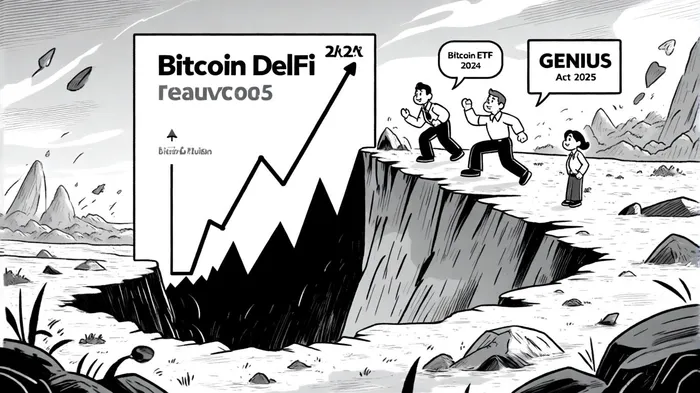
Panic in Late 2024: A Market Correction as a Buying Signal
The late 2024 correction was a textbook example of market psychology. DeFAI, AI agents, and DeSci narratives collapsed by 67%, 86%, and 80% respectively over 90 days, driven by waning enthusiasm for speculative narratives and a shift toward layer-1 blockchains, as reported by Cryptopolitan. For BC.DEFI, this period created a unique inflection point. As Bitcoin's TVL in DeFi protocols surged to $5–6 billion, investors began viewing the dip as a chance to access Bitcoin-driven yield without the technical barriers of traditional staking, according to CoinGecko.
Data from CoinGecko's Q3 2025 report underscores this shift: 24% of institutional investors were already engaged with DeFi protocols, while 50% of non-engaged investors planned to enter within two years. The correction, rather than deterring participation, acted as a liquidity event for value investors. Platforms like EigenLayerEIGEN-- and GMXGMX--, offering APYs of 30–120%, became critical tools for compounding returns during this period, as covered by Cryptopolitan.
Strategic Entry Points: Diversification and Compounding in Action
Value investors capitalized on the panic through disciplined strategies. Dollar-cost averaging (DCA) allowed them to smooth out volatility, while yield farming and liquidity mining on platforms like AaveAAVE-- and JupiterJUP-- generated high APYs, as explained by Cryptopolitan. For example, GMX's GLP pools offered 30–120% APY in late 2024, enabling investors to offset losses from broader market declines.
BC.DEFI's cloud-mining infrastructure further amplified these opportunities. By offering transparent, fixed passive income streams and supporting multiple cryptocurrencies, the platform attracted investors seeking to bypass the complexities of on-chain DeFi, according to CoinGecko. Additionally, the rise of Bitcoin layer-2s like BabylonBABY-- and Core enabled sophisticated use cases-lending, DEXs, and stablecoins-without exposing investors to Ethereum's gas fees, as noted in the Mintlayer analysis.
Regulatory and Technological Catalysts
The 2025 DeFi boom was underpinned by two critical factors: regulatory alignment and technological innovation. The U.S. Strategic Bitcoin Reserve and clearer DeFi guidelines reduced institutional hesitation, while tokenized real-world assets (RWAs) added utility to DeFi protocols, as reported by CryptoNews. For instance, Maple Finance's use of Lightning Bitcoin (LBTC) as collateral demonstrated growing confidence in Bitcoin's liquidity, a trend highlighted by CryptoNews.
Meanwhile, intent-based architecture and automated tools like Intentable's sniping bots optimized entry points during corrections. These platforms allowed investors to execute complex strategies-such as re-staking ETH rewards or leveraging stablecoin arbitrage-with minimal manual intervention, according to Cryptopolitan.
Conclusion: A Quiet Boom in DeFi
The BC.DEFI saga of 2024–2025 exemplifies how market panic can be a prelude to strategic entry. As DeFi shifts from speculative hype to institutional-grade utility, investors who navigated corrections with DCA, yield farming, and regulatory foresight are now reaping the rewards. With Bitcoin's DeFi TVL projected to grow 300× if even 1% of BTCBTC-- is put to work earning yield, as observed by CryptoNews, the stage is set for a new era of decentralized finance-one where panic is not a warning, but a signal.






Comentarios
Aún no hay comentarios