
Palm Oil Market Volatility: Navigating Currency Fluctuations, Production Trends, and Global Demand Shifts
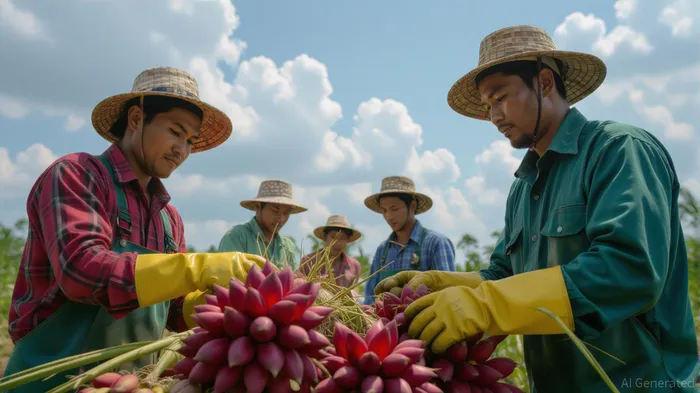
The palm oil market in 2025 remains a high-stakes arena for investors, shaped by the volatile interplay of currency movements, production trends, and shifting global demand. For those seeking undervalued entry points, understanding the Malaysian ringgit's (MYR) role in pricing competitiveness, the production dynamics between Malaysia and Indonesia, and the evolving rivalry with soybean and rapeseed oils is critical. This article dissects these factors and offers actionable strategies for navigating the sector's turbulence.
The MYR's Dual Role: Currency Fluctuations and Export Competitiveness
The MYR's strength or weakness directly impacts the cost competitiveness of Malaysian palm oil. As of July 2025, the USD/MYR rate stands at 4.23, a 11.16% appreciation over the past year. While a stronger MYRMYRG-- makes Malaysian exports more expensive, historical data reveals asymmetric effects: prolonged MYR depreciation (e.g., the 12.5% drop in 2023) has historically boosted palm oil exports by 15–20% as prices become more attractive to dollar-paying buyers in China and India.
Investors should monitor the MYR's trajectory against the USD and Chinese yuan (CNY). A weakening MYR could create undervalued entry points for palm oil futures or equities of export-focused producers like IOI Corporation (5185.KL) and Sime Darby Plantation (4755.KL). Conversely, hedging strategies for firms exposed to currency risk—such as forward contracts or MYR-denominated debt—can mitigate downside risks during periods of ringgit strength.
Production Trends: Malaysia vs. Indonesia's Output Dynamics
In 2025, Indonesia remains the dominant producer, with output projected at 49.8 million metric tonnes (MT) compared to Malaysia's 19.5 MT. However, structural headwinds are reshaping the landscape:
- Indonesia: A 10% export levy (up from 7.5%) and the B40 biodiesel mandate are diverting 2–3 million MT of crude palm oil (CPO) to domestic use, reducing export volumes. While production efficiency has improved, agrarian disputes with 1,100+ communities threaten long-term stability.
- Malaysia: A 21.5% MoM production surge in April 2025 (reaching 1.69 MT) highlights improved yields, but replanting delays and labor shortages constrain growth. The country's focus on sustainability—3.86 million hectares under MSPO certification—positions it to capture market share in ESG-conscious regions like the EU.
Investors should favor Malaysia's producers with strong sustainability credentials and efficient replanting programs, as these firms are better positioned to navigate EU regulatory scrutiny and capitalize on premium pricing in green markets.
Global Edible Oil Rivalry: Soybean and Rapeseed Dynamics
Palm oil's competitiveness hinges on its price spread against substitutes. In 2025, the POGO (Palm Oil–Crude Oil) spread has narrowed to -RM100/ton, indicating palm oil's overvaluation relative to crude-linked oils. However, soybean oil remains a key rival:
- Soybean Oil: Brazil's record 2025 harvest (150 million MT) has depressed prices, challenging palm oil's share in India and China. Yet, palm oil's recent price discount to soybean oil (12% in April 2025) is driving a recovery in Indian imports.
- Rapeseed Oil: Reduced Indian rapeseed production (11.7 MT in 2025) has increased reliance on imports, creating a niche for palm oil in blended oil markets.
Investors should monitor the soybean-palm oil price differential and India's import policies. A widening discount to soybean oil could signal undervaluation in palm oil futures, while a narrowing spread might indicate overbought conditions.
Undervalued Entry Points: Historical Lessons and Strategic Opportunities
Historical data shows that palm oil equities and futures often bottom during periods of MYR weakness and supply shocks. For example, during the 2023 MYR depreciation (12.5% vs. USD), IOI Corporation's stock surged 30% as exports to China and India rebounded. Similarly, the 2024 Indonesian export levy hike led to a 15% price spike in palm oil futures, rewarding early buyers.
Key entry points in 2025 include:
1. MYR Weakness: A sustained decline in the MYR/USD rate to 4.30+ could boost palm oil exports by 10–15%, making futures or ETFs like iShares MSCIMSCI-- Malaysia (EWM) attractive.
2. Sustainability Premiums: Companies with high MSPO certification (e.g., Sime Darby Plantation) may see valuation premiums as the EU's anti-deforestation law phases in.
3. Biodiesel Tailwinds: The B40 mandate in Indonesia and B30 in Malaysia could drive CPO prices higher, benefiting integrated producers with refining capacity.
Risk Mitigation: Navigating Structural Headwinds
The palm oil market is not without risks. Structural challenges include:
- EU Regulations: The “standard risk” label for Malaysia under the EU's anti-deforestation law could trigger a 5–10% price correction unless sustainability efforts are validated.
- Supply Chain Disruptions: Aging plantations in Malaysia and labor shortages could limit output growth, pushing prices higher.
- Geopolitical Shifts: A U.S. Federal Reserve rate cut (projected Q4 2025) may weaken the USD, indirectly supporting palm oil prices.
To mitigate these risks, investors should diversify across regions (e.g., Indonesian and Malaysian equities), hedge currency exposure via futures, and monitor policy updates from the EU and ASEAN.
Conclusion: A Strategic Approach to Palm Oil Investing
The palm oil market's volatility in 2025 demands a nuanced strategy that balances currency trends, production dynamics, and global demand shifts. For investors, the interplay between the MYR and edible oil prices offers both risks and opportunities. By leveraging historical patterns, focusing on sustainability-driven producers, and hedging against structural risks, investors can identify undervalued entry points in a sector poised for long-term resilience.







Comentarios
Aún no hay comentarios