
Palantir vs. Nvidia: A Macro Hedge Fund's Strategic Reallocation
The recent portfolio shift by billionaire Chris Rokos is not an isolated trade, but a strategic realignment reflecting a top-tier macro fund's response to a crowded and expensive AI landscape. In the fourth quarter of 2025, Rokos Capital Management executed a clear move: selling Palantir and buying Nvidia. This decision must be viewed within the broader context of the fund's own capital management strategy. Rokos Capital, which currently oversees , is preparing to return excess capital to investors later this year, aiming to cap its assets under management at $20 billion. This move, echoing steps by peers like and Point72, .
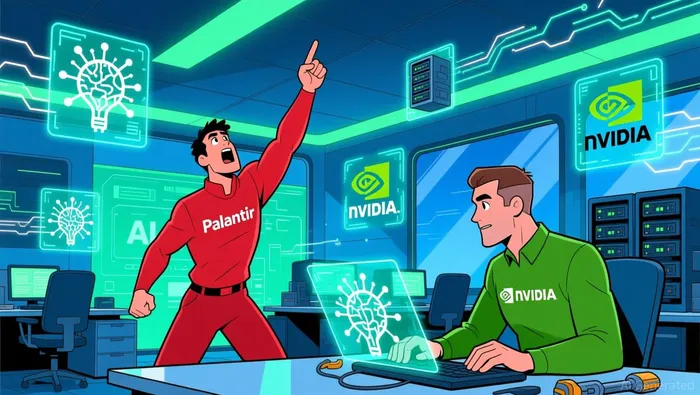
The trade itself crystallizes a fundamental structural debate in the AI investment thesis. On one side is NvidiaNVDA--, the undisputed hardware leader controlling over 80% of the AI accelerator market. Its position is a classic "pick and shovel" play, providing the essential, commoditized tools for the entire industry. On the other is PalantirPLTR--, which is building a software "AI Operating System" designed to integrate and manage complex data workflows for governments and enterprises. The valuation gap between the two is stark. , while Palantir's multiple remains significantly higher, a fact that Michael Burry has highlighted in his bearish put options. Rokos's shift suggests a bet on the visibility and durability of Nvidia's hardware moat over the more opaque, execution-dependent software model.
The catalyst for this pivot is the need for capital efficiency and strategic clarity. As Rokos returns capital to preserve alpha, it is also pruning positions that appear overvalued or complex. The fund's move, therefore, is a dual signal: a tactical reallocation within the AI theme and a strategic commitment to a leaner, more agile portfolio. For investors, it underscores that even the most bullish AI narratives must be filtered through the lens of capital management and relative value.
Valuation and Risk: The Bearish Case for Palantir
The premium valuation that has defined Palantir's recent run is now drawing sophisticated skepticism. While the company's AI-driven growth narrative has captivated the market, a growing chorus of bearish signals suggests the stock is priced for perfection in a business undergoing a high-stakes transition. The risk is that execution will fall short of expectations, leaving the valuation exposed.
The most telling bearish indicator comes from Michael Burry, who has placed more concentrated put options against Palantir than against Nvidia. His rationale, as cited in recent analysis, points to Palantir's "even hotter valuation" and the heightened risk of coming quarters falling "well short of expectations." This is a sophisticated investor's bet that the stock's current price already reflects its best-case scenario, leaving little margin for error. The move is amplified by billionaire Chris Rokos, who has sold Palantir while buying Nvidia, a reallocation that underscores a preference for relative value and clearer visibility.
<That visibility gap is central to the bearish case. The comparison to Nvidia's forward P/E ratio of is stark. While Nvidia's multiple is elevated, it is seen as a reasonable premium for a company with immense, near-term catalysts in AI infrastructure. In contrast, Palantir's valuation remains significantly higher, a multiple that demands flawless execution on a strategic pivot. The market is paying for a seamless shift from a stable, government-contracted business to a dynamic, commercial software platform-a transition that introduces far greater execution and revenue visibility uncertainty.
The bottom line is a valuation at odds with the business's evolving profile. Palantir's stock is trading at a premium that assumes it can successfully replicate the growth trajectory of a pure-play AI infrastructure leader, like Nvidia, while navigating the complexities of a commercial software ramp. The bearish bets from investors like Burry and Rokos suggest they see a higher probability of disappointment. For the premium to be justified, Palantir must not only meet but exceed the lofty expectations baked into its price, a tall order in a market increasingly wary of AI bubble risks.
The Counterargument: Why Palantir's Software Moat Might Be Superior
While Nvidia's hardware dominance is undeniable, a compelling case can be made that Palantir's software platform and its "AI Operating System" model offer a more durable and defensible competitive advantage. The argument centers on a fundamental shift in value creation: from the compute layer to the intelligence layer. Palantir is not just selling chips; it is selling the operating system that runs the AI agents, and that system is built on a deep, organization-specific moat that is exceptionally difficult to replicate.
The financial proof of this model's strength is its profitability. In 2025, Palantir achieved a , a metric that combines revenue growth and profit margin. This score, which management noted as the second-highest globally among large-cap tech companies, demonstrates a rare ability to scale rapidly while maintaining robust profitability. This is a stark contrast to the capital-intensive hardware model, where high growth often comes with proportionally high costs and lower near-term margins. Palantir's software platform, once deployed, has a much higher incremental margin profile, driving its superior financial efficiency.
The core of this advantage is what the company calls its "Ontology"-a digital twin of an organization that embeds real-world context, processes, and relationships into its AI. This is not a generic data lake; it is a deeply customized, living map of how a business or government agency actually works. As the industry shifts toward "Agentic AI," where autonomous systems execute complex tasks, this context becomes the ultimate competitive moat. Competitors cannot simply copy this framework; they must rebuild it from scratch for each client, a process that takes years and requires intimate knowledge of the client's operations. Palantir's decade-long head start in building these ontologies for both government and commercial clients has created a network effect that is difficult to breach.
This moat is directly fueling explosive commercial growth and reducing reliance on government contracts. U.S. , a staggering rate that signals the platform's broad appeal beyond its initial defense and intelligence roots. This acceleration is powered by the company's "Bootcamp" sales model, which has drastically shortened sales cycles and expanded its customer base. The result is a business that is diversifying its revenue stream while simultaneously deepening its relationships with each client, making churn less likely and upselling easier.
Viewed another way, Nvidia provides the engine, but Palantir provides the operating system and the map. In a world where AI agents are automating supply chains, managing logistics, and analyzing regulations, the ability to understand and act within a specific organizational context is the critical differentiator. While Nvidia's hardware is essential, Palantir's software is the intelligence layer that makes that hardware productive. For investors, the question is whether the market is pricing in the full durability of this software moat or overvaluing the hardware play. The evidence suggests Palantir's model, with its high profitability and deep organizational lock-in, may be the more sustainable long-term winner.
Catalysts and Scenarios: The Path of AI Spending
For a macro hedge fund seeking durable, visible growth, the AI investment thesis hinges on two distinct but critical paths: the hardware backbone and the software intelligence layer. The near-term catalysts and long-term scenarios for Nvidia and Palantir present a clear divergence in risk and visibility.
For Nvidia, the immediate catalyst is the launch of its Rubin Ultra GPU, a system designed for the next frontier of AI reasoning. The company's outlook for the first quarter of fiscal 2026 , a figure that assumes a smooth ramp of its Blackwell and now Rubin platforms. The Rubin CPX GPU, with its ability to handle million-token contexts, is built for the massive-scale applications that will drive the next wave of AI spending. This hardware visibility is the core of Nvidia's thesis. The long-term demand is anchored in the colossal capital expenditure plans of hyperscalers, now estimated at . This is a durable, visible growth engine. The key scenario that validates the thesis is a continued, disciplined build-out of AI infrastructure by these giants. The risk is a sharp deceleration in that capex, which would pressure Nvidia's revenue trajectory and valuations. However, the hardware moat and the integration of Rubin into the Vera Rubin platform provide a degree of insulation; the company's role is as the essential compute layer, not a speculative application play.
Palantir's catalyst is the monetization of its Artificial Intelligence Platform (AIP) and the expansion of its flagship U.S. Army contract. The company's , 10-year deal with the U.S. Army is a monumental validation of its software moat, consolidating disparate contracts into a single enterprise layer. The immediate growth driver is the commercial adoption fueled by its "Bootcamp" sales model, . commercial customers. The key scenario for Palantir is a successful transition from a government contractor to a dominant, recurring-revenue software platform for the Fortune 500. This requires demonstrating that its AIP can automate complex business logic at scale, moving beyond niche projects. The risk here is a crowded software market; rivals like C3.ai have struggled to match Palantir's execution, but the competitive landscape remains dynamic. The thesis assumes Palantir's "ontology" advantage-the deep integration of data and AI-creates a durable moat that competitors cannot easily replicate.
The overarching risk for both is an AI bubble bust, where the current euphoria gives way to a reassessment of returns on massive capex. For Nvidia, the hardware visibility provides a different risk profile; its revenue is tied to physical deployments, which are harder to cancel than software subscriptions. For Palantir, the risk is more executional and competitive, centered on converting its platform into predictable, high-margin software revenue. The hedge fund's need for durable, visible growth favors Nvidia's hardware-led model in the near term, while Palantir represents a higher-conviction, longer-duration bet on software dominance.
The Macro Investor's Playbook: What to Watch
The AI trade is maturing from a broad infrastructure bet into a selective hunt for visibility and monetization. For investors, the playbook shifts from chasing capex cycles to monitoring the signals that separate durable winners from overextended laggards. Three key metrics will determine if the current rally is sustainable or a prelude to a more nuanced, differentiated market.
First, watch Nvidia's Q1 FY26 guidance against the $43 billion consensus. The company's latest outlook calls for revenue of , , a figure that will be scrutinized for signs of demand softening for its Blackwell AI supercomputers. More telling will be the gross margin guidance, . A miss here would signal pricing pressure or production hiccups, directly impacting the hardware visibility that underpins the entire AI supply chain. The market's reaction will be a real-time stress test for the Rubin Ultra demand thesis.
Second, track Palantir's U.S. commercial revenue growth and government contract expansions. The company's . commercial customer count by the end of 2025 demonstrated the power of its "land-and-expand" Bootcamp model. Investors should now monitor whether this customer acquisition translates into sustained revenue growth. Any deceleration in commercial revenue, or a pause in the expansion of its massive $10 billion U.S. Army contract, would be a red flag for the software monetization story that has driven its valuation.
Finally, watch for a widening divergence in stock correlation among AI hyperscalers. The average stock price correlation across the large public AI hyperscalers has already since June. This dispersion is the hallmark of a maturing trade where investor focus is shifting from pure capex spending to the link between that spending and future earnings. A continued divergence will signal that the market is rewarding companies with clear paths to monetize their AI investments, while punishing those where debt-funded capex is not yet generating visible revenue benefits.
The bottom line is a framework for selective conviction. The AI trade is no longer a one-way bet on capital expenditure. The new watchpoints are about sustainability: hardware demand, software monetization, and the market's growing sophistication in separating the durable from the dilutive.







Comentarios
Aún no hay comentarios