
Is Paladin Energy (ASX:PDN) a Buy Ahead of Its FY2025 Results? A Deep Dive into Analyst Targets, Operational Momentum, and Valuation Metrics
The uranium market has long been a niche but critical sector, and Paladin Energy (ASX:PDN) has emerged as a key player with its strategic assets and disciplined operations. As the company prepares to release its FY2025 results, investors are scrutinizing its trajectory through three lenses: analyst price targets, operational momentum, and valuation relative to intrinsic fair value.
Analyst Price Targets: A Mixed but Optimistic Outlook
Analysts remain divided on Paladin’s near-term prospects, but the consensus leans toward cautious optimism. The average 12-month price target stands at AU$8.38–AU$8.73, representing a 13–17% upside from the current price of AU$7.41–AU$7.78 [1]. This range reflects divergent views: the most bullish analysts, such as Matthew Hope (Ord Minnett) and Regan Burrows (Bell Potter), have set targets as high as AU$12.56, while more cautious firms like RBC Capital and J.P. Morgan have trimmed their expectations to AU$6.78 [1]. The wide dispersion underscores uncertainty about macroeconomic factors, uranium pricing, and Paladin’s ability to execute its growth plans. However, the persistence of “Buy” ratings from major firms like UBSUBS-- and Bell Potter suggests confidence in the company’s long-term potential [1].
Operational Momentum: A Foundation for Growth
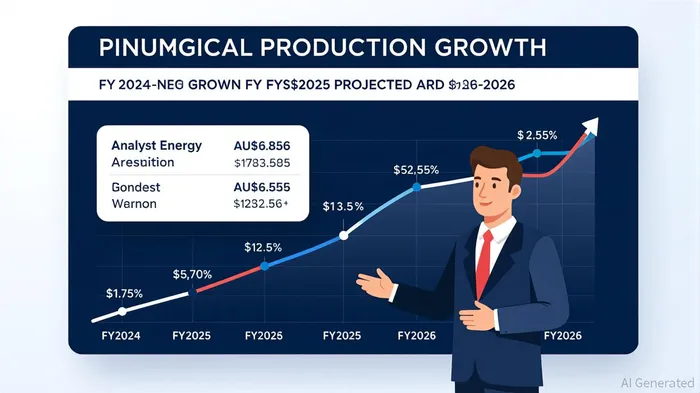
Paladin’s operational performance in FY2025 has been a bright spot. The company achieved a 33% quarter-on-quarter surge in uranium production at its Langer Heinrich mine in Namibia, producing 993,000 pounds of U₃O₈ in Q4 alone [3]. For the full fiscal year, production reached 3 million pounds, driven by optimized processing and higher throughput [3]. Looking ahead, Paladin has set ambitious targets for FY2026, aiming to produce 4.4 million pounds at unit costs of $44–$48 per pound—a range that positions the company to benefit from rising uranium prices [3].
Equally significant is the progress at the Patterson Lake South (PLS) project in Canada. With a projected 10-year mine life and strong financial metrics, PLS could become a cornerstone of Paladin’s growth, addressing global supply gaps in the uranium market [1]. The company’s strong cash reserves and clean balance sheet further bolster its ability to fund these initiatives without diluting shareholder value [3].
Valuation: A Tale of Two Models
Valuation analysis reveals a complex picture. On one hand, a two-stage Free Cash Flow to Equity (FCFE) model estimates Paladin’s fair value at AU$6.46, suggesting the stock is trading near intrinsic value [1]. Conversely, Alpha Spread’s intrinsic value model calculates a base-case fair value of AU$10.52, implying a 26% undervaluation [2]. The disparity arises from differing assumptions about the pace of free cash flow decline and terminal value estimates. Meanwhile, a third model, based on projected free cash flow, suggests an intrinsic value of AU$0.82—a figure that starkly contrasts with the others [4].
The negative P/E ratio of -129.67 as of August 2025 [4] complicates the valuation narrative, as it reflects current losses. However, this metric may not capture the company’s long-term growth potential, particularly if uranium prices stabilize and production costs remain disciplined. Analysts project a statutory profit of US$0.13 per share by 2026 [1], which could mark a turning point for earnings visibility.
Conclusion: A Calculated Buy?
Paladin Energy’s investment case hinges on its ability to capitalize on favorable uranium market dynamics and execute its operational roadmap. The analyst price targets, while mixed, reflect a consensus that the stock is not overvalued and could outperform if uranium prices rise. Operationally, the company’s production growth and project developments provide a solid foundation for long-term value creation. Valuation models, though conflicting, highlight the importance of scenario analysis: investors who believe in Paladin’s ability to reduce costs and scale production may find the stock undervalued, while those wary of macroeconomic headwinds might adopt a more cautious stance.
For those with a medium-term horizon and a tolerance for volatility, Paladin Energy appears to offer a compelling risk-reward profile ahead of its FY2025 results. However, as with any commodity play, success will depend on both the company’s execution and broader market conditions.
**Source:[1] Paladin Energy Ltd (ASX:PDN) Annual Results [https://finance.yahoo.com/news/paladin-energy-ltd-asx-pdn-044646729.html][2] Paladin Energy Ltd - PDN Intrinsic Value [https://www.alphaspread.com/security/asx/pdn/summary][3] Earnings call transcript: Paladin Energy sees Q4 uranium production surge in FY2025 [https://www.investing.com/news/transcripts/earnings-call-transcript-paladin-energy-sees-q4-uranium-production-surge-in-fy25-93CH-4147144][4] PE Ratio - Paladin Energy Ltd [https://www.wisesheets.io/pe-ratio/PDN.AX]







Comentarios
Aún no hay comentarios