
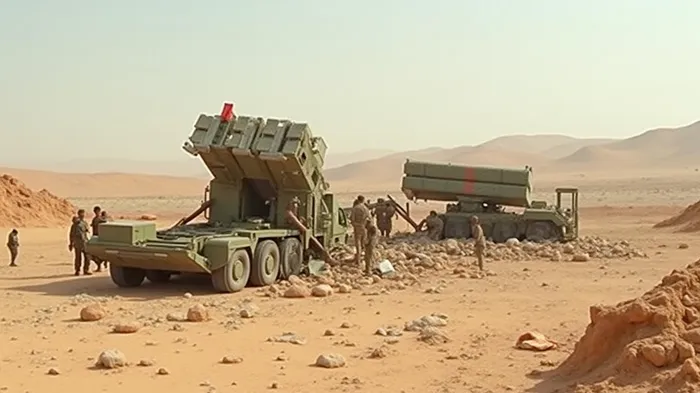
Pakistan's air defense units of HQ-9 missile launchers suffer heavy damage: sources
PorAinvest
jueves, 8 de mayo de 2025, 4:47 am ET1 min de lectura
Pakistan's air defense units of HQ-9 missile launchers suffer heavy damage: sources
In a significant development, Pakistan's air defense units equipped with Chinese-made HQ-9 missile launchers have reportedly suffered heavy damage following India's precision strikes during Operation Sindoor. The strikes, which targeted terror camps in Pakistan and Pakistan-Occupied Kashmir (PoK), exposed vulnerabilities in Pakistan's defense infrastructure and the performance of its imported Chinese military technology.Early on Wednesday, India conducted coordinated missile strikes on nine terror bases, including those belonging to Lashkar-e-Taiba and Jaish-e-Mohammed. The strikes were aimed at locations known for their longstanding terror activities, such as Bahawalpur and Muridke in Pakistan, and Kotli, Barnala, Sarjal, Mehmoona, and Bilal Camps in PoK. Despite the presence of the HQ-9 air defense system, none of the Indian missiles were intercepted, indicating either a failure to detect the incoming threats or an inability to respond in time [1].
The HQ-9 system, similar to the Russian S-300, is designed to track and neutralize incoming threats. However, its failure to intercept the Indian missiles has raised serious questions about the reliability of Pakistan's defense infrastructure and the effectiveness of Chinese military technology. This is particularly concerning for investors and financial professionals who are closely monitoring the geopolitical risks and military capabilities of the region.
Pakistan's response has been swift but cautious. Prime Minister Shehbaz Sharif condemned the strikes as an "act of war" and warned of retaliation. However, the lack of an effective defense against India's attacks has put Pakistan in a precarious position. The global community has urged both countries to exercise restraint and avoid further escalation, while international observers are taking note of Pakistan's failed defenses and India's increasingly accurate strike capability [2].
The aftermath of Operation Sindoor has led to heightened security measures in India, with civil defense drills in place across 244 districts. Prime Minister Narendra Modi has reiterated India's commitment to pursuing terrorists and their backers, no matter where they hide. The future of Pakistan's air defense capabilities and the potential for further geopolitical tensions remain a significant concern for investors and financial professionals.
References:
[1] https://www.india.com/news/world/operation-sindoor-pakistans-air-defence-failed-due-to-chinese-made-hq-9-system-as-india-destroys-targets-with-precision-strikes-along-pok-terror-bases-7803836/
[2] https://economictimes.indiatimes.com/news/newsblogs/india-pakistan-war-live-updates-operation-sindoor-indian-army-airforce-pahalgam-terror-attack-mock-drill-blackout-india-news-today/liveblog/120943152.cms?from=mdr


Divulgación editorial y transparencia de la IA: Ainvest News utiliza tecnología avanzada de Modelos de Lenguaje Largo (LLM) para sintetizar y analizar datos de mercado en tiempo real. Para garantizar los más altos estándares de integridad, cada artículo se somete a un riguroso proceso de verificación con participación humana.
Mientras la IA asiste en el procesamiento de datos y la redacción inicial, un miembro editorial profesional de Ainvest revisa, verifica y aprueba de forma independiente todo el contenido para garantizar su precisión y cumplimiento con los estándares editoriales de Ainvest Fintech Inc. Esta supervisión humana está diseñada para mitigar las alucinaciones de la IA y garantizar el contexto financiero.
Advertencia sobre inversiones: Este contenido se proporciona únicamente con fines informativos y no constituye asesoramiento profesional de inversión, legal o financiero. Los mercados conllevan riesgos inherentes. Se recomienda a los usuarios que realicen una investigación independiente o consulten a un asesor financiero certificado antes de tomar cualquier decisión. Ainvest Fintech Inc. se exime de toda responsabilidad por las acciones tomadas con base en esta información. ¿Encontró un error? Reportar un problema


SOBRE NOSOTROS
Nuestra historiaAutores de noticiasBase de conocimientosPolítica de privacidadTérmino de usoDescargo de responsabilidad de corretaje de tercerosTérminos de uso de AIMEDivulgaciones de riesgos de AInvest AICarrerasCONTÁCTENOS
Email: support@ainvest.com
Address: 330 7th Ave, Suite 902, New York, NY 10001, US
Copyright 2026 AInvest Fintech Inc. All rights reserved.


Comentarios
Aún no hay comentarios