
Pakistan's $300B Crypto Market: A Strategic Gateway for Global Exchanges in a Regulated Frontier Market
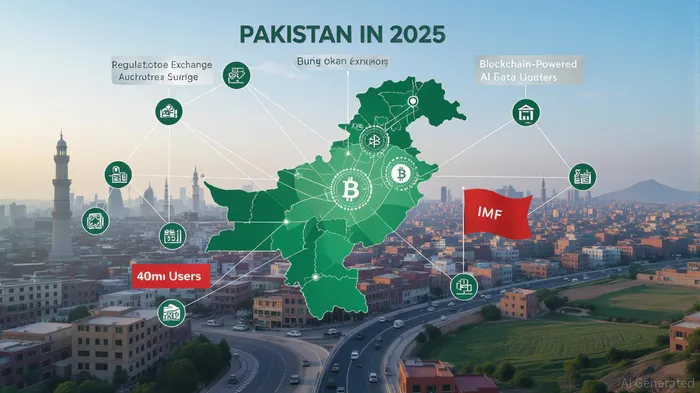
Pakistan's cryptocurrency market has emerged as one of the most dynamic and strategically positioned frontiers in the global digital asset landscape. By 2025, the country has transitioned from regulatory ambiguity to a structured framework under the Pakistan Virtual Assets Regulatory Authority (PVARA), inviting global exchanges and virtual asset service providers (VASPs) to participate in a $300 billion annual trading volume market[1]. This shift reflects a calculated effort to align with international standards while leveraging its demographic and energy advantages. However, the path to becoming a regional crypto hub is not without challenges.
Regulatory Readiness: A Framework for Global Integration
Pakistan's regulatory environment has evolved significantly. The Virtual Assets Ordinance 2025 established PVARA as the central authority to license and oversee VASPs, ensuring compliance with Financial Action Task Force (FATF) guidelines and anti-money laundering (AML)/counter-terrorism financing (CTF) protocols[5]. To qualify for a license, global exchanges must already hold permits from regulators like the U.S. SEC, UK FCA, or Singapore's MAS[2]. This approach not only enhances credibility but also signals Pakistan's intent to integrate its market into global financial systems.
The regulatory sandbox introduced by PVARA further underscores innovation-friendly oversight, allowing firms to test products like Shariah-compliant crypto derivatives[4]. Taxation policies, including a 15% flat tax on capital gains and 29% corporate tax for crypto businesses, add clarity for investors[1]. Yet, a regulatory paradox persists: while the government promotes crypto adoption, the State Bank of Pakistan still enforces a 2018 ban on crypto trading[6]. Resolving this contradiction will be critical for long-term stability.
Market Dynamics: Volume vs. Revenue – The $300B Enigma
The disparity between Pakistan's $300 billion annual trading volume and its $2.4 billion revenue projection[3] highlights the market's speculative nature. With 40 million users—driven by a 60% youth population under 30—retail participation dominates transactions[2]. However, monetization remains low, with an average revenue per user of just $85.4 in 2025[1]. This gap suggests that while the market is vast, its economic impact hinges on institutional adoption and value-added services like cross-border remittances and tokenized assets.
The government's allocation of 2,000 megawatts of surplus electricity for BitcoinBTC-- mining and AI data centers[5] could tip the balance. By reducing mining costs and attracting foreign reserves, Pakistan aims to position itself among the top five global Bitcoin hubs. A strategic Bitcoin reserve, modeled after U.S. and El Salvador initiatives, further signals long-term commitment[5].
Foreign Investment Inflows: A Magnet for Global Players
Pakistan's licensing program has drawn interest from major exchanges, including potential partnerships with firms like Binance and MicroStrategy, which have offered strategic advisory roles[3]. The requirement for international licensing ensures that only vetted players enter the market, mitigating risks of financial crime while fostering trust.
Global firms applying for licenses must submit detailed proposals on cybersecurity, compliance, and market-specific strategies[2]. This rigorous process aligns with Pakistan's goal of creating a transparent ecosystem. For example, Coinbase and Kraken have reportedly expressed interest in establishing local operations, citing the country's young, tech-savvy population and untapped demand[4].
Challenges: Energy, Infrastructure, and Global Scrutiny
Despite progress, hurdles remain. The IMF has raised concerns about energy subsidies for mining, warning of potential strain on Pakistan's grid[3]. While the government argues that surplus electricity from hydro and renewable sources justifies the allocation, critics highlight the risk of diverting resources from critical sectors like healthcare and education.
Infrastructure gaps also persist. While 40 million users exist, financial literacy and internet penetration must improve to sustain growth[6]. Additionally, the regulatory paradox—where the State Bank's ban clashes with PVARA's licensing—creates uncertainty for investors.
Conclusion: A Calculated Bet on the Future
Pakistan's crypto market represents a high-risk, high-reward opportunity. The regulatory framework, though nascent, demonstrates a clear trajectory toward global integration. With a young population, strategic energy advantages, and a growing appetite for innovation, the country is well-positioned to become a regional leader. However, success will depend on resolving internal regulatory conflicts, addressing energy concerns, and converting speculative volume into sustainable revenue.
For global exchanges, the window to enter Pakistan's market is narrowing. As PVARA's licensing process gains momentum, early adopters stand to benefit from a market that, despite its challenges, is undeniably on the cusp of a digital financial revolution.





Comentarios
Aún no hay comentarios