
PagSeguro's Operational Discipline and Margin Resilience: A Blueprint for Sustainable Growth in Brazil's Digital Payments Market
In Brazil's fiercely competitive digital payments landscape, where market saturation threatens to erode margins, PagSeguro Digital Ltd.PAGS-- (PAGS) has emerged as a standout player through a combination of operational discipline and strategic innovation. As the country's economic and regulatory environment evolves, PagSeguro's ability to balance growth with profitability-while navigating challenges like Brazil's high SELIC rate-has positioned it as a model for sustainable competitive advantage.
Operational Discipline: The Foundation of Resilience
PagSeguro's operational rigor is evident in its capital allocation strategies and cost management. For Q2 2025, the company returned BRL 1.9 billion to shareholders through share repurchases, underscoring its commitment to disciplined capital returns, according to a PagSeguro SWOT analysis. This approach aligns with broader efforts to optimize its cost of capital, including securing new financing mechanisms to mitigate the impact of rising interest rates, as highlighted in a Monexa analysis. Despite heavy investments in infrastructure-such as property, plant, and equipment-PagSeguro has maintained liquidity, even as working capital fluctuations and negative net cash from operations in 2024 highlighted short-term pressures in the Monexa analysis.
The company's focus on automation and AI-driven tools further strengthens its operational efficiency. By reducing customer support tickets per user by 30% through enhanced chatbots and streamlining back-office processes, PagSeguro has curtailed labor costs while improving service quality, a point also noted in the Monexa analysis. This "always-on" cost-resilience model, as described by Deloitte in corporate strategy literature, moves beyond episodic cost-cutting to embed efficiency into daily operations.
Margin Resilience Amid Macroeconomic Headwinds
Brazil's high SELIC rate-currently at 13.75%-has posed a significant challenge for PagSeguro's banking segment, PagBank. Financial costs surged by 48.20% year-over-year in Q2 2025, compressing gross margins by 1.50 percentage points, according to the PagSeguro SWOT analysis. Yet, PagSeguro has countered these pressures through pricing discipline and cross-selling high-margin products. For instance, PagBank's revenue grew 61% YoY in Q2 2025, contributing 26.4% of total gross profit, as the PagSeguro SWOT analysis details, as the company deepened its integration of credit, insurance, and SaaS solutions for small businesses.
The strategic pivot toward a "financial operating system" for small and medium-sized enterprises (SMEs) has been pivotal. By bundling payments, lending, and software tools, PagSeguro has increased average revenue per user (ARPU) and reduced reliance on low-margin transaction fees. This diversification has helped maintain a net profit margin of 11.04% as of June 30, 2025, despite macroeconomic turbulence, a conclusion echoed in Deloitte's cost-resilience work.
Competitive Advantages: Ecosystem Over Fragmentation
PagSeguro's dual-sided ecosystem-combining payments and banking-sets it apart from rivals like Mercado Pago and traditional methods like Boleto Bancário. While Mercado Pago leverages its integration with the Mercado Livre e-commerce platform, PagSeguro's broader financial services, including PagBank's credit and debit cards, offer a more comprehensive solution for SMEs, as shown in an FC Noticias comparison. Boleto Bancário, though cost-effective, lacks the technological sophistication and cross-selling potential of PagSeguro's model, according to that FC Noticias comparison.
Moreover, PagSeguro's fee structure remains competitive: 1.99% for débito and 3.19% for crédito à vista, compared to Mercado Pago's 1.41% and 3.31%, respectively, per the FC Noticias comparison. This pricing edge, combined with a vast merchant base and strong brand recognition, reduces customer acquisition costs and enhances stickiness. Analysts note that PagSeguro's ecosystem model creates a "flywheel effect," where cross-selling drives higher engagement and deeper wallet share (as discussed in the Monexa analysis).
The Road Ahead: Balancing Growth and Profitability
Looking ahead, PagSeguro faces the dual challenge of scaling its banking operations while managing interest rate risks. Its 2025-Q4 OKR plan emphasizes improving adjusted net margins by 150 basis points through cost optimization and pricing discipline, a target highlighted in the Monexa analysis. The company also aims to expand multi-product adoption among active merchants from 25% to 40%, a goal that hinges on successful integration of SaaS tools like inventory and payroll software, as outlined in the PagSeguro SWOT analysis.
However, the path is not without risks. Rising financial costs and operational expenses-such as a 42% increase in selling and marketing costs in Q2 2024-could pressure margins if not offset by revenue growth, the PagSeguro SWOT analysis notes. Yet, PagSeguro's strong balance sheet, with net debt falling from BRL 13.48 billion in 2023 to BRL 3.75 billion in 2024, provides flexibility to navigate these challenges, according to the PagSeguro SWOT analysis.
Conclusion: A Model for Long-Term Value Creation
PagSeguro's success lies in its ability to marry operational discipline with strategic innovation. By transforming from a payments processor to a financial ecosystem, the company has insulated itself from margin compression in its core business while capitalizing on higher-margin opportunities. As Brazil's digital payments market matures, PagSeguro's focus on cost resilience, cross-selling, and ecosystem integration offers a compelling blueprint for sustainable growth. For investors, the key will be monitoring how effectively the company balances expansion with profitability in an environment where interest rates remain a wild card.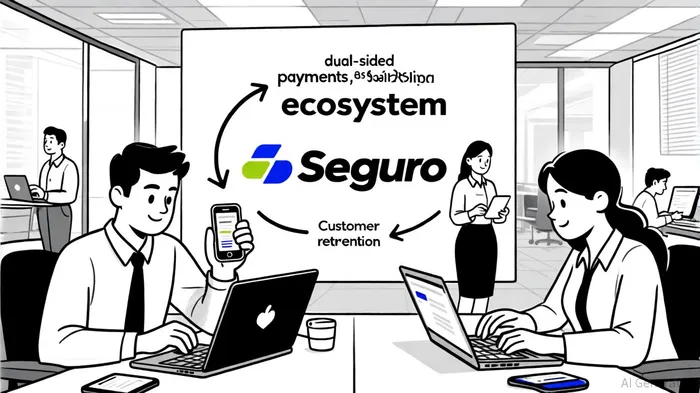







Comentarios
Aún no hay comentarios