
PagSeguro Digital Ltd.: Navigating Brazil's Fintech Boom Amid Margin Pressures and Regulatory Shifts
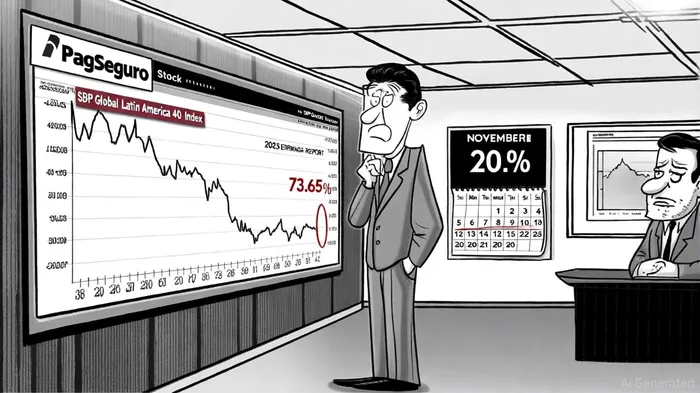
The Brazilian fintech sector is at a crossroads. PagSeguro Digital Ltd.PAGS-- (PAGS), once a darling of the market, has seen its stock plummet by 73.65% over the past five years, trailing both the broader Latin American market and its peers like Nubank (NU) and StoneCo (STNE) (PagSeguro stock chart). Yet, beneath this underperformance lies a company with a dominant position in a digital payments market projected to grow at a 30.5% CAGR through 2033, according to a real-time payments report. As Brazil's economy digitizes, PagSeguro's long-term potential hinges on its ability to balance structural challenges-such as regulatory shifts and margin compression-with its entrenched role in the country's financial ecosystem.
Financial Health: Growth Amid Rising Costs
PagSeguro's Q3 2025 results, expected to show 11.08% year-over-year revenue growth to $967.82 million and an EPS of $0.35, underscore its resilience, according to a digital payments forecast. The company's banking division, PagBank, contributed 26.4% of gross profit in Q2 2025, driven by its end-to-end digital ecosystem that integrates payments, lending, and financial services, the Mordor Intelligence report notes. However, margin pressures loom large. A 48.2% year-over-year increase in financial costs-linked to Brazil's high SELIC rate-has eroded net interest margins, raising concerns about liquidity in a high-rate environment, as also highlighted by Mordor Intelligence. This contrasts with Nubank's disciplined cost structure, which maintains a monthly cost-to-serve of just $0.80 per customer and a 28% ROE, as discussed in a Nubank analysis.
Market Dynamics: Pix, E-Commerce, and Competitive Heat
Brazil's digital payments market is being reshaped by the Pix instant payment system, which now accounts for over 50% of transactions, a finding noted by UnivDatos. PagSeguro's integration of Pix into its platform has been a boon, but competition is intensifying. Nubank's expansion into Mexico and Colombia, coupled with StoneCo's ecosystem-driven growth, has fragmented the market. Nubank's Q2 2025 revenue of $3.7 billion-a 40% year-over-year jump-highlights its scale, while StoneCo's adjusted net income surged 137% in Q3 2024, according to the Monexa Nubank analysis. For PagSeguro, the challenge lies in differentiating its offerings to micro-entrepreneurs and small businesses, a segment where it holds a 30% market share but faces pricing pressures from rivals, as outlined in a PagSeguro banking report.
Regulatory Headwinds: Innovation vs. Oversight
The Central Bank of Brazil's 2025 regulatory agenda has introduced new hurdles. Stricter capital requirements, a 15,000 reais transfer limit for unauthorized institutions, and a ban on non-banks using the term "bank" in their names signal a shift toward caution, according to UnivDatos. These measures, while aimed at curbing fraud and cyberattacks, could slow PagSeguro's expansion. For instance, the accelerated deadline for fintechs to obtain authorization-from 2029 to 2026-adds compliance costs at a time when the company is already grappling with rising interest expenses, a point emphasized in the PagSeguro banking report.
Analyst Optimism: Is the Selloff a Buying Opportunity?
Despite these challenges, analysts remain bullish. A "Strong Buy" consensus rating, with an average price target of $12.33 (39.32% upside from its September 2025 price of $10.24), reflects confidence in PagSeguro's long-term prospects. JP Morgan's recent upgrade to "Strong Buy" with a $13 target underscores this optimism, citing the company's low forward P/E of 6.33 and its leadership in Brazil's $10.65 billion digital payments market (JP Morgan upgrade). However, skeptics warn that structural issues-such as rural-urban digital divides and cybersecurity risks-could dampen growth. Losses from Pix scams alone reached $860 million in 2024, a problem the Central Bank has yet to fully resolve, as Mordor Intelligence reports.
While the stock's 17.58% monthly surge in September 2025 has drawn attention, historical data from 2022 to 2025 shows mixed short-term performance around earnings releases. A backtest reveals that while there's no statistically significant edge in the first five days, a buy-and-hold approach has historically yielded a mean +9% return by day 21, albeit with a small sample size of three events, according to UnivDatos. This suggests that investors may benefit from patience rather than attempting to time the market around earnings announcements.
Conclusion: A Calculated Bet on Brazil's Digital Future
PagSeguro's underperformance reflects near-term headwinds, but its strategic position in Brazil's fintech ecosystem remains compelling. The company's 15.17% ROE and 23.8% ROIC, noted in the PagSeguro banking report, suggest operational efficiency, while its PagBank division offers a sticky, diversified revenue stream. Yet, investors must weigh these strengths against regulatory risks and competitive pressures. For those with a long-term horizon, PagSeguro's low valuation and the explosive growth of Brazil's digital payments sector-driven by Pix and e-commerce-justify a cautious "buy." However, the path to outperforming the market will require navigating a landscape where innovation and oversight are increasingly intertwined.







Comentarios
Aún no hay comentarios