
Packaging Industry's Growth Potential in a Post-Pandemic Economy: J.P. Morgan's Upgrade as a Catalyst for Re-rating
J.P. Morgan's recent upgrade of Packaging Corporation of AmericaPKG-- (PKG) to Overweight with a $242 price target—implying a 13.19% upside—has thrust the packaging sector into the spotlight as a strategic growth area[1]. This move reflects a broader re-rating of an industry long viewed as cyclical and commodity-driven, now repositioned by structural shifts in efficiency, sustainability, and consolidation. For investors, the upgrade underscores a pivotal inflection point: packaging is no longer just a cost of doing business but a value-creation engine in a post-pandemic economy.
Structural Transformation: Efficiency, Consolidation, and Sustainability
The packaging industry is undergoing a fundamental redefinition. J.P. Morgan analysts highlighted PKG's 21% return on equity and 23-year dividend streak as evidence of a sector evolving beyond cyclical volatility[1]. PKG's $1.2 billion acquisition of Greif's containerboard assets exemplifies a trend of consolidation, as firms scale operations to leverage economies of scale and navigate regulatory pressures[1]. This aligns with broader industry dynamics: U.S. containerboard production rose 4.2% in Q3 2024, while exports surged 16.2%, signaling demand stabilization[1].
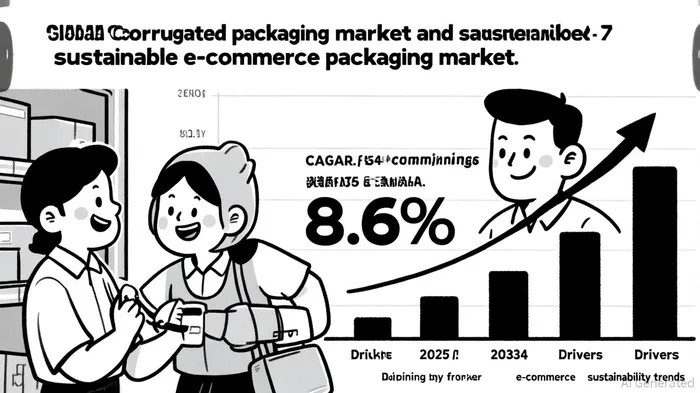
Sustainability is a key driver of this transformation. The global sustainable e-commerce packaging market, valued at $35.6 billion in 2024, is projected to grow at a 8.6% CAGR through 2034, fueled by consumer demand for eco-friendly solutions and regulatory bans on single-use plastics[2]. Innovations like seaweed-based packaging and circular economy models—such as International Paper's reusable SpaceKraft containers—are gaining traction[4]. However, challenges persist: high costs for recycled materials like rPET and performance limitations of alternatives like PHAs hinder widespread adoption[1].
E-Commerce and Technological Innovation: Twin Engines of Growth
The post-pandemic surge in e-commerce has amplified demand for lightweight, tamper-evident packaging to reduce shipping costs and enhance product safety[4]. North America leads this shift, with the U.S. market driving 1.19 trillion in e-commerce sales in 2025[3]. Meanwhile, Asia-Pacific is expected to see the fastest growth, driven by regulatory mandates and expanding online retail in China and India[3].
Technological advancements are further reshaping the sector. Smart packaging incorporating IoT sensors and blockchain is enhancing supply chain transparency, while AI and automation are optimizing production efficiency[4]. These innovations position packaging firms to meet evolving consumer expectations and regulatory demands, creating a virtuous cycle of growth and differentiation.
Financial Resilience and Strategic Positioning
PKG's financial metrics underscore its appeal as a bellwether. With a 21% ROE and consistent cash flow generation, the company has balanced growth with shareholder returns, even amid macroeconomic headwinds[1]. J.P. Morgan's $242 price target reflects confidence in PKG's ability to capitalize on industry tailwinds while maintaining its dividend-paying legacy[1]. The broader corrugated packaging market is forecasted to grow at a 5% CAGR through 2034, driven by e-commerce and sustainability mandates[1].
However, investors must remain mindful of near-term risks. Regulatory shifts, such as extended producer responsibility (EPR) programs and trade dynamics under the Trump administration, could introduce volatility[2]. Additionally, the cost gap between sustainable materials and traditional plastics remains a barrier to adoption[1].
Investment Implications: A Re-rating in the Making
J.P. Morgan's upgrade signals a re-rating of the packaging sector from a cyclical commodity play to a growth-oriented asset class. The firm's emphasis on PKG's strategic acquisitions, sustainability initiatives, and financial discipline aligns with investor priorities in ESG-focused portfolios[5]. As the industry consolidates and innovates, firms that integrate circular economy principles and digital technologies—like smart packaging—will likely outperform.
For investors, the key takeaway is clear: the packaging sector is no longer a passive beneficiary of economic cycles but an active participant in shaping the future of commerce. With e-commerce and sustainability as tailwinds, and J.P. Morgan's endorsement as a catalyst, the sector offers compelling long-term value.





Comentarios
Aún no hay comentarios