
Pacific Gas and Electric Company's 4.36% Preferred Dividend Stability: A Rising Rate Dilemma
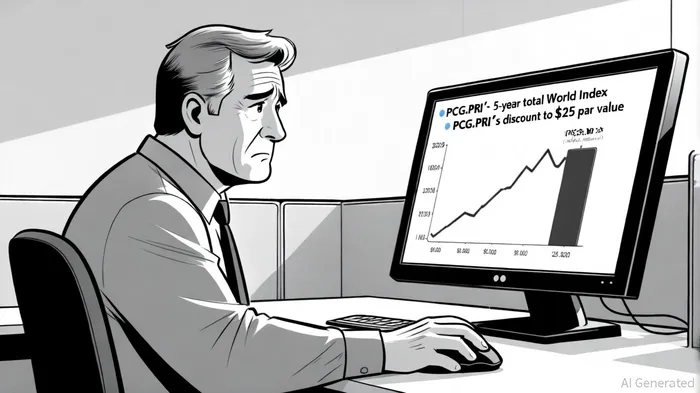
The 4.36% preferred stock of Pacific Gas and Electric Company (PCG.PRI) has long been a fixture in conservative income portfolios, offering a cumulative dividend of $1.09 annually, or $0.2725 per quarter, despite a challenging macroeconomic landscape. However, as interest rates climb and investors recalibrate their fixed-income strategies, the appeal of this preferred security—trading at a 39.73% discount to its $25 par value—has come under scrutiny. This analysis evaluates PCGPCG--.PRI's dividend stability and its viability as a yield source in a rising rate environment, drawing on PG&E's financial strategy, sector trends, and market dynamics.
Dividend Stability: A Historical Anchor
PCG.PRI's dividend has remained consistent over the past five years, with no missed payments despite rising interest rates [1]. This reliability is underpinned by PG&E's role as a regulated utility serving 16 million customers in California, a market insulated from some of the volatility faced by unregulated peers. The stock's cumulative feature ensures unpaid dividends accrue until settled, adding a layer of security for income seekers [3]. However, the stock's underperformance relative to broader markets—0.00% total return versus 80.56% for the MSCIMSCI-- World Index—highlights its limited capital appreciation potential [2].
Rising Rates and the Preferred Stock Paradox
Preferred stocks like PCG.PRIPRI-- face a dual challenge in a rising rate environment. First, they compete directly with bonds, which offer higher yields as rates climb. For instance, the 10-year U.S. Treasury yield surpassed 4.3% in late 2025, making bonds more attractive than PCG.PRI's 4.36% dividend yield [1]. Second, utility companies—already capital-intensive—see borrowing costs rise, squeezing margins if they cannot pass these costs to consumers. PG&E's proposed 11.3% return on equity (up from current levels) aims to offset this by allowing rate hikes for customers, but regulatory approval remains uncertain [3].
PG&E's Financial Resilience and Risks
PG&E reported record 2024 profits of $2.47 billion, yet it pays the lowest dividend in the utility sector, reinvesting 97% of earnings into infrastructure and safety initiatives [3]. This strategy, while prudent for long-term stability, limits immediate shareholder returns. The company's redeemable preferred structure—allowing it to call shares at $25 plus accrued dividends—adds flexibility but introduces reinvestment risk for investors if rates fall [1]. Meanwhile, wildfires and regulatory uncertainties in California pose tail risks, though PG&E's focus on renewable energy and grid modernization may mitigate these over time [3].
Investment Considerations
For income-focused investors, PCG.PRI's current yield of 4.36% (based on its $15.52 price) appears attractive, particularly for those seeking a steady, cumulative dividend. However, the stock's deep discount to par suggests market skepticism about its redemption prospects and PG&E's ability to maintain payouts amid rising costs. Analysts caution that the stock's appeal could wane further if the Federal Reserve signals prolonged high rates, pushing investors toward bonds or higher-yielding equities [1].
Conclusion
PCG.PRI's dividend stability is a testament to PG&E's operational resilience, but its value proposition in a rising rate environment remains mixed. While the cumulative feature and regulated utility model provide a safety net, the stock's weak total returns and competition from higher-yielding alternatives pose headwinds. Investors should weigh PG&E's infrastructure investments and rate hike proposals against the broader risk of interest rate volatility. For now, PCG.PRI may suit conservative portfolios seeking defensive income, but it is not a substitute for a diversified fixed-income strategy.





Comentarios
Aún no hay comentarios