
Pacific Empire's $300,000 Private Placement: A Strategic Catalyst for 2025 Exploration and Copper-Gold Discovery
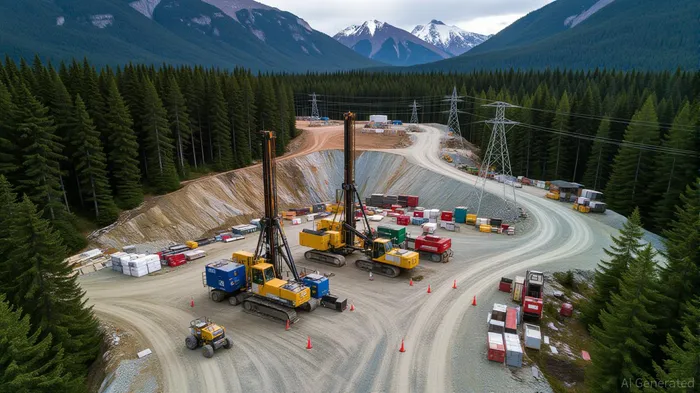
Pacific Empire Minerals Corp. (TSXV: PEMC) has taken a decisive step toward unlocking its flagship TridentTDTH-- copper-gold project with the successful completion of a $300,000 non-brokered private placement on August 8, 2025. This financing, structured as 15,000,000 units at $0.02 each (plus warrants exercisable at $0.05 for 24 months), provides the capital needed to advance a critical diamond drilling program in 2025. For investors, the transaction represents more than a routine capital raise—it is a strategic catalyst that positions the company to test a high-potential porphyry target in a jurisdiction uniquely aligned with the global shift toward sustainable resource development.
Unlocking Porphyry Potential: A Geological and Strategic Play
The Trident project, spanning 22,500 hectares in north-central British Columbia, sits in a district-scale copper-gold porphyry system with historical drilling results that hint at significant mineralization. The company's revised drilling strategy—targeting the A-Zone and extending northward—leverages geophysical data (airborne resistivity, IP surveys, and MT anomalies) to focus on structurally favorable zones. These areas are underpinned by hornblende-feldspar monzonite porphyry intrusions, a geological signature commonly associated with large, economically viable deposits.
The 2025 drilling program, which includes up to 20 diamond drill holes, is designed to test for a porphyry body that has never been systematically evaluated. Historical rock chip samples from the Eastern and Western Breccia targets have returned grades up to 6.0% copper, 6.0% zinc, and 6.0 g/t gold, suggesting the presence of a robust hydrothermal system. With sinistral transpression—a tectonic process that has historically driven mineralization in the region—evident in the area, the geological framework at Trident mirrors that of established deposits like New Afton and Mt. Milligan.
A "Green" Jurisdiction: Infrastructure, Energy, and Market Proximity
British Columbia's status as a "green" copper jurisdiction is not merely a marketing tag—it is a strategic advantage. The region's abundant hydroelectric power reduces the carbon footprint of mining operations, aligning with global decarbonization goals. For Pacific Empire, this means lower operational costs and a more attractive profile for ESG-focused investors.
Infrastructure further amplifies the project's viability. Recent logging operations and forest fires have opened access to previously inaccessible areas, reducing road-building costs. The proximity to North American demand centers—particularly the U.S. and Canada's growing EV and renewable energy sectors—ensures that any discovery at Trident would be logistically and economically feasible to develop. This is a critical differentiator for junior explorers, where remoteness often deters investment.
Financing Structure and Risk Mitigation
The private placement's structure reflects a balanced approach to capital allocation. By issuing warrants exercisable at $0.05, the company creates upside potential for investors while preserving liquidity. The involvement of directors and officers ($23,500) as co-investors signals management's confidence in the project's potential. Regulatory exemptions under Multilateral Instrument 61-101 (due to the transaction's small size relative to market cap) streamline compliance, allowing the company to focus on execution.
However, risks remain. The success of the drilling program hinges on the ability to intersect a large, high-grade porphyry body—a geological gamble. Additionally, while British Columbia is a Tier 1 jurisdiction, junior miners often face permitting delays and environmental scrutiny. Investors must weigh these factors against the project's strong technical foundation and strategic positioning.
Investment Implications and Outlook
For investors, the $300,000 raise is a pivotal moment. If the 2025 drilling program uncovers a significant porphyry deposit, Pacific Empire could transition from a speculative explorer to a resource holder with tangible value. The company's focus on a "green" jurisdiction also aligns with macro trends, including the U.S. Inflation Reduction Act's emphasis on domestic critical minerals and the EU's Critical Raw Materials Act.
Given the low cost of entry (current share price of $0.02) and the potential for a step-out discovery, PEMC presents an asymmetric risk-reward profile. While the stock is likely to remain volatile until drill results are released, the combination of a well-structured financing, a high-potential target, and a favorable jurisdiction makes it a compelling speculative play for those with a medium-term horizon.
Conclusion
Pacific Empire's $300,000 private placement is more than a funding event—it is a catalyst for exploration at a project with the geological and logistical attributes to attract larger industry partners. As the world pivots toward sustainable resource development, companies like PEMC that operate in Tier 1 jurisdictions with low-carbon footprints are poised to benefit. For investors willing to tolerate the inherent risks of early-stage exploration, the Trident project offers a rare opportunity to participate in the potential discovery of a next-generation copper-gold porphyry deposit.







Comentarios
Aún no hay comentarios