
Paccar's Strategic Position in a Tariff-Driven Market
The imposition of 25% tariffs on imported heavy-duty trucks by President Donald Trump, effective October 1, 2025, marks a pivotal shift in the U.S. commercial vehicle industry. Framed as a measure to protect domestic manufacturers from “unfair competition” and address national security concerns, the policy has immediate and long-term implications for companies like Paccar IncPCAR--. (PCAR). While the tariffs have sparked industry-wide uncertainty, Paccar's strategic alignment with domestic production, proactive supply chain adjustments, and R&D-driven innovation position it as a resilient player in a tariff-impacted market.
Domestic Manufacturing as a Shield Against Tariff Volatility
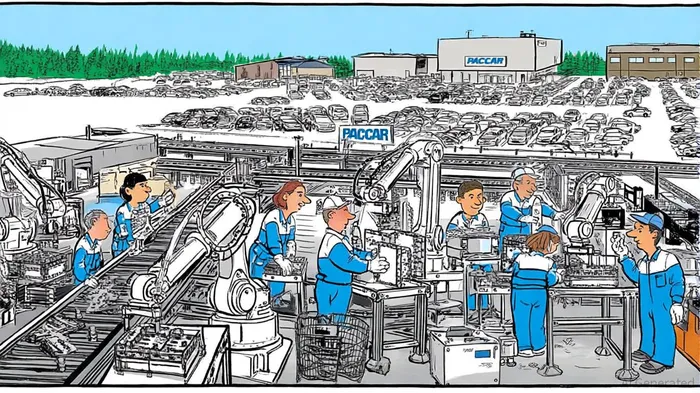
Paccar's core strength lies in its domestic manufacturing footprint. Approximately 90% of its U.S.-delivered trucks are produced in the United States, significantly reducing exposure to the 25% tariffs on imported vehicles [1]. This contrasts sharply with competitors like Daimler and Volvo, which rely on Mexican production facilities to assemble models such as the Freightliner Cascadia and Volvo VNL tractor. While these rivals benefit from USMCA-compliant manufacturing to avoid tariffs, Paccar's localized production model inherently insulates it from retaliatory measures or supply chain disruptions tied to cross-border trade [2].
The tariffs, however, do impact Paccar's component sourcing. The company estimates a $75 million hit in Q3 2025 due to tariffs on parts imported from Mexico, Canada, Asia, and Europe [3]. To mitigate this, PaccarPCAR-- has implemented a tariff surcharge in the U.S. and Canada and prioritized USMCA-certified components. These adjustments demonstrate agility in navigating trade policy shifts, a critical advantage in an environment where tariffs are likely to remain a feature of U.S. economic strategy.
R&D and Innovation: Future-Proofing the Business
Paccar's competitive edge extends beyond its production base. The company is investing heavily in R&D, with 2025 expenditures projected at $460–$500 million. This funding targets next-generation technologies, including clean diesel engines, battery-electric powertrains, and autonomous driving systems [4]. These innovations align with the EPA's 2027 emissions standards, which will require significant technological upgrades. By staying ahead of regulatory curves, Paccar not only secures compliance but also differentiates its offerings in a market where sustainability is becoming a key purchasing criterion.
Volvo and Daimler, while also investing in electrification, face challenges in scaling their U.S. operations. For instance, Daimler's Mexican-built Freightliner Cascadia is priced at $165,000, compared to Paccar's Kenworth T680 at $195,000 [5]. The price premium reflects Paccar's focus on premium features and fuel efficiency—its newer models offer 10–15% better fuel economy than five-year-old equivalents [6]. This value proposition, combined with Paccar's robust aftermarket services, strengthens customer loyalty and profitability.
Strategic Positioning Amid Industry-Wide Challenges
The tariffs have created a dual-edged sword for the industry. While they protect domestic producers, they also raise costs for fleets, with the average Class 8 truck expected to cost $170,000 before tariffs [7]. Paccar's ability to absorb and pass on these costs through surcharges and pricing power gives it an edge over smaller competitors. Additionally, the company's $700–$800 million capital expenditure plan for 2025—focused on factory expansions and clean energy infrastructure—ensures it can scale production to meet demand as the market adjusts to new trade realities [8].
Critics argue that tariffs could backfire by inflaming trade tensions or stifling innovation. However, Paccar's diversified supply chain and emphasis on domestic partnerships reduce these risks. For example, its joint venture, Amplify Cell Technologies, is developing low-cost batteries tailored for commercial vehicles, insulating the company from global supply chain bottlenecks [9].
Conclusion: A Long-Term Investment in Resilience
Paccar's strategic positioning in a tariff-driven market is underpinned by its domestic production base, adaptive supply chain, and forward-looking R&D investments. While the Trump administration's tariffs introduce short-term volatility, they also create a favorable environment for companies that can leverage protectionist policies without sacrificing innovation. For investors, Paccar represents a compelling long-term bet: a business that is not only weathering the storm but actively shaping the future of the industry.





Comentarios
Aún no hay comentarios