
Paccar's January Catalysts: Leadership, Dividend, and a Pre-Buy Trap?
The setup for PACCAR's recent move is clear. On January 1, the company announced a major leadership reshuffle, elevating Kevin D. Baney to President and expanding roles for other executives. Crucially, the board also declared a $1.40 per share special dividend and reaffirmed its regular $0.33 quarterly dividend. This combination of top-level changes and a substantial capital return is a direct signal of management confidence, arriving just as investors grapple with expectations for weaker near-term earnings.
That confidence is being mirrored by insiders. On January 6, Director Brice Hill purchased 1,569 shares of the stock. This is a tangible vote of confidence from someone with a deep view into the company's operations and financial health, aligning with the board's actions.
The market has taken note. The stock gained 2.52% yesterday, a notable outperformance against a flat S&P 500 and a sector that actually declined. This price action suggests the leadership and dividend signals are being priced in. Yet, a closer look reveals a more complex dynamic. The surge in North American Class 8 truck orders in December, which fueled much of the recent optimism, was driven by a regulatory pre-buy ahead of the EPA 2027 rules. The insider buying and dividend declaration are strong confidence signals, but they are unfolding against a backdrop where the underlying demand catalyst is inherently cyclical and may fade once the pre-buy window closes. This creates the tactical risk/reward setup: the stock is rallying on management's confidence, but the foundation of that confidence-regulation-driven demand-could be temporary.
The Order Surge: A Pre-Buy, Not a Recovery
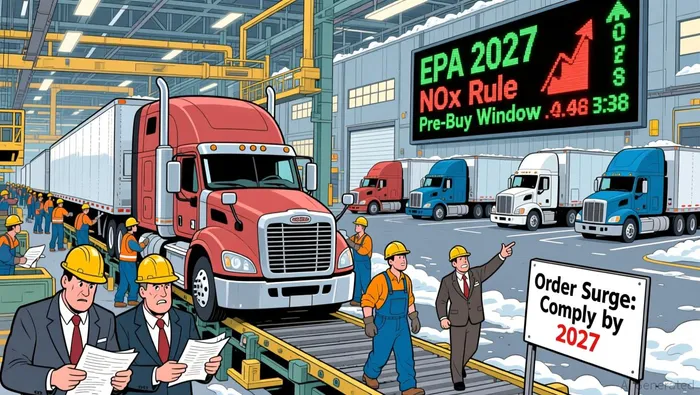
The core demand catalyst is now clear. In December, North American Class 8 truck orders for PACCARPCAR-- surged to 42,200 units, a 108% month-over-month increase and a three-year high. This spike is the primary driver behind the recent stock rally. Yet, the source of this surge is a critical distinction. Analysts at FTR Transportation Intelligence explicitly state the rebound reflects the release of deferred orders along with the early stages of a modest EPA 2027 NOx pre-buy, not a broad market recovery. The December orders were well above the 10-year December average of 29,351 units, but the broader order season for 2026 remains down 22% year-over-year, highlighting the fragility of the underlying market.
This pre-buy dynamic creates a fundamental valuation risk. The stock is trading near its 52-week high of $119.21, a level that prices in sustained strength. However, the average analyst price target sits at $111.04, a notable discount to the current share price. This gap suggests Wall Street sees the recent order surge as a cyclical event, not a new growth trajectory. The setup is classic: a one-time regulatory-driven demand spike has fueled a price pop, but the forward view from analysts remains cautious, citing ongoing soft freight demand and constrained fleet profitability.
The bottom line is that the order surge is a tactical event, not a strategic inflection. It provides a near-term tailwind for PACCAR's backlog and near-term revenue, which management is betting on with its dividend and leadership moves. But for the stock to hold its premium valuation, the company must transition from pre-buy-driven orders to a self-sustaining recovery in fleet replacement spending. That transition is not yet in sight, leaving the stock exposed to a potential correction if the pre-buy window closes and the underlying market shows no signs of improvement.
The Risk/Reward Setup: Earnings and Catalysts
The rally has priced in a strong December, but the real test is what comes next. The immediate forward-looking scenario hinges on a single, critical question: is the order surge a one-time pre-buy or the start of a durable recovery? The evidence points strongly to the former. Analysts see the December spike as a release of deferred orders and an early modest EPA 2027 NOx pre-buy, not a fundamental shift. This creates a clear risk: Q1 earnings could face a sharp sequential decline as the regulatory-driven demand flushes through the system.
The first key watchpoint is the Q4 earnings report, projected for late January. This release will be the first concrete data on whether the order strength translates to resilient profitability. The consensus expects a significant year-over-year drop, with earnings projected at $1.06 per share, down 36%. The market will scrutinize the report for any sign that the company is navigating the soft freight environment and rising costs better than feared. Upward revisions to estimates could signal management's confidence is justified, while further cuts would validate the bearish view that the pre-buy is a temporary blip.
Beyond the earnings call, the regulatory timeline for the EPA 2027 NOx rule is the second major catalyst to monitor. Any acceleration or deceleration in the rule's implementation could directly impact the pre-buy cycle. Clearer guidance has already helped ease uncertainty and boost December orders, so further developments in the coming weeks will be a leading indicator of whether fleets will lock in more equipment ahead of tighter standards. A delay could shorten the pre-buy window, while a more aggressive timeline might extend it.
The bottom line is a classic event-driven setup. The stock is trading at a premium, near its 52-week high, while analysts remain cautious. The leadership change and dividend are strong confidence signals, but they are betting on a transition from a cyclical pre-buy to a sustainable recovery that is not yet evident. Investors must watch the Q4 report for a confirmation of underlying strength and keep an eye on regulatory developments to gauge the durability of the demand tailwind. If the pre-buy fades and earnings disappoint, the rally could unravel quickly.





Comentarios
Aún no hay comentarios