
PACCAR's Dividend Strategy and Leadership Shift: A Reassessment of Capital Allocation Priorities
PACCAR Inc. (PCAR) has long been celebrated for its disciplined capital allocation strategy, balancing robust shareholder returns with strategic reinvestment in innovation and operational resilience. The recent announcement of a $1.40 per share special dividend, payable on January 7, 2026, has reignited debates about whether the company is pivoting toward prioritizing shareholder payouts over growth investments. To evaluate this, we must dissect the interplay between PACCAR's historical practices, its 2025–2026 financial commitments, and the evolving dynamics of the commercial vehicle market.
The Special Dividend: A Signal of Confidence or a Shift in Priorities?
PACCAR's decision to declare a $1.40 special dividend-on top of its regular quarterly payout of $0.33 per share-reflects its strong cash flow generation and a long-standing policy of distributing approximately 50% of net income to shareholders. According to a report by PACCAR's investor relations team, this approach has historically outperformed the S&P 500 index, underscoring the company's commitment to rewarding investors. However, the timing of the payout, amid soft truck demand and regulatory headwinds, raises questions about whether the company is reallocating capital away from growth initiatives.
Reinvestment in Innovation: A Contradiction or Complement?
Critics might argue that a large special dividend could divert resources from critical R&D and capital expenditures. Yet, data from PACCAR's third-quarter 2025 earnings call reveals a different story. The company invested $156.0 million in capital projects and $111.0 million in R&D during the quarter, with full-year 2025 R&D spending projected to reach $450–$465 million. For 2026, PACCAR has already signaled a target range of $450–$500 million for R&D, focusing on clean diesel technology, alternative powertrains, and driver assistance systems. These investments are explicitly tied to preparing for regulatory changes, such as the 2027 NOx emission standards, and maintaining a competitive edge in a market where truck prices could rise by $10,000–$15,000 due to compliance costs.
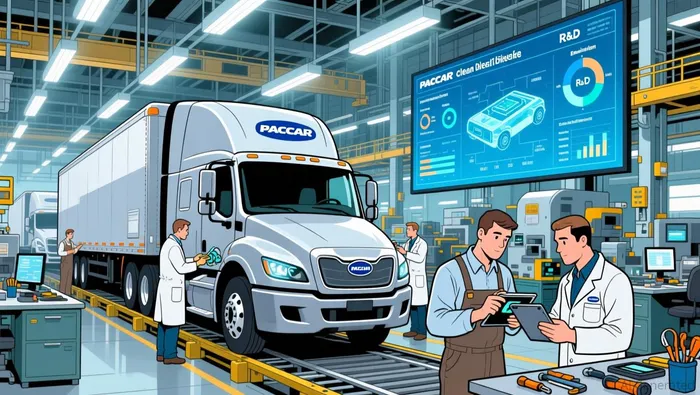
Moreover, PACCAR's leadership has emphasized that its capital allocation philosophy remains balanced. As CEO Preston Feight noted in a recent earnings call, the company's "strong profits and cash flow" have enabled simultaneous investments in premium truck models (e.g., the DAF XF Electric) and cutting-edge technology, while maintaining its dividend discipline. The Kenworth Chillicothe Expansion, for instance, represents a significant capital outlay to modernize production lines and enhance manufacturing resilience, positioning the company to capitalize on potential surges in vocational truck demand.
Navigating Soft Demand and Regulatory Uncertainty
The broader commercial vehicle market remains under pressure, with soft truckload demand and economic uncertainty dampening near-term outlooks. PACCAR has acknowledged these challenges, noting that carriers are delaying purchases amid regulatory and tariff-related uncertainties. However, the company anticipates stabilization in 2026, particularly as Section 232 tariffs reduce market ambiguity and carriers adjust to new compliance requirements. This suggests that PACCAR's dividend strategy is not a reaction to short-term pressures but a calculated move to reward shareholders during a period of strategic reinvestment.
Leadership and Long-Term Value Proposition
Mark Pigott, PACCAR's executive chairman, has consistently framed the special dividend as a reflection of the company's durable business model, citing its "robust financial services" and "innovative technology solutions" as key drivers of long-term value. This aligns with the company's historical approach: PACCARPCAR-- has maintained a dividend payout ratio of roughly 50% for years, even during cyclical downturns, while continuing to reinvest in core operations. The recent leadership structure-featuring Pigott's strategic oversight and Feight's operational focus-appears to reinforce this dual commitment to growth and returns.
Conclusion: A Balanced Approach, Not a Shift
While the $1.40 special dividend may appear to signal a heightened focus on shareholder returns, the evidence suggests PACCAR is maintaining its balanced capital allocation strategy. The company's 2025–2026 R&D and CAPEX commitments, coupled with its proactive approach to regulatory and market shifts, indicate that reinvestment remains a top priority. For investors, the key takeaway is that PACCAR is leveraging its strong cash flow to both reward shareholders and position itself for long-term growth-a duality that could prove critical in an industry marked by cyclical volatility and technological disruption.





Comentarios
Aún no hay comentarios