
P2P.org's Alleged Validator Status on the Canton Network: A Cautionary Tale for Blockchain Investors
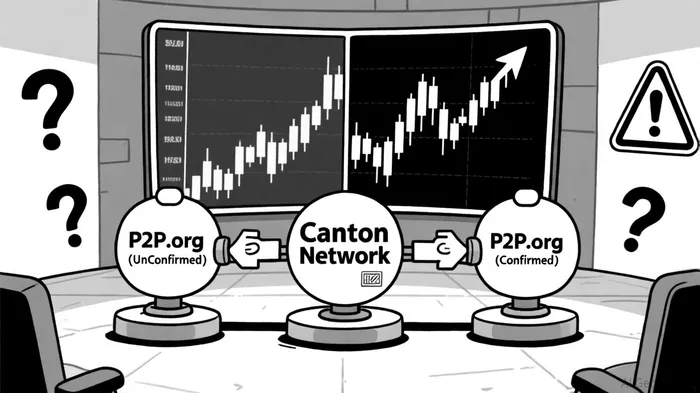
In the fast-moving world of blockchain infrastructure, the line between innovation and speculation often blurs. The recent controversy over P2P.org's validator status on the Canton Network—a privacy-focused blockchain for institutional finance—exemplifies this tension. While some reports claim P2P.org has joined the network as a validator[1], others highlight a lack of official confirmation[2]. This ambiguity raises critical questions for investors: How should one assess the credibility of such claims? And what does this case reveal about the broader risks and opportunities in speculative blockchain investments?
The Conflicting Narratives
P2P.org, a staking infrastructure provider managing over $10 billion in assets across 40+ networks, has been reported to operate validator nodes on the Canton Network, which is said to handle $4 trillion in tokenized assets[1]. Cointelegraph and P2P.org's own press release describe this as a “significant step” in institutional blockchain adoption[3]. However, Kanalcoin and other independent observers note that neither P2P.org nor the Canton Network has issued an official statement confirming this partnership[2]. This discrepancy underscores a key challenge in evaluating blockchain projects: the reliance on self-reported or third-party claims in the absence of transparent governance.
The Canton Network itself operates under an invite-only model, requiring new validators to secure sponsorship from existing super validators or the Global Synchronizer Foundation (GSF)[4]. This closed process, while designed to ensure institutional-grade security, also creates an environment where validator status can be difficult to verify. For instance, Hypernative's approval as a “Weight 1 Super Validator” was confirmed via a Canton Improvement Proposal (CIP-0076)[4], but no such documentation exists for P2P.org.
Implications for Investors
The Canton Network's potential is undeniable. Its protocol-level privacy features and focus on real-world asset tokenization position it to serve a $4 trillion market[1]. If P2P.org's validator status is legitimate, it could accelerate adoption by leveraging the firm's institutional expertise. However, the lack of official confirmation introduces significant risk.
For speculative investors, this case highlights the dangers of acting on unverified information. The absence of a public validator list on CantonScan[2] and the network's invite-only structure mean that even seemingly credible claims can lack verifiable proof. This mirrors broader trends in blockchain investing, where hype often outpaces transparency. For example, the 2023 collapse of the TerraLUNA-- ecosystem was partly fueled by overreliance on unproven governance models and opaque tokenomics.
Conversely, the situation also presents opportunities for due diligence-savvy investors. The Canton Network's restricted access model suggests a high bar for entry, which could limit competition and enhance long-term value for approved validators. If P2P.org's involvement is later confirmed, early investors who navigated the uncertainty could benefit from its expanded role in the ecosystem.
Broader Lessons for the Blockchain Ecosystem
The P2P.org-Canton sagaSAGA-- reflects a larger debate about transparency in blockchain governance. While privacy is a core tenet of many institutional blockchains, it can conflict with the need for accountability. The Canton Network's reliance on super validators and the GSF to control access is a double-edged sword: it ensures security but also creates bottlenecks for independent verification.
For investors, the key takeaway is to prioritize projects with clear onboarding processes and publicly accessible governance records. The absence of such transparency should trigger caution, even if a project's use case appears promising. As one industry analyst noted, “In blockchain, the devil is in the documentation. If there's no proof of participation, it's a red flag.”
Conclusion
The alleged validator status of P2P.org on the Canton Network serves as a microcosm of the opportunities and risks inherent in blockchain investing. While the project's institutional focus and privacy features are compelling, the lack of official confirmation underscores the importance of due diligence. For investors, this case is a reminder that speculative gains often come with the cost of uncertainty—and that the most successful strategies balance ambition with a healthy skepticism.







Comentarios
Aún no hay comentarios