
Oxford Industries (OXM): A High-Yield Dividend Play Amid Earnings Volatility
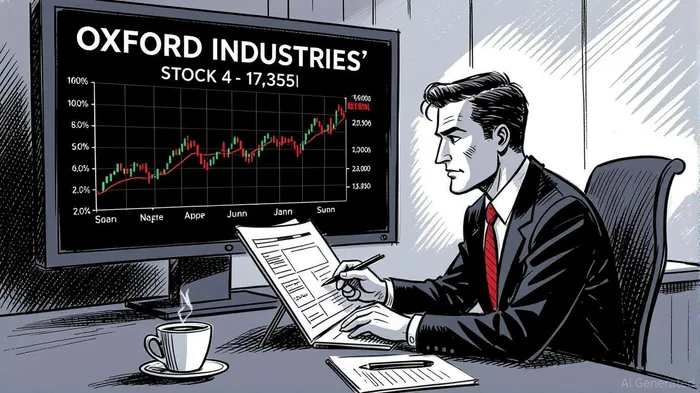
In the world of dividend investing, few propositions are as tantalizing—and as perilous—as Oxford IndustriesOXM-- (OXM). With a projected dividend yield of 6.5% for 2025[1], the company offers a compelling income stream for investors seeking high returns in a low-yield environment. Yet, beneath the surface of this siren song lies a complex interplay of earnings volatility, supply chain headwinds, and a debt burden that raises critical questions about the sustainability of its payout.
The Allure of the Dividend
Oxford Industries' dividend strategy is anchored in a payout ratio of 53.59%[3], which, while moderate on its face, exceeds the 39.8% average for the Consumer Cyclical sector[6]. This suggests a commitment to rewarding shareholders, even as the company navigates a challenging operating environment. The recent quarterly dividend of $0.69 per share[5], annualized to $2.76, underscores this resolve. For income-focused investors, the regularity of these payments—distributed in January, May, August, and November—provides a predictable cash flow stream[6].
However, the sustainability of this dividend hinges on earnings performance. Q2 2025 guidance of $1.05 to $1.25 per share[5] represents a stark decline from the $2.77 EPS recorded in the same period of 2024[6]. This 55% year-over-year drop highlights the fragility of Oxford's earnings base, driven by rising freight costs and U.S. tariffs that have added $40 million in expenses[6]. While the company has made strides in diversifying its supply chain away from China—projected to be “substantially out” by mid-2026[6]—the near-term pain persists.
Earnings Volatility and Free Cash Flow Woes
The earnings picture is further complicated by Oxford's free cash flow (FCF) trajectory. For the period ending May 3, 2025, FCF totaled $11.432 million[1], a 92.63% plunge compared to the prior year. This collapse places the company in the bottom 10% of its industry for TTM FCF growth[1], while its debt-to-FCF ratio of 47.6x[4] dwarfs the industry median of 1.9x. Such metrics signal a precarious balance sheet, where debt servicing could strain the ability to maintain dividend payments if earnings remain volatile.
Data from Macrotrends reveals a widening debt-to-equity ratio, rising from 0.59 at the end of fiscal 2024 to 1.26 as of April 30, 2025[1]. This shift reflects a more aggressive capital structure, which, while potentially boosting returns in stable environments, amplifies risk during downturns. The company's recent Q1 2025 results—$1.82 EPS within guidance—offer some solace[6], but the broader trend of declining margins and FCF remains a red flag.
A Delicate Balance: Income vs. Risk
The key question for investors is whether Oxford's dividend can withstand the pressures of its current environment. On one hand, the company's 6.5% yield[1] is a magnet for income seekers, particularly in a market where alternatives are scarce. On the other, the combination of a high payout ratio (52–53%[6]), shrinking FCF, and elevated leverage creates a fragile foundation.
A critical factor will be the success of its supply chain diversification. If OxfordOXM-- can reduce costs by shifting production away from China, it may stabilize earnings and free up cash for dividends. The double-digit growth of the LillyLLY-- Pulitzer brand[6] also offers a potential offset, though the drag from Tommy Bahama's modest decline tempers optimism.
Conclusion: Proceed with Caution
Oxford Industries presents a classic high-yield dilemma: a generous dividend in a volatile business. For risk-tolerant investors who believe in the company's long-term strategy to mitigate supply chain costs and stabilize earnings, the 6.5% yield could justify the risk. However, those prioritizing dividend safety may find the current fundamentals—particularly the debt burden and FCF weakness—too concerning to ignore.
As the company prepares to report Q2 2025 earnings on September 10[6], the market will be watching closely. A beat on the $1.21 EPS consensus[3] could bolster confidence in the dividend's sustainability. But a miss would likely reignite concerns about its ability to balance shareholder returns with operational realities. In the end, Oxford's story is one of promise and peril—a reminder that high yields often come with high stakes.





Comentarios
Aún no hay comentarios