
Ownership Structure and Governance at CUCKOO International (CKI): A Pathway to Sustainable Investor Value?
In the evolving landscape of corporate governance, ownership structure and institutional shareholder influence have become pivotal in determining sustainable investor value. CUCKOO International (CKI), a Malaysian home appliance and furniture retailer, has navigated a complex 2025 environment marked by regulatory shifts, declining board diversity disclosures, and recalibrated institutional investor priorities. This analysis examines CKI's ownership framework, governance practices, and alignment with ESG-driven value creation, offering insights into its potential to deliver long-term returns.
Ownership Structure: Institutional Influence and Strategic Resilience
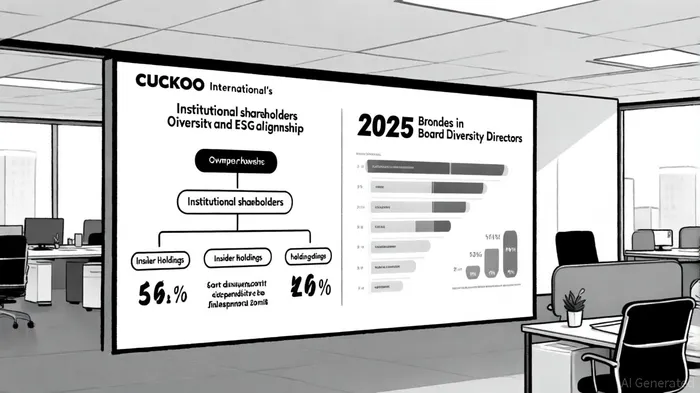
CUCKOO International's ownership structure, as detailed in its 2025 Annual Report, reveals a mix of institutional shareholders and insider holdings. The company's June 2025 IPO raised RM154.7 million in gross proceeds, significantly bolstering its cash reserves and signaling confidence from public market investors [1]. While specific institutional shareholder changes are not disclosed, platforms like Simply Wall St and Investing.com indicate that CKI's institutional ownership remains stable, with no major shifts in ownership concentration [4]. This stability suggests a degree of institutional alignment with the company's strategic direction, particularly its focus on expanding its omni-channel distribution network and enhancing logistics capabilities [3].
However, the absence of detailed insider transaction data raises questions about transparency. In 2025, many U.S. public companies have faced scrutiny over opaque governance practices, with investors increasingly demanding clarity on executive compensation and board accountability [5]. For CKI, the lack of granular disclosures could either reflect a streamlined governance model or a potential gap in stakeholder communication.
Governance in a Post-DEI Era: Navigating Regulatory and Political Shifts
The 2025 corporate governance landscape has been reshaped by the U.S. Court of Appeals for the Fifth Circuit's decision to strike down Nasdaq's board diversity rules, removing mandatory diversity disclosure requirements for listed companies [2]. This ruling, coupled with softened investor expectations and rising litigation risks, has led to a decline in public board diversity metrics. Proxy advisors like Institutional Shareholder Services (ISS) and Glass Lewis have revised their policies, with ISS suspending the use of diversity factors in director voting recommendations [4].
CUCKOO International's governance policies, while not explicitly detailing board diversity metrics, appear to align with this recalibrated environment. The company's 2025 Annual Report emphasizes “integrated and sustainable reporting practices,” a phrase that resonates with scholarly reviews highlighting the role of board diversity in fostering innovation and risk resilience [3]. However, CKI's public filings do not provide granular data on gender, ethnic, or experiential diversity among its board members, a trend mirrored by many firms in 2025 as they embed DEI goals into internal governance structures to mitigate legal exposure [1].
Institutional Engagement and ESG Alignment
Institutional shareholders in 2025 have increasingly prioritized strategic engagement on ESG issues, particularly climate transition, human capital management, and shareholder rights [5]. CKI's governance roadmap reflects these priorities, with its IPO proceeds earmarked for IT system upgrades, retail expansion, and Singapore operations—initiatives that align with long-term value creation [3]. The company's focus on operational efficiency and market diversification addresses investor concerns about inflationary pressures and shifting consumer dynamics, positioning it to capitalize on regional growth opportunities.
Yet, the evolving regulatory environment poses challenges. The SEC's revised guidance on ESG-related shareholder engagements has imposed stricter disclosure requirements, potentially limiting the frequency and scope of institutional dialogues [5]. For CKI, this means balancing proactive ESG initiatives with compliance risks, a delicate act that could influence investor sentiment.
A Pathway to Sustainable Value?
CUCKOO International's governance framework and ownership structure suggest a strategic alignment with sustainable investor value, albeit within the constraints of 2025's regulatory climate. The company's emphasis on operational expansion, coupled with its institutional shareholder stability, provides a foundation for long-term growth. However, the lack of transparency around board diversity and ESG metrics may deter investors seeking granular accountability.
To strengthen its appeal, CKI could adopt a dual approach: embedding DEI into internal governance while reframing public disclosures to emphasize qualitative outcomes over quantitative benchmarks. This strategy, observed in companies navigating 2025's legal and political landscape, could enhance stakeholder trust without exposing the firm to litigation risks [2].
Conclusion
CUCKOO International's journey in 2025 underscores the complexities of balancing governance innovation with regulatory prudence. While its ownership structure and strategic initiatives position it for growth, the company must navigate the evolving ESG landscape with agility. For investors, CKI represents a case study in adaptive governance—where institutional alignment and operational resilience may outweigh the absence of traditional diversity metrics in the pursuit of sustainable value.







Comentarios
Aún no hay comentarios