
OSR's $30M Deal: A Binding Term Sheet to Beat the March Delisting Clock?
This is a high-stakes, near-term catalyst. OSR's Swiss subsidiary, Vaximm, has received a binding term sheet from BCM Europe, its largest shareholder, for a global license to its lead drug candidate, VXM01. The deal's immediate financial impact is a $30 million upfront payment, structured as half cash and half digital assets. That's a significant cash infusion for a clinical-stage biotech, but its value is entirely contingent on a definitive agreement being signed by a hard deadline.
The critical timeline is now defined. The parties have targeted a definitive agreement by the end of May 2026. More telling is the shortened exclusivity period: the term sheet now includes a three-month exclusivity period, down from six months. This compression signals strong confidence from BCM Europe and creates intense pressure to close. It turns this from a long-term negotiation into a race against a clock.
The setup is clear. OSROSRH-- has a binding proposal with a $30 million immediate payoff, but it must be converted into a signed contract by late May. Failure to do so would likely invalidate the term sheet and leave the company back at square one. For now, the binding nature of the document and the shortened timeline make this a tangible, event-driven opportunity. The market's reaction will hinge entirely on whether OSR can deliver a definitive deal before the clock runs out.
The Immediate Risk/Reward Setup
The deal's direct impact is a clear, immediate cash injection. The binding term sheet calls for a $30 million upfront payment, structured as half cash and half digital assets. That means OSR will receive approximately $15 million in immediate cash. For a company under financial pressure, this is a tangible boost to the balance sheet. It provides runway and liquidity to fund operations and clinical development, directly addressing the capital constraints that have plagued the stock.
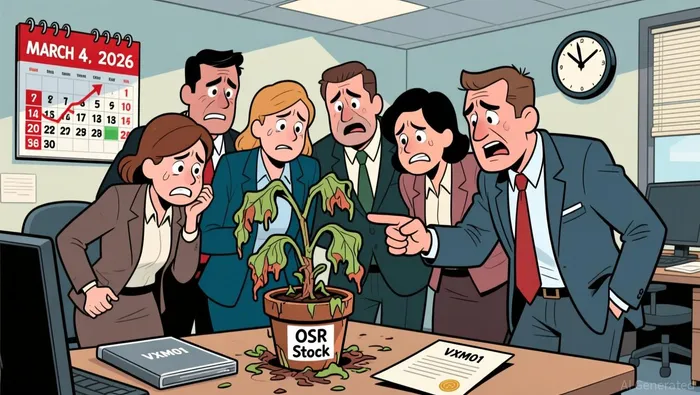
Yet the clock is ticking on a far more urgent threat. OSR has until March 4, 2026 to regain compliance with Nasdaq's minimum bid price requirement of $1.00 per share. The stock currently trades well below that level, with recent prices hovering around $0.62 to $0.66. This deep discount reflects the market's profound skepticism. The setup is a race: the company needs to either close the Vaximm deal to secure the cash and signal a turnaround, or find another path to lift the share price before the delisting deadline.
The risk/reward is stark. The reward is a $15 million cash infusion and a potential $815 million milestone pipeline, contingent on closing by late May. The immediate risk is that the stock remains stuck below $0.65, failing to meet the Nasdaq requirement by March. The recent "Sell" rating from Wall Street analysts underscores the prevailing doubt. For the deal to matter in this near-term battle, OSR must convert the binding term sheet into a signed contract before the delisting clock strikes. If it doesn't, the cash from the license deal may arrive too late to save the listing.
Valuation and Clinical Reality Check
The deal's $30 million upfront payment and $815 million potential upside are ambitious for a drug still in early development. VXM01 is currently in Phase 2a for recurrent glioblastoma, with final data showing it is well tolerated and demonstrated early signals of efficacy. The reported overall response rate was modest, and survival benefits, while present in some subgroups, remain preliminary. This is a proof-of-concept stage, not a late-stage asset with established clinical benefit. The valuation must reflect that high-risk, early-stage reality.
The milestone structure is telling. The up to $815 million in aggregate milestone payments is weighted primarily toward clinical and development achievements, not operational sales. This is typical for early-stage assets where commercial potential is speculative. The payments would likely be tied to advancing the drug through Phase 2b, Phase 3, and regulatory approval. For now, the financial upside is a long-term bet on clinical success, not a near-term cash generator.
A unique and complicating factor is the 50% digital assets component of the upfront payment. This is an unconventional payment method that introduces significant uncertainty. The value and liquidity of these digital assets are unproven, and their inclusion adds complexity to the deal's execution. It could serve as a creative financing tool for the licensee but creates a valuation challenge for OSR's shareholders, who receive a mix of cash and an asset whose worth is not yet clear.
The bottom line is that the deal's terms are justified only if the market believes in a high probability of clinical success. The binding term sheet provides a tangible cash infusion, but its value is entirely contingent on VXM01 navigating the perilous path from Phase 2a to approval. The digital asset component amplifies the risk, making the deal's financial outcome more speculative. For now, the numbers reflect hope more than current value.
Catalysts and Key Watchpoints
The path forward hinges on a few clear, near-term events. The primary catalyst is the conversion of this binding term sheet into a definitive agreement by the end of May 2026. This is not a mere formality; the deal is contingent on Vaximm's board securing an independent fairness opinion. That process will be a key watchpoint, as any delay or negative finding could derail the timeline. The shortened exclusivity period to three months adds urgency, but the board's diligence and the fairness opinion are the gatekeepers to the final contract.
Monitor the stock price reaction to the binding term sheet and any subsequent news on negotiation progress. The market has shown deep skepticism, with shares trading around $0.62 to $0.66. A positive move toward the $1.00 Nasdaq threshold would signal belief in the deal's execution. Conversely, a failure to rally-or a drop-would highlight the prevailing doubt. Any updates on the board's fairness opinion process or milestones in the negotiation would be immediate catalysts for volatility.
The key risk is the deal falling apart. If the definitive agreement is not signed by late May, the binding term sheet expires. That would leave OSR with no new capital from this transaction, and the Nasdaq delisting deadline of March 4, 2026 would loom with no new runway. The company would then be forced to rely on its existing cash, its Digital Asset Treasury, or other distressed financing, all while the stock remains below the required bid price. In that scenario, the catalyst becomes a collapse, with the stock facing a clear path to delisting. For now, the deal is the only near-term lifeline.





Comentarios
Aún no hay comentarios